Sunday, August 10, 2008

Some Thoughts on Aid to Religion & Originalism

I'm going to come back to yesterday's post on the opinions of Christian Nationalist J. Phillips because Phillips' pithy summary well illustrates the Christian Nationalist view on government aid to religion. As the author wrote: The Founders believed

God exists, we were created by God, the Bible is his word and therefore it should be printed and promoted with government funds and contrary positions are not in accord with the truth....


This is what David Barton et al. leave their followers believing. Importantly, this is what they have them believing the FEDERAL government could do.

"Religion" was originally left to the states. And their approach towards its establishment varied. Jefferson and Madison, in their historic Virginia Statute on Religious Freedom adopted a rule of no direct aid to religion. Indeed the statute (a document they claimed was based on "natural right" like the Declaration of Independence -- no mere statute!) held it was sinful to tax someone to support a religion in which he didn't believe.

George Washington and John Adams on the other hand didn't believe it violated natural right to publicly aid "religion" or even "the Christian religion." However, this was with the caveat that those of non-Christian religions still equally possessed their unalienable rights of conscience. As Washington put it reacting to the controversy in Virginia -- Patrick Henry's plan to publicly aid teachers of the Christian religion:

I am not amongst the number of those who are so much alarmed at the thoughts of making people pay towards the support of that which they profess, if of the denomination of Christians; or declare themselves Jews, Mahomitans or otherwise, and thereby obtain proper relief. As the matter now stands, I wish an assessment had never been agitated, and as it has gone so far, that the Bill could die an easy death;…


You can see right off the bat how Washington's "accommodationist" position is not in accord with the above quoted Christian Nationalist sentiment. Christian Nationalism holds Christianity is Truth and as such should be publicly supported, other religious opinions entirely disregarded.

Washington, on the other hand, held the opinions of Jews and Muslims -- opinions that reject the "Truth" of Christianity -- have some kind of natural right to "proper relief" such that their tax dollars won't be used to aid a religion (Christianity) in which they don't believe.

Regarding how the federal government could aid religion, ours is a Constitution of limited, enumerated powers. And "religion" -- indeed the "Christian religion" -- is left entirely unendowed. Christian Nationalists have taken a few instances of the federal government involving itself in religious matters -- instances that can be explained in nuanced historical context -- and extrapolate a general norm that the federal government saw itself as having the role of supporting (even with public funds!) Christianity, not contrary claims of truth. In short, Christian Nationalists' distortion of history has lead folks to erroneously believe that the federal government was originally in the business of printing and disseminating Bibles and otherwise supporting Christian only claims of truth.

Chris Rodda has done excellent work exposing the nonsense of these claims. She writes about one of those instances in this post at Talk To Action where I sometimes post as well. She addresses the following Christian Nation assertion that actually found its way into a Congressional Resolution:

"Whereas in 1777, Congress, facing a National shortage of `Bibles for our schools, and families, and for the public worship of God in our churches,' announced that they `desired to have a Bible printed under their care & by their encouragement' and therefore ordered 20,000 copies of the Bible to be imported `into the different ports of the States of the Union';"


And she responds:

First of all, the first two quotes in this statement, which Mr. Forbes claims were "announced" by Congress, were not the words of Congress, but come from the petition of a group of Philadelphia ministers. Second, Congress did not import any Bibles.

In 1777, three ministers from Philadelphia, Francis Alison, John Ewing, and William Marshall, came up with a plan to alleviate the Bible shortage caused by the inability to import books from England during the Revolutionary War. The ministers' request for help from Congress, and Congress's consideration of the ministers' petition had to do with the problem of price gouging during the war.

The ministers' idea was to import the necessary type and paper, and print an edition of the Bible in Philadelphia. The problem with this plan, however, was that, if the project was financed and controlled by private companies, the Bibles would most likely be bought up and resold at prices that the average American couldn't afford. What the ministers wanted Congress to do was to import the materials and finance the printing, as a loan to be repaid by the sale of the Bibles. As Rev. Alison explained in the petition, if Congress imported the type and paper, and Congress contracted the printer, then Congress could regulate the selling price of the Bibles.(4)

The petition was referred to a committee, which concluded that it would be too costly to import the type and paper, and too risky to import them into Philadelphia, a city likely to be invaded by the British, and proposed the less risky alternative of importing already printed Bibles into different ports from a country other than England. If Congress did this, they would still be able to regulate the selling price and be reimbursed by the sales.

What appears in the Journals of the Continental Congress after the committee's report is the following motion.

"Whereupon, the Congress was moved, to order the Committee of Commerce to import twenty thousand copies of the Bible."(5)

The problem for those who claim or imply, as Mr. Forbes does, that the Bibles were imported is that, although this motion passed, it was not a final vote to import the Bibles. It was a vote to replace the original plan of importing the type and paper with the committee's new proposal of importing already printed Bibles. The vote on this motion was close -- seven states voted yes; six voted no. A second motion was then made to pass an actual resolution to import the Bibles, but this was postponed and never brought up again. No Bibles were imported. This little problem is solved in the religious right history books by either misquoting the motion to turn it into a resolution, or omitting the motion altogether and ending the story with some statement implying that the Bibles were imported.

See also Chapter 1 of Liars For Jesus: The Religious Right's Alternate Version of American History, "Congress and the Bible," at http://www.liarsforjesus.com/downloads/LFJ_chap_1.pdf

The Biblical Covenant is Undemocratic (or Unrepublican)

Robert P. Kraynak's Christian Faith and Modern Democracy is another book (there are many) written by a conservative Christian (he's a Catholic) that debunks the "Christian Nation" thesis.

Dr. Gregg Frazer heavily relies on this work in his Ph.D. thesis. The following quotes from Dr. Frazer's thesis quoting Kraynak's book:

First, as Kraynak pointed out, "the biblical covenant is undemocratic: God is not bound by the covenant and keeps His promises solely out of His own divine self-limitation." Second, "(t)he element of voluntary consent is missing from the covenant with Israel....There is nothing voluntary or consensual about the biblical covenant; and the most severe punishments are threatened by God for disobedience." Third, "insofar as the covenant with Israel sanctions specific forms of government, the main ones are illiberal and undemocratic;" including patriarchy, theocracy, and kingships established by divine right. Fourth, "the Bible shows that God delivers the people from slavery in Egypt and supports national liberation, not for the purpose of enjoying their political and economic rights, but for the purpose of putting on the yoke of the law in the polity of Moses." Fifth, "the content of the divine law revealed to Moses consists, in the first place, of the Ten Commandments rather than the Ten Bill of Rights, commanding duties to God, family, and neighbors rather than establishing protections for personal freedom." Finally, the combination of judicial, civil, ceremonial, and dietary laws imposed on the people "regulate all aspects of religious, personal, and social life." The history of Israel, therefore, had to be radically rewritten to provide support for the demands of political liberty and for republican self-government.

-- Kraynak, 46-49 quoted in Frazer, "The Political Theology of the American Founding," Ph.D. dissertation, 18-19.

Saturday, August 9, 2008

Noah Webster Calls the United States an "Empire of Reason"

Noah Webster is one of the "Christian Nation" crowd's favorite founders to quote, because in the 19th Century, many of his words seem to support their ideal. Yet, as Tom Peters noted on this page, almost all of those quotations come from after 1808 when "Webster underwent a profound religious conversion that changed both his politics and his religious outlook." He "bec[a]me[] skeptical of democracy, distrustful of government, and far more sympathetic to an alliance between church and state."

Before that time, most importantly when the US Constitution was being framed and ratified, he supported separation of church and state along the lines of Madison's and Jefferson's understanding of the concept.

I've never studied Webster's religious beliefs in detail. I know that in the 1800s when he was saying the things that David Barton et al. like to quote, he was a devout orthodox Christian. Perhaps his political change of mind was precipitated by a bona fide religious change of mind and before that he was, like America's key founders, a theistic rationalist.

[For the rest, see here]

Misunderstanding the Phrase "Religion & Morality"

One J. Phillips writes an article featured in this morning's WorldNetDaily with three quotations from the Founding Fathers -- two from John Adams and one from Patrick Henry. The article typifies how Christian Nationalists misunderstand the Founding Fathers' words. When the Founding Fathers said "religion and morality" they meant "religion and morality," not necessarily orthodox biblical Christianity only. For instance, from those quotations Phillips summarizes the Founding Fathers' position:

When I saw these used recently it struck me that if they are not wrong then their Constitution will not work for those who exist today, because their moral and religious standard (i.e. God exists, we were created by God, the Bible is his word and therefore it should be printed and promoted with government funds and contrary positions are not in accord with the truth) is not our moral and religious standard.


The following is the email I sent to the author:

Mr./Ms. Phillips,

I read your article. While I can't speak for Patrick Henry whom I understand was an orthodox Christian, as an expert on John Adams' religion I can speak for him and you misunderstand his position. For instance, while he did believe:

1. "God exists," and
2. "we were created by God,"

he did not believe:

3. "the Bible is his word and therefore it should be printed and promoted with government funds and contrary positions are not in accord with the truth."

Rather as a theologically unitarian and universalist man he thought most or all religions were valid ways to God and the Bible was only a partially inspired book. Adams didn't have a problem with government support for "religion," but wouldn't limit it exclusively to biblical Christianity.

[...]

I've got plenty of quotations from him explaining how "religion and morality" exist within all sorts of pagan non-Christian religious systems, available upon request.

Friday, August 8, 2008

Amazing Grace: Pop Culture v. History

by Brad Hart

I realize that I may be stretching a bit on this post. Though we are devoted exclusively to the history of religion in America's founding, it would be virtually impossible -- and possibly even irresponsible -- to cover this all-important topic without occasionally delving into tidbits of history from other lands. After all, we have discussed Locke, Calvin, Luther, and many others, who never physically touched American soil, yet their ideas and contributions have made a tremendous impact on our nation's religious landscape.

With this in mind, I would like to take an in-depth look at a few historical characters that have received some attention in recent years. The movie, Amazing Grace, which was directed by Michael Apted and stars Albert Finney as the Reverend John Newton and Ioan Gruffudd as William Wilberforce, is an inspiring tale of Great Britain's struggle to end the African slave trade.[1] In addition, the movie also attempts to shed light on the origins of the infamous hymn, Amazing Grace, which was written by John Newton in 1779. The film also does an elegant job of recreating the Great Britain of the 18th century, including an excellent portrayal of London's contrasting social classes.

Despite these delightful cinemographic recreations, Amazing Grace is deeply saturated with a pop culture image that distorts the historical record. As Adam Hochschild points out in his article, English Abolition: The Movie, the abolitionist movement to end the slave trade was in no way a solo effort on the part of William Wilberforce.[2] In fact, Wilberforce had a tremendous amount of support for his abolitionist agenda. As the articles states:

In recent decades, however, scholars have seen the history of British abolition as involving far more than Wilberforce's personal virtue. In 1787–1788, during the heady period between the American and French Revolutions, a huge grassroots movement against the slave trade burst into life in Britain, startling abolitionists and slave traders alike… more than 300,000 people refused to buy West Indian sugar. This was the largest consumer boycott the world had yet seen.[3]
To be certain, Wilberforce is a man that is more than deserving of the accolades he has received over the years, however, we should all be mindful that British abolitionism was a movement in which thousands of British citizens felt morally compelled to take action. In fact, the British abolitionist movement was deeply inspired by the religious attitudes of the masses. As Hochschild again points out:

The movement was led by an extremely imaginative, hard-working committee of activists, most of them Quakers, who pioneered tactics that are still used by human rights groups today…In addition, Anglican sentiment against the slave trade forced clergy members to adopt a pro-abolitionist stance in their sermons.
In addition, the best-selling memoirs of Olaudah Equiano, a former slave who became a powerful voice for abolition in Britain -- essentially Britain’s Frederick Douglass -- made mention of the Christian imperative to end the slave trade:

“O, ye nominal Christians! might not an African as you, learned you this from your God, who says unto you, Do unto all men as you would men should do unto you?”[4]
Apart from the story on the abolition of the slave trade, Amazing Grace attempts to provide an inspiring tale on the origins of John Newton’s infamous hymn. In the movie, the Reverend John Newton is portrayed as a former heathen, who goes the way of the world by taking part in the transportation of thousands of African slaves. While in the course of transporting these slaves, Newton allegedly experiences a change of heart, in which he realizes the errors of his ways and devotes the rest of his life to the ministry and a remission for his sins.

While this comes off sounding nice, the truth is actually a bit different. As Adam Hochschild points out:

The reality was quite different. Most inconveniently for sin-and-repentance storytellers, John Newton came to evangelical Christianity before making four transatlantic voyages as a slave-ship officer, not afterward. He left the trade not for reasons of conscience but of health. And when he later was ordained a minister, he had all his savings invested with his former employer, who still had a fleet of slave ships at sea. There is no evidence that he mentioned slavery when Wilberforce first came to see him. Newton said not a word in public against the slave trade until 1788, several years after meeting Wilberforce and more than thirty years after he left the sea; by then a huge mass movement was underway and it was no longer easy for so prominent a former slave trader to avoid taking a stand. He then wrote a forceful pamphlet against the trade, testified twice at hearings, mentioned the subject once or twice in sermons, and otherwise did not openly raise it again for the remaining two decades of his preaching and writing life. He believed that the major evil of the day was blasphemy, which he once called "Our national sin."
So instead of being offered as an atonement for sin, Newton’s Amazing Grace was actually written while the reverend continued to profit from the slave trade.

So why does a pop culture spin on an 18th century British story matter? Because Christian politicians have taken up the “cause of Wilberforce” to help further their respective agendas. As Hochschild again points out:

Congressman Frank Wolf, a Virginian Republican, says, "If we can get the word out about Wilberforce's life and legacy, as shown in the movie Amazing Grace, we can change this country." Senator Sam Brownback of Kansas, talks about the man so much that The Economist recently dubbed him and others "Wilberforce Republicans." Their agenda is much the same as that of others on the far right, with a few twists, such as an interest in prison reform (Wilberforce himself used to visit prisoners and ask them to repent). Many Wilberforce Republicans claim that if he were alive today, their hero would be leading the fight against abortion.

Even the unsavory political consultant Dick Morris portrays himself as a Wilberforce admirer. When asked on Fox News recently about the uproar over racist remarks by talk-show host Don Imus, Morris said, "It reminds me of William Wilberforce.... His whole crusade was a reformation of manners. No cock fighting. No dog fighting. No bull baiting. No abusing of horses.... And of course no slavery." (Morris did not mention various other things Wilberforce opposed, which ranged from the theater to public bathing in the Thames to "the progressive rise of Wages.")
Though often entertaining, the radical distortions made by pop culture outlets are often more powerful than the truth. For political leaders to glean their historical knowledge and perspective from film is disturbing to say the least. If you are wanting a long-term prognosis, my guess is that pop culture and history are likely to be at war for a long time to come.

Here is a clip from Amazing Grace in which William Wilberforce and the Reverend John Newton discuss the evils of the slave trade. See the twisting of history for yourself:


Notes:
[1] http://www.amazinggracemovie.com/
[2] Adam Hochschild, “English Abolition: The Movie,” published in The New York Review Of Books Volume 52, Number 10, June 14, 2007. http://www.brh.org.uk/articles/eng_abolition.html
[3] Special thanks to Edward Babinski for sending me a copy of this article. His website: http://www.edwardtbabinski.us/
[4] Olaudah Equiano, The Interesting Narrative of the Life of Olaudah Equiano. Pp. 68-69. http://books.google.com/books?id=4w7HoFYTkGIC&printsec=frontcover&dq=equiano&sig=ACfU3U2TAklswTm0uOl1e5TOA3SJ33Tt3A#PPA68,M1

Washington's Prayer Journal, A Fraud

Sorry, I have to put it so bluntly. No serious historian could accept the validity of George Washington's "The Daily Sacrifice" Prayer Journal. Handwriting experts have proven that the journal was not written in his own hand. And even pietists Peters Lillback and Marshall refuse to endorse it.

Brad Hart pointed to a very valuable source that irrefutably proves the journal a fraud. From that source, Frank E. Grizzard's assessment in an email he sent to Ed Brayton:

"The so-called prayer journal is not in GW's writing, although I'm not sure it's actually a forgery. The manuscript dealer (Burk I think) who first sold it when it came to light in the 19th century printed a facsimile edition in which he admits that the Smithsonian rejected it as a non-GW document, but it did have Washington family provenance, so he said. Thus it apparently was a descendant's. Johnson's version is taken from Burk. The prayers are based on the English prayer book."

-- Frank Grizzard (senior associate editor of the George Washington Papers collection at University of Virginia) [in an email he sent] to Ed Brayton (2004).

Washington's Prayer Journal: Fact NOT Fiction

Dan Atkinson

For my second installment on this blog, I would like to pick up with some comments made in my previous post regarding George Washington's prayer journal. As could be expected, Jon Rowe and Brad Hart came down on the side that the journal is an utter fabrication that is clearly not the work of our Commander-in-Chief. This conclusion, which is based purely on speculation and not fact, has been tossed around irresponsibly for decades and has caused most people to believe in this utter falsehood.

Originally discovered in 1891, the Washington Prayer Journal has electrified both supporters and denouncers of Washington's Christian faith. As can be seen from a sample from this journal, the language used clearly supports a deep abiding faith in Jesus Christ, which has naturally caused friction between secularists and believers. Here is just a sample from the Journal for you examine:


"O most Glorious God, in Jesus Christ my merciful & loving father, I acknowledge and confess [illegible] guilt, in the weak and imperfect performance of the duties of this day. I have called on thee for pardon and forgiveness of sins, but so coldly and carelessly, that my prayers are become my sin and stand in need of pardon. I have heard thy holy word, but with such deadness of spirit that I have been an unprofitable and forgetful hearer, so that, O Lord, tho' I have done thy work, yet it hath been so negligently that I may rather expect a curse than a blessing from thee. But, O God, who art rich in mercy and plenteous in redemption, mark not I beseech thee what I have done amiss, remember that i am but dust, and remit my transgressions, negligences, & ignorances, & cover them all with the absolute obedience of thy dear Son, that those sacrifices which I have offered may be accepted by thee, in and for the sacrifice of Jesus Christ offered upon the cross for me..."


As can clearly be seen from the above text, George Washington (or the mystery author for you that doubt) invokes a deeply personal faith in salvation through Jesus Christ.

Of course this journal is not without its skeptics. Rupert Hughes, an alleged expert in handwriting (even though he lived in the 1920s when handwriting analysis was nothing like it is today) argued that the Washington Prayer Journal was an utter fraud:


"The impossibility of the work being in Washington's hand should be apparent to the most casual comparison. The writer of the Prayers, for instance, always crosses his final "t's," and all his "t's" are squatty and fat. Washington always wrote a tall thin "t," and usually ended it with a mere sidewise uplift. Little words like "and," "the," "this," and "most" are utterly unlike Washington's other examples, early or late. The capital "I" is not like his, nor the familiar "G," nor the "L," nor the "D," nor any of the capitals. The same is true of the small letters, their joinings and angles. The dates and days of the week are not in the least like his. "

Yet Dr. Tim LaHaye, a legitimate expert of theology who has had his own handwriting experts analyse the Washington Journal stated the following:


"That President George Washington was a devout believer in Jesus Christ and had accepted Him as His Lord and Savior is easily demonstrated by a reading of his personal prayer book (written in his own handwriting), which was discovered in 1891 among a collection of his papers. To date no historian has questioned its authenticity... An objective reading of these beautiful prayers verifies that were George Washington living today, he would freely identify with the Bible-believing branch of evangelical Christianity that is having such a positive influence on our nation."
Another important factor to consider in this debate is the fact that George Washington's handwriting changed over the course of his lifetime. Don't believe me? See for yourself. Here are some handwriting samples of George Washington for you to see what I am talking about:

Sample from 1735:

Sample from 1752:
Sample from 1792:

After enduring the hardships of an eight-year war, it comes as no surprise that an elderly Washington was not as steady with his pen. Clearly his handwriting was much sharper and clearer in his youth, which is the age of the prayer journal.

In conclusion, this should serve as irrefutable evidence to anyone that is willing to be honest with themselves that George Washington was a passionate believer in Jesus Christ.

Roy Masters v. Walter Martin

This is interesting. Both are arch-conservative theologians in the "Judeo-Christian" tradition. Martin is an uber-orthodox Christian. And Masters can sound like one but believes in all sorts of things which evangelicals consider cultic and heretical. In other words, Masters' Foundation For Human Understanding is in the same box as the Mormons and Jehovah's Witnesses.

Masters rejects the Trinity and intimates that Trinitarians aren't saved.

Note: I don't follow either of their creeds. Just makes for interesting discussion between historic orthodox Christianity and one of the new fangled forms of exotic religions that has grown out of the Judeo-Christian tradition and gets termed a "cult" for its rejection of orthodoxy. Welcome to American Protestantism.

Normally I wouldn't post something like this to American Creation, but my other blogs. However, I think this tangentially relates to the issue of Christianity & the American Founding because it relates to such issues as how movements within Founding American Protestantism rejected orthodoxy (indeed Masters, like some of America's Founders is a biblical "unitarian"). And what is true Christianity what is not?

Thursday, August 7, 2008

Reading and Listening to the Great Thinkers, Part Deux

Or: What was John Locke up to, anyway?
By Tom Van Dyke


OK, Having read Reading and Listening to the Great Thinkers Part Un... What a minute, you did read it, din't you? If you didn't, that's OK, go back and check it out. We'll wait.

[Da-da-dee... No really, no time pressure. Take your time. Read it twice. It was written and re-written at least four times...]

OK, welcome back. Now you know the drill. What's wrong with this cover?


Hehe. That's right. John Locke published The Reasonableness of Christianity anonymously, too.

Why would he do such a thing?

The first answer is that he didn't want the Holy Rollers to come down on his head, although they did anyway and eventually figgered out Locke wrote it. A well-founded fear, then.

The second answer is that John Locke was a genuine philosopher; philosophers take no conventions for granted. They test and prove, and most importantly, ask the Big Questions over and over. Locke asks these questions until the end of his life, his studies and thoughts increasingly concentrating on theology, and his next set of answers are interrupted only by death.

It's indisputable that Locke ends up with some answers that conflict with the prevailing Christian orthodoxy of England in the late 1600s. But what is his purpose in writing The Reasonableness of Christianity? To reform the prevailing theology? Who is his audience?

I submit it's the "cool guys," the intellectuals, the "philosophers," those who find Christianity a bit too quaint and are repulsed by vociferous self-appointed defenders of the faith like the aforementioned John Edwards.

If you google "tom van dyke" and find his various writings on politics and faith, you won't find arguments claiming the Christian religion is true. But you might find him [me] clearing up misconceptions about it, arguing against either cementheaded interpretations of Scripture or against cementheaded ridicule of them. I might not argue for Christianity or even the existence of God, but I do freely argue for their possibility as truth.

My audience? I don't frequent the sites dominated by orthodoxers like John Edwards; come to think of it, neither did the apostle Paul. I find such folks tend to be beyond reason, or even feeling, nor do I see any point in debating the subtleties of dogma. When at an advanced age, Ben Franklin was quizzed about the divinity of Jesus, he replied he'd find out soon enough. Well, I'm not quite of advanced age, but I find his answer satisfying.

And so, I write for the "cool guys" [and gals] in fora like this one, simply asking them to keep the Big Questions open in their minds and hearts. It would be the philosophical thing to do. Whatever Locke's faith was, he would not argue from it, because one man's faith is another man's nonsense.

If you were to collect and title my own canon, you might title it something like The Reasonableness of Christianity. When you read John Locke, think of me now and then. When I write, I think of him.

Frazer Defends MacArthur at WND

I blogged about Dave Welch's WorldNetDaily article attacking the anti-dominionist position of John MacArthur here. I alerted Dr. Gregg Frazer -- who teaches at the college where MacArthur is president -- to the article and suggested that he submit his reply to WorldNetDaily. Well he did and to their credit, WND published it.

Read the whole thing. There's lots of great stuff in it like the orthodox biblical case for anti-dominionism, how America's Founders arguably violated Romans 13 by rebelling against Great Britain, and how many of the patriotic preachers supporting the American cause were not orthodox Christians and used an unorthodox interpretation of Romans 13 to attempt to justify rebellion against Great Britain. Here is a taste from the article on Jonathan Mayhew, one of the most important pro-revolutionary preachers:

It is also instructive to point out that Mayhew is not exactly the most reliable authority on what the Bible says. His reputation for unorthodoxy was so pronounced that his ordination had to be rescheduled because not enough ministers attended. He was a unitarian (did not believe in the deity of Christ) and a rationalist who believed that reason was the ultimate determiner of what counts as revelation. He specifically denied the doctrines of imputation, justification by faith, the virgin birth and original sin and held an unorthodox view of the atonement. He denied them because he found them to be unreasonable. Doctrines, which he called "niceties of speculation," were not of particular interest to him, though, because he believed that there were many roads to God and that one walked them through works. He listed Plato, Demosthenes, Cicero, Sidney and Hoadly among his intellectual influences. His quoted remark in the article that a king can "un-king himself" is completely without biblical foundation. Mayhew's view of Romans 13 had nothing to do with what Paul said and everything to do with what Mayhew found reasonable under the circumstances.

Wednesday, August 6, 2008

Christian Orthodoxy, Part II

And building upon Tom Van Dyke's posting below, here is an excellent map to illustrate the "orthodoxy" of American society. The map was originally posted at the Religion in American History blog by Paul Harvey.


Determining the "correct" form of Christian orthodoxy is about as constructive as determining whether the chicken or the egg came first.

Christian Orthodoxy (!?)

By TVD

Via the latest print edition of First Things, the World Christian Encyclopedia reports that as of 2001, there were 33,820 Christian denominations, up from 20,780 in 1982.

Each holds the whole truth about Christianity, of course; all the rest are wrong.

Misunderstanding Orthodoxy

Let me first thank you all for your gracious invitation to the American Creation website. I am excited to be a part of this forum.

I want to dedicate my first post to what I deem is a gross misunderstanding of orthodoxy by some on this website. If I understand their arguments correct, they are defining Christian orthodoxy in the following manner:

1. An orthodox Christian must hold fast to specific dogmatic creeds that are inflexible. Any variation from said creeds serves as sufficient evidence of a person's "heresy."

2. Deism, Universalism, Unitarianism, Arianism, etc. played as large of a role (or larger) as did Christianity. Therefore, any reference to the aforementioned beliefs shows the lack of orthodoxy of many of our founding fathers

3. A person's choice of words indicates their suspicion of Christianity.

Simply put, this "template" for orthodoxy is incomplete.

To be certain Orthodox Christianity can be a difficult term to define. What one may esteem to be the path of salvation another will proclaim to be heresy. It is for this very reason that the aforementioned definition of "orthodoxy" is incomplete. We cannot (no matter how convenient it may be) categorize one's Christian leanings according to a dogmatic set of creeds that may or may not be supported by the individual. Take the often misunderstood case of John Locke. To be certain, Locke was neither an agnostic or a heretic as he is often portrayed. In Locke's
"Letter To The Right Reverend Edward, Lord Bishop of Worcester," Locke affirms his belief in both Jesus Christ as the supreme savior of mankind and in the divine nature of God's word as found in the Bible. In his own words Locke states:

"And if your lordship has brought in the mention of my book in a chapter, entitled, 'Objections against the Trinity, in Point of Reason, answered;' when, in my whole Essay, I think there is not to be found any thing like an objection against the Trinity..."

Locke continues:

"The holy scripture is to me, and always will be, the constant guide of my assent; and I shall always hearken to it, as containing infallible truth, relating to things of the highest concernment. And I wish I could say, there were no mysteries in it: I acknowledge there are to me, and I fear always will be. But where I want the evidence of things, there yet is ground enough for me to believe, because God has said it."

Despite this obvious acknowledgement of Christ as Lord and the Bible as His word, there are still those who refute Locke as an agnostic. Skeptics will point out that Locke's Tabula Raza is somehow indicative of his stance against orthodoxy. How exactly is this possible? It is as if skeptics maintain a dillusional belief that free thought is somehow not allowed in Christianity. Yet Locke's Tabula Raza is actually very compatible with Christianity. As Acts 10:34 states, God is "no respecter of persons." In other words, "all men are created equal."

The same mistake is made when it comes to our first Commander-in-Chief, George Washington. In my perusing of this website I have noticed the tendency of many to classify Washington as anything but Christian, simply because he allegedly backed out on Communion, confirmation, etc. These individuals are essentially making the same mistake that is made when it comes to Locke. They are merely picking and choosing from an assortment of statements that they believe serve as a body of conclusive evidence against Washington's Christianity. Again, this is incomplete. As Washington stated in his 1779 Speech to the Delaware Chiefs:

"You do well to wish to learn our arts and ways of life, and above all, the religion of Jesus Christ. These will make you a greater and happier people than you are."

Strange that a "Deist" or "Universalist" would make such a bold claim!

And again, in his March 6, 1776 General Orders, Washington stated:

"Thursday the seventh Instant, being set apart by the Honourable the Legislature of this province, as a day of fasting, prayer, and humiliation, 'to implore the Lord, and Giver of all victory, to pardon our manifold sins and wickedness's, and that it would please him to bless the Continental Arms, with his divine favour and protection.'"

Again, strange that a "Deist" would invoke a "pardoning" of sins.

Of course my opposition will point to the fact that Washington rarely if ever used words like "Jesus," "Christ," "Savior," "Redeemer," etc. This point, however, misses the larger point. Colonial America, especially amongst elites, was a culture of eloquent speech and articulate vocabulary. For Washington and others to speak or write of "Providence" or "The Divine Author of our Blessed Religion" was both typical and accepted of a devout Christian. It does not, however (as some on this site may suggest), point to a lack of Christian conviction. Reverencing the name of Christ was a proper practice for a gentleman of Washington's caliber. What I am trying to get at here is that his choice of words is hardly a representation of his "heresy." If anything it helps to prove his devotion to Christian principles, because he is following the accepted practice of reverencing Jesus.

In conclusion, let us keep in mind that orthodoxy is a relative term. Instead of dwelling on the ins-and-outs of this impossible to define term one should center his/her scholarly focus on the larger picture. Christian principles were at the very heart of our founding and the majority of our founding generation accepted the basic tenants of Jesus Christ's gospel (i.e. his Holy Word as found in the Bible, accepting Christ as Lord and Savior, etc.).

Thanks for including me in this forum and I look forward to future debates!

Dan Atkinson

Tuesday, August 5, 2008

Colonial Williamsburg and Christian Nationalism

Recreating Colonial Religion in an
era of Christian Fundamentalism.
by Brad Hart


Historian John Fea of the Religion in American History blog has posted a brief synopsis of a recent trip that he took to Colonial Williamsburg. In the post, Fea discusses how the "national treasure" that is colonial Williamsburg has endeavored to portray the religious heritage of America's founding in their re-enactments. As Fea states:

I noticed that the re-enactors (particularly George Washington) made a lot of references to "God" and "Providence" in their speeches. (I did not hear "Jesus" or "Jesus Christ" mentioned). This, I think, is an accurate reflection of how Washington would have spoken, but I wonder how much pressure the "powers that be" at CW have received from the large number of conservative evangelicals and "Christian America" types who may have petitioned for more religious language. While I can't verify this, I have heard that the administration at Williamsburg have tried to address this issue...

...the stock of colonial and revolutionary history at the Williamsburg Book Sellers (located in the CW Visitors Center) is quite impressive. They had a nice section on early American religion, which included both scholarly and popular treatments of the era. The closest thing they had to "Christian America" literature was Peter Lillback's George Washington's Sacred Fire, an extended argument for Washington's Christianity...

...the National Park Service has a monument to Rev. Robert Hunt, the first Anglican who dedicated the settlement to the glory of God. There is also a huge cross behind the fort, a symbol of the original Anglican presence in Jamestown. Both of these religious displays played an important role in last year's 400th anniversary celebrations sponsored by Pat Robertson and a Christian America organization called Providence Forum.
For the most part, it sounds like Colonial Williamsburg has been able to effectively avoid the Christian Nationalist onslaught. Only time will tell if they can maintain such a position.

Monday, August 4, 2008

Obama, Religion & the American Presidency

The following is an email/comment I sent to Ilana Mercer based on her WorldNetDaily article on Obama's religion. [Hat Tip Ed Brayton.]

Ms. Mercer,

I’ve done extensive research into religion & the American Presidency over the past few years (and published in First Things and Liberty Magazine on the matter) and can attest the kind of “Christianity” that Obama believes in (sans its alleged Muslim component) is par for the course for the American Presidency.

Indeed what you describe as “Christianity” — we can term it “orthodox Christianity” — is, if anything, more anathema to the American Presidency. As you wrote:

“Christian doctrine decrees that embracing Jesus Christ as personal savior is the only road to redemption. Jesus said, ‘I am the way and the truth and the life. No one comes to the Father except through me.’ Obama disagrees. He, the Holy Son, says: ‘There are many paths to the same place.’ Is that Christianity? Apparently so in post-Christian America.”

To the contrary, this unorthodox theology is the “Christianity” that forms America’s Founding civil religion, the one without question believed in by John Adams and Thomas Jefferson and probably George Washington and James Madison. Abraham Lincoln likewise believed in something similar. And, as far as I can tell, John McCain is a nominal Christian who probably doesn’t believe embracing Jesus Christ as personal savior is the only road to redemption.

Though you may have a point that arguably this belief system is not “Christianity.” As such America’s key Founders and Lincoln were not “Christians” but something else.

Sunday, August 3, 2008

Reading and Listening to the Great Thinkers

People say believe half of what you see,
Some or none of what you hear
by Tom Van Dyke


Sister Stansberry's long-anticipated first post on this blog states she'd like "to concentrate on aligning the works of the above named English and French contributors to America’s creation in addition to concepts provided for in the Scriptures that their philosophies echo."

Indeed.


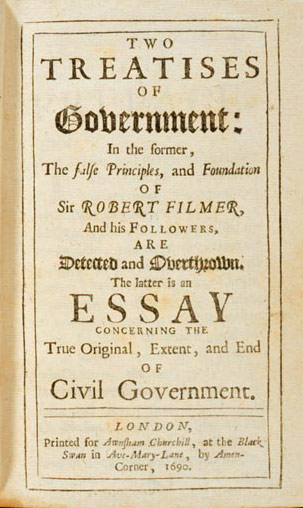
Notice anything funny about this cover? Take a moment. Take two.

[Da-da-dee, da-da-da-dah-daah... Insert the music from Final Jeopardy here...]

OK, the question is, Why is the author's name missing? [All answers must be in the form of a question in Final Jeopardy, silly.]

Because it was published anonymously---John Locke only admitted he was the true author of the "Two Treatises" when he was on his deathbed and the bastards couldn't get at him anymore!

(God, I love using exclamation points when writing about history. It's not as dull as all that, is it? Ripley's Believe It or Not! Thomas Jefferson had three penises!)

John Locke wrote the "Two Treatises" even earlier than he published them, but figured the coast was clear in December 1689 after the Glorious Revolution of 1688, which put William and Mary up under a monarchy that was well-limited by parliament. Locke had already gone into voluntary exile to Holland and France twice in his life as he became a "person of interest" when the England's political climate got too hot---best he still publish the Two Treatises anonymously in case the tide turned against him again.


The important thing as we read these Great Minds of Yore is to remember what the Athenians did to Socrates. [If you don't remember what they did to Socrates, kindly stop reading here. He didn't have three penises, as far as history records. Neither did Thomas Jefferson. I just said that to keep you reading.]

Ideas, especially bold ones, tend to be subversive to the prevailing order and are a threat to the state. So, out of self-preservation, the state is obliged to kill you. And England in the 1600s was a tough town, especially the Tower of London.

Locke's contemporary, Algernon Sidney, argued along the same lines as Locke, for liberty and against the "divine right of kings." Sidney got his neck stretched by the English crown in 1683 for his outspokenness. Since there was only one witness against Sidney in his A Man for All Seasons-type tribunal but the law required two, the second witness called was Sidney's Discourses upon Government, a book that was much admired by the American Founders, but which proved fatal to its author. Aaaaaaaaaa-ack!

John Locke was not so naïve as poor Algernon Sidney as to the ways of man and his governments. If you want to die in bed, keep a low profile and tell the truth not at the top of your lungs, but sotto voce.

There are scholars who consider Locke quite the Christian, as he quotes the Bible and refers to "Our Saviour" quite copiously. But others see him as Thomas "Nasty, Brutish, and Short" Hobbes in vestryman's clothing,
Locke throwing rhetorical stones at Hobbes from behind the Rev. Richard Hooker's skirts, all the while agreeing with him beneath the surface of his writings.

As our blogbrother Ray Soller illustrates here, even the best and most admired of "experts" and scholars might be wrong about things.

So, the lesson is, think for yourself when you read historians and scholars. There is no "truth" that lies just a google click away. Nothing is "settled" in history, especially the history of ideas, so inquire away. There's no embarrassment in what you don't know, only in what you think and are sure you know. [As one eminent historian just learned from our Mr. Soller.]

When you read John Locke---or any of the Great Thinkers---take nothing for granted. Take nothing at face value. Those were dangerous times they were writing and thinking in, and the Sword of Damocles or the hangman's knot was just a careless statement or two away. In fact, for a philosopher or even a politician, the best thing about dying is that you can finally tell the truth and sign your name to it.


2ndTreatise, First American Edition, 1773, by John Locke, Esq. [1632-1704] Ah. Freedom at last. One penis.

Saturday, August 2, 2008

John Locke and other Beginnings

I have for some time contemplated the topic of my first post here at American Creation and the recurring theme running through my mind has centered on that of John Locke whose influence over Thomas Jefferson can best be described as instrumental to the formation of our great nation. We have seen Locke’s influence written into the Declaration even by near plagiarism on the part of Jefferson who reiterated that “ The object of the Declaration of Independence … was … not to find out new principles, or new arguments, never before thought of, not merely to say things which had never been said before; but to place before mankind the common sense of the subject … Neither aiming at originality of principle or sentiment, nor yet copied from any particular and previous writing, it was intended to be an expression of the American mind ... All its authority rests then on the harmonizing sentiments of the day, whether expressed in conversation, in letters, printed essays, or in the elementary books of public right, as Aristotle, Cicero, Locke, Sidney, etc.”

Thus, can we deduce from this that the sentiment of the day not only espoused this form of thought but that this philosophy was undergirded by religious principles as John Locke’s own writings reveal?

“The obligations of the law of nature cease not in society, but only in many cases are drawn closer, and have by human laws known penalties annexed to them, to inforce their observation. Thus the law of nature stands as an eternal rule to all men, legislators as well as others. The rules they make for other men’s actions, must, as well as their own and other men’s actions, be conformable to the law of nature, i.e. the will of God, of which that is a declaration, and the fundamental law of nature being the preservation of mankind, no human sanction can be good or valid against it.”

Carl Becker, in his book The Declaration of Independence: A Study in the History of Political Ideas had this to say,” Not all Americans, it is true, would have accepted the philosophy of the Declaration, just as Jefferson phrased it, without qualification, as the ‘common sense of the subject’: but one may say that the premises of this philosophy, the underlying preconceptions from which it is derived, were commonly taken for granted. That there is a ‘natural order’ of things in the world, cleverly and expertly designed by God for the guidance of mankind” that the ‘laws’ of this natural order may be discovered by human reason; that these laws so discovered furnish a reliable and immutable standard for the testing of ideas, the conduct, and the institutions of men—these were the accepted premises, the preconceptions, of most eighteenth century thinking, not only in America but also in England and France.”

The Reformation had set a radical new course for religious principles in Western Europe through its priority in education and logical reasoning. To this extent today I recognize that many hold to an ill-conceived notion of what Christianity is, viewing it as merely an emotional response rather than a united front of heart, mind, and soul. Thomas Hooker, John Locke, and Montesquieu among others found in the Scriptures the basis for their philosophies of government and the more I examine the Scriptures and their works side by side I can see greater evidence of this.

Undertaking this topic I can see where my thoughts diverge and in the next couple of weeks I’d like to concentrate on aligning the works of the above named English and French contributors to America’s creation in addition to concepts provided for in the Scriptures that their philosophies echo.

Religion's Role in American Nationalism and Providentialism

by Brad Hart

In a recent post by fellow blogger, Tom Van Dyke, we briefly discussed some of the specifics behind the "Christian Nation" phenomenon and its role in the development of American nationalism. In the following video, Dr. Ron Edsforth, a history professor at Dartmouth University, expounds upon the doctrine behind American nationalism and how it has been influenced by religious providentialism. Dr. Edsforth emphasizes how religion has instigated an abiding and passionate belief in many Americans that our nation's history is centered exclusively on divine intervention and inherent superiority. As Dr. Edsfourth put it:

American nationalism, what Americans call "patriotism," is grounded in this belief that Liberty and Empire are uniquely reconciled in the history of the rise of the United States to world superpower status. Most Americans who tell this history, tell it in the language of "Manifest Destiny," while excluding from that history the voices of others who see it differently.
Dr. Edsfourth's insight is an excellent way for us to continue our discussion on American providentialism and nationalism.

In the video, Dr. Edsfourth reads Joseph Warren's famous poem, Song on Liberty, or Liberty's Song, which serves as an excellent example of one of America's first nationalistic pieces of literature/music. The poem gained even greater praise after Warren's death at Lexington & Concord. It is easy to see the roots of American providentialism and nationalism in Warren's epic poem, which states:

That Seat of Science Athens,
And Earth's great Mistress Rome,
Where now are all their Glories,
We scarce can find their Tomb;
Then guard your Rights, Americans!
Nor stoop to lawless Sway,
Oppose, oppose, oppose, oppose,
My brave America.

Proud Albion bow'd to Caesar,
And num'rous Lords before,
To Picts, to Danes, to Normans,
And many Masters more;
But we can boast Americans!
We never fell a Prey;
Huzza, huzza, huzza, huzza,
For brave America.

We led fair Freedom hither,
When lo the Desart smil'd,
A paradise of pleasure,
Was open'd in the Wild;
Your Harvest, bold Americans!
No power shall snatch away,
Huzza, huzza, huzza, huzza,
For brave America. :

Torn from a World of Tyrants,
Beneath this western Sky,
We form'd a new Dominion,
A Land of liberty;
The World shall own their masters here,
Then hasten on the Day,
Huzza, huzza, huzza, huzza,
For brave America.

God bless this maiden Climate,
And thro' her vast Domain,
Let Hosts of Heroes cluster,
Who scorn to wear a Chain;
And blast the venal Sycophant,
Who dares our Rights betray.
Preserve, preserve, preserve, preserve
My brave America.

Lift up your Heads my Heroes!
And swear with proud Disdain,
The Wretch that would enslave you,
Shall spread his Snares in vain;
Should Europe empty all her force,
Wou'd meet them in Array,
And shout, and shout, and shout, and shout,
For brave America!

Some future Day shall crown us,
The Masters of the Main,
And giving Laws and Freedom,
To subject France and Spain;
When all the Isles o'er Ocean spread
Shall tremble and obey,
Their Lords, their Lords, their Lords, their Lords
Of brave America.
Anyway, enjoy the video! FYI, skip the first 11 minutes of this video, since they are nothing more than introduction.

David McCullough Tells a Good Story

But what happens to history?
by Ray Soller


On April 24, 2007, my wife and I attended a lecture at Emory University presented by the well-known author, David McCullough. The title of his talk was "Leadership, Ambition, and the History You Don’t Know.” I brought my copy of 1776 with me so I could get it autographed. I also brought a folder full of historical material relating to Washington's first inauguration on April 30, 1789. The folder duplicated my earlier effort where I had already sent a lengthy e-mail with similar material to the Emory program coordinator, Andrew Shahan, hoping that Shahan would pass it on to McCullough.

McCullough's presentation was outstanding. Afterwards, a hundred people gathered in the book signing line. When I arrived at the table Mr. Shahan served as an assistant. He opened each book so it could be autographed. He, likewise, took my book and inspected my folder. He then told McCullough that I was the gentleman who had written the material he had already received. McCullough looked up at me with a penetrating gaze that seemed to say, "So you're the guy." My senior citizen face didn't impress the author. He put my material aside and then signed my book without saying a word. Finally, my wife and I moved on as everyone else had already done.

The material I submitted to David McCullough reviewed Washington's first inauguration as narrated in his book, John Adams. A close examination of his narrative prompts the reader to ask, "Given McCullough's ability to tell a good story, what happens to history?"

Here's McCullough's narrative of Washington's inauguration (page 403):
On the day of his inauguration, Thursday, April 30 1789, Washington rode to Federal Hall in a canary-yellow carriage pulled by six white horses and followed by a long column of New York militia in full dress. The air was sharp, the sun shone brightly, and with all work stopped in the city, the crowds along his route were the largest ever seen. It was as if all New York had turned out and more besides. "Many persons in the crowd," reported the Gazette of the United States "were heard to say they should now die contented – nothing being wanted to complete their happiness … but the sight of the savior of his country."

dot - dot - dot

[When the anticipated moment arrived] Washington, his right hand on the Bible, repeated the oath of office as read by Chancellor Robert R. Livingston of New York, who had also been a member of the Continental Congress.

In a low voice Washington solemnly swore to execute the office of the President of the United States and, to the best of his ability, to "preserve, protect, and defend the Constitution of the United States." Then, as not specified in the Constitution, he added, "So help me God," and kissed the Bible, thereby establishing his own first presidential tradition.

Confabulated six white horses: It certainly would have been grand if the inaugural parade had included a "canary-yellow carriage pulled by six white horses," but the record shows there were only four horses. (All of the other carriages were pulled by two horses. See Arriving in Style, page 3: "A Carved and gilded English-made coach drawn by four horses carried Washington from his home on Cherry Street to Federal Hall on Wall Street, escorted by militia, members of Congress, and other eminent citizens. A chorus of cheering crowds observed the procession and followed in carriages and on foot." A detailed newspaper account given in the New York Packet of May 1, 1789, the day after the ceremony, reported that "the President joined the procession in his carriage and four.")

Later in Washington's term, the president toured the southern states in a canary-yellow carriage with six horses, but at the time of the inauguration he rode alone in the gilded carriage of state that was loaned out for Washington's use by the wealthy Beekman family. Washington was so impressed that he ordered one for himself. It was shipped from London and arrived in New York that same year.

Post-dated article from the Gazette: When reading the McCullough's text for Washington's inaugural ceremony one would assume that the author is citing a Gazette article for April 30, 1789, but he wasn't. The article in question is dated April 25th, which was five days too early. It described the events of April 23rd when Washington arrived in New York City, and, indeed, some people in the crowd may have felt thay could "die contented." Others, however, thought that the monarchial trappings were overdone. A very contrasting representation appeared at the same time in the form of a caricature, which portrayed "General [Washington] mounted on an ass, and in the arms of his mulatto man, Billy, --- [David] Humphreys leading the jack, and chanting hosannas and birthday odes. The following couplet makes the motto of this device:
'The glorious time has come to pass,
When David shall conduct an ass'"

Back-dated tradition - So help me God: McCullough, along with an almost countless number of other authors, have taken what is essentially a modern-day inaugural tradition and conjured up the notion that George Washington started this "hoary tradition" by his first adding "So help me God" to the presidential oath. It's simply not true, since no elected-President has been documented as having added "so help me God" until the beginning of the twentieth century. Furthermore, in spite of the widespread notion to the contrary, there is no contemporary or firsthand historical evidence showing that George Washington added anything to his presidential oath of office. The first report claiming that Washington added "So help me God" to his presidential oath came sixty-five years after the event.

So, my fellow readers, If you like your historical narratives confabulated with a super-sized team of six horses mixed in with a post-dated newspaper article and a back-dated inaugural tradition, then McCullough's biography of John Adams and HBO's adaptation are just right for you.

WorldNetDaily Article on Pastors & Politics

One Dave Welch wrote an article for WorldNetDaily defending Dominionism and attacking John MacArthur's anti-Dominionist position. The article fires and misses. I'm not going to dissect it in detail. I've alerted Dr. Gregg Frazer about the article and he's planning a response which we'll feature here. Here is the introduction to Welch's article:

"I'm not concerned about that (2008 presidential election) for five seconds. It has nothing to do with the kingdom of God. … His kingdom has nothing to do with this world." Those words spoken by renowned pastor, author and speaker Dr. John MacArthur recently as part of a radio interview, combined with his belief that our Declaration of Independence was an unscriptural act of rebellion, cry out for a biblically and historically accurate response.

The breathtakingly unscriptural nature of his position is tragically held by many evangelicals who have bought into the "sacred vs. secular" dichotomy....


Perhaps there is a case to be made for Dominionism, but Welch sure doesn't make it in this article. A few points. This passage is particularly telling:

We are blessed beyond measure that great preachers of the past such as Jonathan Edwards, John Wesley, Jonathan Mayhew, Samuel West and legions of others adhered to that mandate rather than the "Abandonment Theology" position Dr. MacArthur is espousing.


LOL. John Wesley supported the British in the American Revolution. And West and Mayhew weren't even "Christians" as Welch understands and defines the term. They were unitarians who denied Jesus full Godhood or second place in the Trinity. Further, they were enlightenment rationalists who thought man should be ruled, not chiefly by the Bible, but "nature" and "reason." I discussed Samuel West's sermon in a detailed post about theistic rationalist principles being preached from the pulpit. In essence you have a theological unitarian, Rev. Samuel West, preaching that biblical texts must meet the test of "reason," such that "[a] revelation, pretending to be from God, that contradicts any part of natural law, ought immediately to be rejected as an imposture;..." Revs. Mayhew and West as enlightened unitarians hardly support Welch's "Domionist" position.