Tuesday, February 19, 2019

Lash Article on Incorporating the Establishment Clause, Blasphemy & Religion Left to the States

For those who wish to see an originalist case for incorporating the Establishment Clause to apply to state and local governments, see Professor Kurt Lash's classic article here. You can also read a blog post that summarizes Lash's research here. It concludes:
If one takes an originalist approach to Fourteenth Amendment incorporation, the principle of non-establishment as a privilege or immunity of citizens of the United States emerged at the time of Reconstruction and was entrenched through the adoption of the Fourteenth Amendment.
Though the entire article and post are worth reading, I'm going to focus on the very interesting discussion of blasphemy laws in Lash's longer article. But first a quotation from Walter Berns' "Making Patriots" that I've oft-cited:
Liberty of conscience was widely accepted at the time of the Founding, but this did not prevent some jurists and legislatures from insisting, at least for a while (and given our principles it could be only for a while), that Christianity was part of the law, meaning the common law. So it had been in England, and so, it was assumed by some (but not Jefferson), it would continue to be in America. But there was no disagreement about the place of the common law. Indeed one of the first things done by the states after independence was to declare (here in the words of the New Jersey constitution of 1776) that “the common law of England, as well as so much of the statute law, as have been heretofore practiced in this Colony, shall remain in force, until they shall be altered by a future law of the Legislature; such parts only excepted, as are repugnant to the rights and privileges contained in this Charter [or constitution].”  
But if the “rights and privileges” contained in the various state charters or constitutions included the right of liberty of conscience, and if, in turn, this right required, in Madison’s words, “a perfect separation between ecclesiastical and civil matters,” what did it mean to say that Christianity was part of the common law? Very little, as it turned out; and it turned out as it had to turn out. Consider, for example, the case of blasphemy in America…. pp. 32-33.
Lash's article treats us to an analysis of the four classic known blasphemy prosecutions in post-founding America. (Starting on page 18/1101). A few points: Blasphemy was a "common law" crime and the prosecutions took place at the state level.  The four different prosecutions involve different states, different judges and different times. As Berns notes above, the common law exists at a level where a state statute can trump it. Though, judges back then looked up to the brooding omnipresence in the sky to "find" common law principles.

The first two prosecutions have dicta that could support "Christian nationalist" claims. They act as though it's presumed Christianity will be the religion of the state and the only religion about which the law would be concerned. It's with the second two cases where the judges start to turn blasphemy into an offense akin to a secular breach of the peace.

And in fact, Delaware v. Chandler, decided in 1837, has dicta that blatantly contradicts the Christian nation thesis. The case notes:
If in Delaware the people should adopt the Jewish or Mahometan religion, as they have an unquestionable right to do if they prefer it, this court is bound to notice it as their religion, and to respect it accordingly.
And:
It will be seen then that in our judgment by the constitution and laws of Delaware, the christian religion is a part of those laws, so far that blasphemy against it is punishable, while the people prefer it as their religion, and no longer. The moment they change it and adopt any other, as they may do, the new religion becomes in the same sense, a part of the law, for their courts are bound to yield it faith and credit, and respect it as their religion. Thus, while we punish the offence against society alone, we leave christianity to fight her own battles,...

Sunday, February 17, 2019

DAVID UPHAM on Everson/The Religion Clause

Professor David Upham makes the case for overturning Everson at the Law & Liberty site here. In this piece he is more clear on how he feels about the Establishment Clause applying against the states than the Free Exercise Clause. Yes, before the 14th Amendment the entire Bill of Rights including the Free Speech and Free Exercise Clauses applied to the federal government only.

But he writes:
To my knowledge, the sole exception to the Permoli legal consensus, from 1875 to 1925, can be found in dicta made only by Justice John Harlan and only in his last decade on the Supreme Court (1900-1911).  So, for instance, in Maxwell v. Dow, Harlan objected to the majority’s anti-incorporation conclusion with an argument ad absurdum, that the logical result would be that Utah could establish the Mormon Church.[2]
So I noted in the comments:

There is one point of view that says religion is left to the states and the 14th Amendment didn’t incorporate any of the bill of rights. If this is true states would be permitted to infringe on the free exercise rights. What conservative jurists presently support this position? State Blaine Amendments, even though they discriminate against religion would be perfectly constitutional. 
There is another point of view that says individual rights are what was intended to be incorporated. Free exercise clearly relates to an individual right. Establishment would only incorporate to the extent you can demonstrate it relates to such. Clarence Thomas has endorsed this point of view. But he doesn’t see what beyond the FEC incorporates. Akhil Amar suggests there are some “equality” rights that the FEC (which is more of a “liberty” right) doesn’t capture.
To which Upham replied:
... Nonestablishment is not a privilege or immunity of citizenship under the 14th Amendment. No one said it was, and for good reason–it did not fit the definition of the terms, as understood by that generation. Conversely, many mentioned other rights in the bill of rights–and for good reason–they did fit the general definition. 
State Blaine amendments, as I understand them, are not inconsistent with the original understanding. They are, I think, unjust and imprudent, but not unconstitutional–in part because their very existence, passed often by the same folks who adopted the 14th Amendment, is strong evidence that they were not inconsistent with the 14th Amendment. Did anyone–in any of the states–protest such measures as contrary to the 14th Amendment? 
To which I then replied:

Kurt Lash has suggested that the last state establishment ended in 1833 — well before the 14th Amendment — one could argue the right to be free from a religious establishment is included in the P or I Clause. 
And again, Prof. Amar has suggested, rightly in my opinion, it’s liberty and equality interests that drive the First Amendment and the entire BOR generally. 
If Utah did have the Mormon Church as a state establishment or Maryland the Roman Catholic Church, is that consistent with a state treating its citizens as equals without regard to religious creed[?] 
These kinds of questions as opposed to original expectation of the constitution’s applied text are what drives the new originalism.
And finally Upham:

Lash rightly and easily points out that nonestablishment can be an individual right and not exclusively a federalism provision. But it cannot satisfy the full test of being fundamental to the United States–whether that test is Corfield’s or the similar tests announced in various formal interpretations of the proposed Amendment–that it be foundational to the American Republic since 1776. 
Those tests, and that failure, I think adequately explain why no one seemed capable of saying that the Fourteenth Amendment incorporated the Religion Clauses, even when the silence was deafening. that is to say–the original meaning explains fairly clearly the originally expected NON-application. 
As for equality before the law: the establishment of republicanism, as presupposed by our entire Constitution, does not make monarchists second-class citizens of our Republic. So too the establishment of Mormonism or Roman Catholicism–which would be highly unlikely, imprudent and even un-American, in my opinion, would not, absent a suppression of liberty or an imposition of special taxes or burdens–reduce non-Mormons or non-Catholics to second-class citizenship in Utah and New Mexico, respectively. 
I gave him the last word in the comments over there, but  let me take a final word here. One of the difficulties in constitutional interpretation is that the text of the Constitution doesn't specify a formula or a "test" for interpreting it.

I'm certainly skeptical of Upham's application of his aforementioned "tests." What does "foundational to the American Republic since 1776" mean? That we freeze everything in 1776? What about 1789 or 91 or 1868? Is Upham arguing that what the 14th Amendment incorporates has to relate back to 1776?

This isn't what Akhil Amar argues. Rather he argues it's an 1868 understanding or lens of the Bill of Rights that were ratified in 1791 (not 1776). But 1868, not the late 18th Century is the more centrally determinative time. And if that's the case, given the state establishments were gone by 1868 one could argue, after Lash, that it's foundational to the American Republic since 1868 that American citizens have a right not to live under a state established church.

I'm also skeptical that the state level establishment of Mormonism, Roman Catholicism or a fundamentalist sect of the Baptist religion can be done without making other members into second class citizens on account of their religion.

Friday, February 15, 2019

Presidents Day Weekend is the Most Worthless Holiday Weekend of the Year

I hate Presidents Day.  
Don't get me wrong. I don't mind holidays. Getting an extra day off work is great. But I like my holidays to mean something. The root words, after all, behind "holiday" are "holy day." Granted, we live now in a largely secular culture, so the adjective "holy" may seem off-putting to some. But the important point is that our holidays should mean something. They should stand for something. They should call our attention as American citizens to something worthwhile - something worth remembering, celebrating, and/or honoring. 
That is not really the case with "Presidents Day." Now, of course, this isn't the official name of the holiday. The United States government recognizes the third Monday of February by its legal name: George Washington's Birthday Observed. But legal technicalities are trumped by public discourse and popular consciousness. Most Americans know the holiday as "Presidents Day." And that is therefore effectively what they celebrate.
Informed readers of course are aware that "Presidents Day" evolved from two developments: 
1) the Monday Holidays Act, which moved several holidays (including Washington's Birthday) to Monday to create 3-day weekends
2) the desire of many Americans to honor Abraham Lincoln
These factors are responsible for Washington's Birthday holiday now being known as "Presidents' Day." But the effect has gone beyond the intent. The effect is that Americans now hear "Presidents" and not the names of Washington or Lincoln. They hear and say "Presidents Day," not "Washington-Lincoln Day." 
The effect of that is to essentially celebrate all our Presidents. Even if many graphic artists put Washington's face and Lincoln's face next to the words "Presidents Day," it merely serves to propagate the notion that Lincoln and Washington are kind of the "first and second among equals" rather than being the exclusive focus of the holiday. 
Most Americans of course don't reflect on the meaning behind any of the holidays. They just enjoy the extra day off. And businesses enjoy making extra money through sales and promotions. So even having this discussion is somewhat academic. 
Nevertheless, I can't let a "Presidents Day Weekend" go by without saying something about it. The very name "Presidents Day" showcases the vague and shallow identity that has befallen a holiday that was once quite intentional, meaningful, and worthwhile.
Rather than honor the man who made the United States possible, we now - in effect - celebrate the legacies of all our "presidents," including such notables as Martin Van Buren, William Henry Harrison, John Tyler, Millard Fillmore, Franklin Pierce, James Buchanan, Andrew Johnson, and Warren G. Harding.
But remember... George Washington's legacy extends beyond his accomplishments as President of the United States. Washington was a hero of the French and Indian War, an influential leader in Colonial America, the commander-in-chief of the Continental Army in the American Revolution, the president of the Constitutional Convention, and then the President of the United States. There's a reason most historians recognize him as "the indispensable man." Without Washington, it's hard to imagine the United States even getting off the ground. 
You of course may celebrate "Presidents Day Weekend" as you wish, but as for me... I will remember and be grateful for the man who made the United States of America possible. And the man who made all the other Presidents possible. 
It's ironic that George Washington must  now share his holiday with the other 44 Presidents, but without Washington, none of the other 44 men ever would have been President in the first place. 
Happy George Washington Birthday Weekend!
Blessings to all. 

Monday, February 11, 2019

‘Washington “God letter” is up for sale’

     
Courtesy Raab Collection
The Raab Collection, a Pennsylvania-based curator of historical documents and other artifacts, has announced the proposed sale of a letter penned by George Washington in which the future president invokes the blessings of deity upon the U.S. Constitution.

The letter had been in the private collection of Paul Richards. According to the Raab Collection, this September 7, 1788 correspondence to Richard Peters, speaker of the Pennsylvania General Assembly, is the first letter in which Washington thanks God for victory in the Revolution and passage of the U.S. Constitution.

The purchase price is $140,000.

Continued resistance to the Constitution was fomenting still at the time Washington communicated his thoughts to Speaker Peters. “It would seem from the public Gazettes that the Minority in your State are preparing for another attack of the–now–adopted Government; how formidable it may be; I know not. But that Providence which has hitherto smiled on the honest endeavors of the well meaning part of the People of this Country will not, I trust, withdraw its support from them at this crisis,” Washington writes.

The three-page missive primarily addresses farming topics, but concludes abruptly with the above mention of the current political concerns. See the complete text here.

“Mount Vernon notes that Washington’s use of the term ‘Providence’ to mean ‘Divine Providence,’ and the organization states thusly his theological beliefs: ‘It is clear that he believed in a Creator God of some manner, and seemingly one that was also active in the universe. This God had three main traits; he was wise, inscrutable, and irresistible. Washington referred to this God by many names, but most often by the name of ‘Providence,’” the Raab website reports.
     

Saturday, February 9, 2019

John Adams and the Trinity: Why should we care?

Much is made in some quarters that John Adams was a "unitarian" Christian, in other words, he didn't believe Jesus was God. This is true. In a letter to Jefferson praising a British parliamentarian's defense of the rights of the "Antitrinitarians," he wrote


Had you and I been forty days with Moses on Mount Sinai and admitted to behold, the divine Shekinah, and there told that one was three and three, one: we might not have had courage to deny it, but we could not have believed it. The thunders and lightenings and earthqu[ak]es and the transcendant splendors and glories, might have overwhelmed us with terror and amazement: but we could not have believed the doctrine.

But why the "unitarian controversy" matters much to some people, I don't know. Samuel Adams, John's cousin and his virtual co-leader in the early days of the American Revolution, was a Trinitarian, and John and Sam's political theology differed not at all---whether you believed Jesus is God or not didn't make any difference.

The other thing about John Adams' unitarianism is that it was expressed in private letters like these, after he left public life. As a public man, as president, what did America know of John Adams' "unitarianism"? 

The answer is, little or nothing.

President John Adams' 1798 thanksgiving proclamation explicitly recognizes God the Father, Jesus the Redeemer and the Holy Spirit:

"I have therefore thought fit to recommend, and I do hereby recommend, that Wednesday, the 9th day of May next, be observed throughout the United States as a day of solemn humiliation, fasting, and prayer; that the citizens of these States, abstaining on that day from their customary worldly occupations, offer their devout addresses to the Father of Mercies agreeably to those forms or methods which they have severally adopted as the most suitable and becoming; that all religious congregations do, with the deepest humility, acknowledge before God the manifold sins and transgressions with which we are justly chargeable as individuals and as a nation, beseeching Him at the same time, of His infinite grace, through the Redeemer of the World, freely to remit all our offenses, and to incline us by His Holy Spirit to that sincere repentance and reformation which may afford us reason to hope for his inestimable favor and heavenly benediction..."


Bold face mine. As we see, the Father is in there, Jesus is still the "Redeemer," and the existence of the Holy Spirit is acknowledged, not denied.  The Trinitarian formulation.

Most people, whether in 1798 or in 2019, would read President Adams' proclamation as explicitly "Christian," explicitly in harmony with Christian orthodoxy. What John Adams believed in private is of some interest, but it is of little importance. These days, we use the term "Judeo-Christian" specifically to dispose of the question of whether Jesus is God or not anyway. And as we see here, in public, President John Adams comes off as more Christian than that minimum, not less.

Tuesday, January 29, 2019

NY Mag: "AOC Thinks Concentrated Wealth Is Incompatible With Democracy. So Did Our Founders."

You can read the link here. It relies mainly on Thomas Jefferson and James Harrington to represent "our Founders." Historian Kevin Gutzman, writing on Facebook noted:
George Washington was the wealthiest president of the United States. A recent study of the question estimated his wealth at approximately $5B. Article II of the Constitution was written with him in mind, and in both 1789 and 1792, he won unanimous Electoral College victories.

On the other hand, James Madison wrote extensively of "agrarian laws" (that is, government redistribution of wealth), which he considered both harmful and immoral.

Thomas Jefferson's criticism of the French nobility was of a legally privileged class. There is no such class in today's United States.

In short, this story is bunk.

(Rep. Ocasio is a walking advertisement for Jefferson's insistence that prior to citizenship, Americans should be taught the history of republican regimes--so that they could avoid repeating the mistakes that had led prior ones to fail.)
I agree that the author's thesis ultimately fails; it was too broadly stated. However, I wouldn't write it off entirely as "bunk." That's because, as I noted in the comments, some notable "republican" thought both on the Continent, but more importantly in Great Britain was in favor of such sentiment and I think such policies were implemented in various cases. 

James Harrington who was referenced in the original piece really did believe in Agrarian redistribution and he really was influential on America's founders. And Jefferson DID flirt with such sentiment as Harrington's. It probably was his friend Madison who convinced him that these ideas were unwise. Madison's vision prevailed at the time of the American founding.

But Harrington's vision perhaps prevailed in the modern era of
Western Civilization. That is, when we focus, not just on America, but Western Europe and the other industrialized nations.  The "modern world" as Eric Nelson puts it. That's one of his core theses and he pins such present day redistributionist policies on the Hebrew Bible.


Another commenter at Dr. Gutzman's site noted:
Agrarian Laws and similar legislation have created little but trouble since Roman times, but every government since has, in one way or another, engaged in such legislation. It's simply too easy and appealing to engage in what amounts to massive payoffs to influential factions.

Sunday, January 27, 2019

Ben Franklin Didn't Think Ben Hur Needed Jesus

This post features another one of those letters that contain multiple points about one of America's founders' religious beliefs. Ben Franklin's exact faith can be hard to pin down. He was not, I have concluded, a "sola fide" Protestant. Or a strict deist. But he also didn't think, like J. Adams and Jefferson did, that "works" were all that counted. Or perhaps in a sense he did.

You see Franklin didn't think that HIS good works merited Heaven, but he thought God would let him in anyway. What that means is that Franklin, like orthodox Catholics and Protestants (and others) thought ultimately God's unmerited grace would get him in. But Franklin also intimated that there were some better than him who perhaps could work their way into Heaven? That's part of what I get out of the quotation featured below.

How does Jesus and "faith" figure in? To Franklin faith was a means to the end of virtue. Good works were an essential component of Franklin's belief in "justification" (if you want to call it that). I don't think Franklin thought Jesus to be an Incarnate God, 2nd Person in the Trinity; in fact he admitted that he "doubted" such a thing. But he did think Jesus the greatest moral teacher of all time. So it stands to reason that if the purpose of faith is morality and Jesus is the greatest moral teacher, various forms Christianity would be valued for that reason.

I don't believe Franklin thought God's "grace" needed to be "channeled" through Christ's atonement. Rather the unmerited grace that got Franklin into Heaven was some kind of mysterious gift of God. Franklin differed with the "orthodox" there.

In a letter he wrote in 1753 (and later sent a copy to Ezra Stiles in 1790) where Franklin conceded that he didn't think his good works merited him Heaven, he also described what he saw as Jesus' role, quoting Jesus Himself.
He profess’d that he came not to call the Righteous but Sinners to Repentance; which imply’d his modest Opinion that there were some in his Time so good that they need not hear even him for Improvement;...
This sentiment comports 100% with Jesus as greatest moral teacher, and 0% with orthodox theology. He blatantly said there were some in Jesus' time, so righteous that they didn't need Him.

Think of Ben Hur, who in the story met Jesus at the end and converted. Franklin probably wouldn't have had a problem with this righteous man meeting and following the greatest moral teacher. He probably thought they had a lot in common. However, Franklin would not have thought Ben Hur necessarily needed Jesus.

From John Adams to John Quincy Adams, 28 March 1816

Over the years, we've quoted from various letters of America's founders to prove a point about which they believed. Some letters though contain much information useful to demonstrate many different points in which they believed. This letter is one of them. We've quoted many different times from it. But I don't believe I ever quoted what I quote below(?).
We do not expect to be “Saved” or damned for Unitarianism, or any other Philosophical or metaphiscal or Theological opinions; but by Sincerity Candour Charity Benevolence and Beneficence: or their Contraries.
Adams is talking to his namesake son and future President about differences in their theologies. The elder Adams is a Unitarian. The younger is a Calvinist.

Thursday, January 17, 2019

Kidd on GW's Faith

From this post in 2017, Thomas Kidd examines "Ron Chernow’s extraordinary 2010 biography of Washington" and makes some observations about George Washington's faith. A taste:
For his own part, Washington’s Anglican faith was moderate and utterly reserved. That is how we should account for Washington’s irregular church attendance and his failure to take communion, Chernow explains. He never liked to make a public show of his own faith. This is also the reason why Chernow doubts that Washington was ever seen praying as depicted in the popular painting “George Washington in Prayer at Valley Forge.”
“The reason to doubt the story’s veracity is not Washington’s lack of faith,” Chernow writes, “but the typically private nature of his devotions.” Chernow’s portrayal of Washington’s near-secretive faith seems quite plausible, although it would still not account for Washington’s strange decision hardly ever to utter or write the name of Jesus Christ in his thousands of surviving letters and public statements.
Yes this is true. In the perhaps 20,000 pages of words that George Washington left us, the name "Jesus Christ" is mentioned only once by name and one other time by example. Both in public addresses written by aides, but given under Washington's hand. In none of Washington's private letters is the name or example of Jesus Christ invoked. Though more generic God words are replete throughout Washington's recorded public and private words.

Sunday, January 6, 2019

What Was Unique About the American Founding and Religion

The American founding had a number of novel things to it. Though it wasn't entirely novel. For instance, the American Revolution wasn't quite as novel as say, the French Revolution which it inspired. On religion (correct me if I am mistaken), every single modern Western European nation state at the time was in some way formally connected to an official Christian sect.

At the state level, America post founding still retained some "state established" churches, which were on their way out.

But at the federal level, there was nothing. George Washington, America's first President, was like many founders, formally/nominally affiliated with the Anglican then Episcopalian Church. "The Church of England" against which America had then separated.

When Washington spoke to the different religious "factions," he had a method of seeming to be all things to all people. For instance, recent events remind of us of Islam's place in the mind of America's founders. With the assistance of his Secretary of State, Thomas Jefferson, Washington delivered remarks to Morocco where he claimed to "adore" (his word) the same God as the Muslim leader.

Now, one could write this off as something "diplomatic." Perhaps it was. It's certainly the kind of sentiment today that leaders in pluralistic societies use. But back then, before America, every single head of state was connected to an official church. And it was expected that in their public utterances, they would endorse that particular brand of faith. Not generic, bridge building, monotheism.

That's something that arguably Washington and the other early American Presidents invented. And perhaps they were so effective at it because such a sentiment mirrored their privately held religious convictions which focused more on commonly held doctrines of monotheism and virtue, while if not downplaying, outright removing other more divisive sectarian "doctrine."

Friday, January 4, 2019

On "Jefferson's Qur'an"


Missing from the current "happy face" reporting on new congresspersons swearing in on "Jefferson's Qur'an" is that his 1764 edition of the translation by George Sale is accompanied by a preface that is highly critical of Islam as serious religion.


The Protestants alone are able to attack the Koran with success; and for them, I trust, Providence has reserved the glory of its overthrow.


and


...for how criminal soever Mohammed may have been in imposing a false religion on mankind...


The Qur'an of course, borrows liberally from the stories of the Bible and indeed contains many common sense truths of its own; thus the cover page itself quotes St. Augustine, "Nulla falsa doctrina est quae non aliquid veri permisceat," that is, “There is no false doctrine that does not contain some truth.”

So the front page of the very "Jefferson Qur'an" these folks are swearing upon calls its contents "false doctrine" mixed with some truth. The irony is complete. And so it goes also in our current world of "news": We may get the truth, but seldom the whole truth.

Full text here, courtesy of Gutenberg.org.


Jefferson's Koran

So Rep.-elect Rashida Tlaib (D-Mich.) will be sworn in using Thomas Jefferson's copy of the Koran. There is a myth going around that Jefferson owned a copy of that book because he wanted to better understand the enemy.

The problem with this claim is that it is not true. I've studied the Founding record meticulously and found NO evidence that Jefferson was interested in the Koran because he saw Islam as an ENEMY faith or to better understand a threat.

That's not to say that certain Islamic forces didn't cause threats and other problems for Jefferson and other Founders. The best someone like Robert Spencer could argue is that the Founding Fathers were naive for NOT concluding Islam qua Islam was a threat.

Read the Treaty of Tripoli where the Founders conceded the American government was not in any sense founded on the Christian religion and as such they sought peaceful relations with Muslims.

Jefferson, J. Adams, Franklin and Washington all thought Jews, Christians and Muslims worshipped the same God. The Founding Fathers arguably saw Roman Catholicism as more of a threat than Islam. And they were far more concerned with the persecution and bloodshed that in-fights among Christian sects had been causing than from Islam.

Tuesday, December 25, 2018

Merry Christmas from the Moon


Fifty years ago today, remembering the important things as these men did, seems longer ago and even farther away with each passing year and to some, even silly. But Merry Christmas to all those here gathered anyway—May we smile today, give thanks, and be inspired in the coming year to perpetuate their silliness...


It was on Christmas Eve 1968 that the astronauts of Apollo 8, Frank Borman, Jim Lovell, and Bill Anders, became the first of mankind to see an earthrise from the orbit of the moon, and looking back on us, they spoke these words:


Anders: "We are now approaching lunar sunrise. And, for all the people back on earth, the crew of Apollo 8 have a message that we would like to send to you...


"In the beginning, God created the Heaven and the Earth. And the Earth was without form, and void; and darkness was upon the face of the deep. And the Spirit of God moved upon the face of the waters. And God said, Let there be light; and there was light. And God saw the light, that it was good; and God divided the light from the darkness."


Lovell: "And God called the light Day, and the darkness He called Night. And the evening and the morning were the first day. And God said, Let there be a firmament in the midst of the waters, and let it divide the waters from the waters. And God made the firmament, and divided the waters which were under the firmament from the waters which were above the firmament; and it was so. And God called the firmament Heaven. And the evening and the morning were the second day."


Borman: "And God said, Let the waters under the Heaven be gathered together unto one place, and let the dry land appear; and it was so. And God called the dry land Earth; and the gathering together of the waters He called Seas: and God saw that it was good."


And from the crew of Apollo 8, we close with good night, good luck, a Merry Christmas, and God bless all of you, all of you on the good earth."

Tuesday, December 18, 2018

Who Were the American Unitarians?

Much has been written here about the "unitarians" of the Founding era. John Adams averred he was one, as did Abagail Adams. But were they Christians?

Well, they certainly considered themselves Christians, and protested quite vociferously when accused of not being Christians, usually by competing "orthodox" clergy.

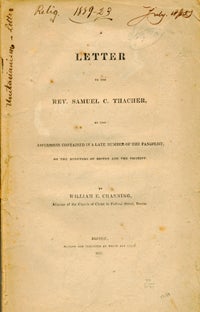
It all came to a head around 1815, when William Ellery Channing---generally regarded then (as now) as exemplary of that era's unitarianism---answered some prevailing charges against unitarianism in

A Letter to the Rev. Samuel C. Thacher on the Aspersions Contained in a Late Number of the Panoplist, on the Ministers of Boston and the Vicinity
.


Image result for 1815 A LETTER TO THE REV. SAMUEL C. THACHER ON THE ASPERSIONS CONTAINED IN A LATE NUMBER OF THE PANOPLIST, ON THE MINISTERS OF BOSTON AND THE VICINITY

Now, perhaps the defining feature of unitarianism was that it didn't believe in the Trinity---as John Adams noted, 1 + 1 + 1 would equal Three, not One. Hence the term "unitarian."

There were other orthodox doctrines rejected, too, namely, as Channing wrote:

"I fear, that the Author of the Lord's prayer will, according to this rule, be driven as a heretick from the very church which he has purchased with his own blood. In that well known prayer I can discover no reference to the "inspiration of the holy scriptures, to the supreme divinity of the Son and Holy Ghost, to the atonement and intercession of Jesus Christ, to the native and total depravity of the unregenerate, and to the reality and necessity of special divine grace to renew and sanctify the souls of men;" and these, let it be remembered, are _five_ out of the _six_ articles which are given by the Reviewer as fundamental articles of a christian's faith."


So that's what they didn't believe. So what did they believe? Channing wrote:

"The word UNITARIANISM, as denoting this opposition to Trinitarianism, undoubtedly expresses the character of a considerable part of the ministers of this town and its vicinity, and the commonwealth...We both agreed in our late conference, that a majority of our brethren believe, that Jesus Christ is more than man, that he existed before the world, that he literally came from heaven to save our race, that he sustains other offices than those of a teacher and witness to the truth, and that he still acts for our benefit, and is our intercessor with the Father. This we agreed to be the prevalent sentiment of our brethren." 


Is that Christian enough? Certainly not to the orthodox clergy and various laymen of the time who stood in opposition to them.

Probably not Christian enough for most Christian theologians of any stripe today, certainly not evangelical or orthodox.

But perhaps Christian enough for the sociologist or the historian. "Unitarian Christian" is my own preference, both descriptively and definitively, at least for our best understanding in this day and age. [Channing and others used "'rational' Christians," but in our day, I'm not sure that's helpful or descriptive enough, although it's certainly a proper term. Channing himself published a popular tract in 1819 called Unitarian Christianity.]

Do read Channing's letter for yourself, as there's more than can be sketched or excerpted here. It offers an excellent window into what is called the Unitarian Controversy today, and clearly outlines the issues and the players, a clarity we need to consider the unitarians properly in the scheme of things.


The primary qualitative sine qua non for an understanding of unitarianism as Christianity is a belief that the Bible is literally the Word of God--even if corrupted over the centuries by churches, churchmen and assorted prophets and scholars, even if well-intentioned. The following excerpt from Channing contains too many ellipses [by a Dr. Jan Garrett] to be taken as a primary source, but it conveys enough of the unitarian view of scripture to serve as a starting point.

1 Thes. v. 21: "Prove all things; hold fast that which is good."


I shall [try to explain] the [methods we use] in interpreting the Scriptures . . . and . . . some of the [teachings] that [they] . . . seem to us clearly to express.
I. We regard the Scriptures as the records of God's . . . revelations to mankind, . . . Whatever [ideas] seem to us to be clearly taught in the Scriptures, we receive without reserve . . . We do not, however, attach equal importance to all the books in this collection.
Our religion . . . lies chiefly in the New Testament. . . . whatever [Jesus . . . ] taught, either during his personal ministry, or by his . . . Apostles, we regard as of divine authority . . . This authority, which we give to the Scriptures, is a reason . . . for studying them with peculiar care, and for inquiring . . . into the principles of interpretation . . . by which their . . . meaning may be [determined] . . .
Our [primary guideline] in interpreting Scripture is this, that the Bible is a book written for [human beings], in [human] language . . . and that its meaning is to be sought in the same [way] as that of other books. . . . God, when he speaks to the human race, [abides by] the established rules of speaking and writing. . . . Now all books, and all conversation, require in the reader or hearer the constant exercise of reason; . . . their . . . [meaning] is only to be obtained by continual comparison and inference. Human language, . . . admits various interpretations; and every word and every sentence must be modified and explained according to the subject which is discussed, according to the purposes, feelings, circumstances, and principles of the writer, and according to the [features] of the language . . . he uses. These are acknowledged principles in the interpretation of human writings . . .

One may protest this contains too much theological leeway to be considered "Christian," but as one unitarian argued in the 19th century, it certainly qualifies as Protestant!

Monday, December 17, 2018

Waligore on Unitarians

Dr. Joseph Waligore is working on a new book that will tackle, among other things, some of the unitarians who influenced the American founding and who otherwise were influential in Great Britain during the times that interest the American Creation blog.

In the comments section he gave us a little taste:
The best known of the liberal Dissenters were the Unitarians, Christians who rejected the doctrine of the Trinity, and often thought Jesus was merely human. Many scholars of American religious history, such as Gregg L. Frazer and Paul Conklin, assert that the religious beliefs of John Adams and Thomas Jefferson mean they were Unitarians. Furthermore these scholars assert these presidents’ mentor was Joseph Priestley, the most important Unitarian theologian. Chapter seven explains in detail how Jefferson and Adams shared the English deists’ emphasis on God’s goodness and total fairness. The scholars who think Priestley was Jefferson and Adams’ mentor also think Priestley shared their emphasis on God’s total goodness. Frazer declares that Priestley stressed God “was, fundamentally, benevolent, . . . [he] rejected biblical accounts of God’s wrath and vengeance.” What Frazer and other scholars do not understand is how much Priestley was situated in the tradition of the liberal Dissenters, and shared their beliefs about the Bible, particularly their belief in the accuracy of the Old Testament. The scholars of American religious history share religion scholar Bruce K. Waltke’s mistaken idea of Priestley’s view of biblical authority. Waltke, in his book on Old Testament theology, claimed Priestley, like French skeptics such as Diderot and Voltaire, had a liberal outlook on the authority of the Bible. According to Waltke, liberals put reason above revelation and so detract from the authority of the Bible by making reason the foundation of theological reflection. For Waltke, this means liberals approach the Bible with the same skepticism they apply to other ancient Near Eastern myths. Waltke asserts liberals consider the Bible stories as the product of human mythopoetic imagination, and so he thought liberals gave no more credence to the Bible’s account of God’s intervention in human affairs than they do to other Near Eastern myths. 
 
Waltke is claiming that anyone who believes in reason must treat the Bible as a myth. But Priestley shared with other liberal Dissenters a belief that reason supported the authority of the Old Testament. Priestley’s views will be discussed in detail in chapter seven when his views are compared to those of John Adams and Thomas Jefferson’s. Priestley’s beliefs on biblical authority were very similar to those of John Taylor, another prominent liberal Dissenter. Taylor was a minister and scholar who eventually taught at Warrington Academy, the most eminent Dissenter college. In fact, when Taylor died in 1761, Priestley replaced him as professor at the academy.

Taylor believed the Bible was not the fully inspired Word of God. However, he thought the historical parts of the Bible were written by men fully acquainted with the facts; meaning that he accepted the Old Testament accounts as true historical facts of what actually happened before Jesus was born. Taylor believed in the Garden of Eden, Noah’s Flood, and the destruction of the Tower of Babel. To explain how Moses could have a reliable account of far earlier events without being inspired by God, Taylor pointed to the biblical claim that Hebrew patriarchs lived for many hundreds of years. So while there were 1,656 years from the creation to Noah’s Flood, Taylor believed Methuselah lived with Adam for 243 years and received from him an accurate account of creation and the Fall. Methuselah then passed that knowledge on to Noah who also lived many hundreds of years. Eventually other long-lived patriarchs passed the knowledge to each other until it was given to Moses. Taylor reasoned that three people, Methuselah, Shem, and Jacob “were sufficient to hand down the Knowledge and Worship of the true God, from Adam to the time when the Children of Israel went down into Egypt, that is, through the Space of 2238 Years.” Taylor reasoned God let these patriarchs live so long precisely because there was no other way to accurately pass down this knowledge before the invention of writing. 
 
With this belief about the reliability of the Old Testament, Taylor believed a race of impious giants once lived on Earth, as well as the whole world was once covered by Noah’s Flood. More pertinently, he also believed God ordered the total extermination of Israel’s neighbors, the Canaanites, cursed whole peoples, and chastised whole nations with plagues, fires, and locusts. The other liberal Dissenters, including the Unitarians, also believed the Old Testament God performed these actions.

Sunday, December 16, 2018

Lester Kinsolving, RIP

Here at American Creation we spend a lot of time examining religious boxes. How do they define and how ought a particular historical figure be placed? Into what box do they fit?

Someone like Lester Kinsolving demonstrates that people often don't fit so neatly into these boxes. Kinsolving, RIP was, politically, a right wing crack pot (sorry Brian, if you get to take a shot at AOC, I get to take a shot at Kinsolving).

He was also an Episcopalian priest and a devoted theological universalist in the tradition of Benjamin Rush, John Murray and Elhanan Winchester.

Wednesday, December 12, 2018

Is it Bad that Alexandria Ocasio-Cortez Can’t Run for President?

Congresswoman-elect Alexandria Ocasio-Cortez (D-NY) is the rising star of the Democratic Party and the most visible and compelling figure of the American socialist movement. (Hard to believe that it’s now mainstream to put the words “socialism” and “American” in the same sentence). And she’s not yet reached the age of 35. Therefore, according to the Constitution of the United States, she cannot run for President of the United States. Is that a bad thing?

According to Vox, it is. Writing for Vox, Matthew Yglesias says it’s “completely ridiculous” that AOC can’t run for the highest office of the land. See his article at the link below...


The Founders had their reasons for limiting the office of the land to those 35 or older. Not that this matters to many Americans today, particularly those on the left. Yglesias certainly doesn’t care. He dismisses the Founders’ rationale as arbitrary and considers the age requirement as but one part of the “weird lacuna that was handed down to us from the 18th century.” 

There was a time (not that long ago) when America’s Founders were generally respected by both major political parties in the United States and by a majority of Americans whether they identified as conservative or liberal. That time is rapidly passing away. And it’s a shame. 

Saner minds of course prevail at National Review (as compared with Vox). That publication, owing to its conservative leanings, still respects the Founders. And thus Charles C.W. Cooke points out that, before making a change to our Constitution, we should consider bigger issues than the inconvenience such restrictions represent to someone like AOC. You can read Cooke’s brief response to Vox at the link below...


Thankfully, it’s unlikely Vox’s call for constitutional change will result in any short-term change. And that’s a good thing. It’s also, in my mind, a good thing that a socialist airhead like AOC can’t run for President right now, but I digress. 

The biggest concern is that the plain reading of the Constitution and the wisdom of the Founders used to carry more weight than is the case today. As our nation values the Founders less, our nation itself diminishes in value. I hope we recognize that before it’s too late. 

Saturday, December 8, 2018

Frazer on Locke v. Reformed Resisters as a Source

Gregg Frazer who has a new book out has been graciously participating in the comments at American Creation. I found this comment the most illuminating on a dispute that we have been engaged in for probably over a decade now.
"The facts" are that beginning with Elisha Williams in 1744, American preachers cited "the celebrated Lock," and Locke as "the noble Assertor of the Liberties of humane Nature." Peter Whitney cited "the great Mr. Locke" for his ideas; Samuel West (in his sermon that is second to that of Mayhew in terms of influence) identified "Mr. Locke" as the source of his ideas. Samuel Cooper said that the "principles and arguments" he was using were "grounded" in "the immortal writings" of Locke. John Tucker had an extensive quote from "Lock on civil Government" in the crucial part of his best-known sermon. 
[C]an [anyone] identify a single Patriot sermon that cites Calvin or Beza or "justifications of political resistance found within Reformed Protestantism." [A]s always, I'm open to such evidence. In Donald Lutz's acclaimed study of the influences on American Revolutionary thought, there is not a single Reformer in the list, but Locke is 3rd in terms of citations. Dreisbach's chapter on the Revolutionary sermons spends 18 pages on the 16th & 17th century Reformed guys and then 6 pages on actual American preachers -- almost exclusively Mayhew. He includes no citations by Patriot preachers of any of the Reformers he had introduced as the fundamental influences. Dreisbach is, of course, right that Mayhew does not cite Locke AND that he doesn't cite the Reformed guys either.  
So, whose arguments/principles are reflected in Mayhew's sermon? 
Mayhew's entire argument fits and flows perfectly from Lockean presuppositions and principles, but it includes elements completely foreign to the Reformers. Most notable of these is emphasis on a state of nature -- an idea anathema to Reformers who believed in the biblical record of the beginning of man and society as recorded in Genesis. 
Mayhew -- and the other Patriot preachers -- did not speak of "covenants" as did Knox et al, but rather of "contracts." They did not speak of "lesser magistrates" or of "interposition" or any of Beza's creative notions. Their arguments went right down the line of Lockean thought -- which is why Tucker seamlessly included extensive quotes from Locke in the middle of his sermon. Additionally, for his part, Calvin explicitly rejected any notion of rebellion -- as did Luther. So two of the most important and prominent voices of the Reformation were not even available to those who might have wanted to make Reformed arguments.  
Again, as I note in my first book ..., this is a primary reason that Mayhew's sermon was so influential. Those raised in Reformed churches and taught by Calvin to be subject to authority -- even tyrannical authority -- found in Mayhew a plausible excuse to rebel against an authority they found inconvenient or disagreeable. Mayhew's sermon was groundbreaking because it was new to those people -- not because it rehashed what they had already been taught. 
....
I think it's true that reformed resistance under law may well have softened up the congregants in America, making them more amenable to the arguments of Locke. But when we examine the sermons, it's Locke and not Rutherford et al. And, in a nuanced sense, Locke teaches something different from Beza et al. The difference between resistance under law and revolution.

Parts of the Declaration of Independence speak in the language of resistance under law; these are the parts where the Patriots made the claim that what Great Britain was doing violated British law. Other parts of the Declaration are revolutionary; those are the Lockean parts.

This is somewhat complicated. Locke was cited in sermons. These sermons understandably also cited the Bible. In Lutz's above mentioned study, Locke was cited during the period of time when the Bible was constantly being cited (the revolutionary period, the DOI). The later period when the Constitution was being framed and ratified, Lutz notes the biblical references dry up and it was more Enlightenment and other sources.

Yet I've also seen it argued (I think from Robert Kraynak) that references to Locke also start to dry up during the period of the Constitution's framing and ratifying. That those Enlightenment sources are non-Lockean. More Montesquieu than Locke.

Saturday, November 24, 2018

John Locke on Romans 13

Today, John Locke is held to be an Enlightenment philosopher, "Enlightenment" used as rationalism in contradistinction to religious faith and the Christian Bible. However, the Founders largely considered him simply a very smart and elegant Christian thinker. What is not largely known even among scholars is that Locke's final life project, after the [anonymous!] publishing of his historic Two Treatises of Government, was a study of Paul the Apostle's Epistles.


Re Romans 13:1,

"Let every soul be subject unto the higher powers. For there is no power but of God; the powers that be are ordained of God. Whosoever, therefore, resisteth the power, resisteth the ordinance of God; and they that resist shall receive to themselves damnation."

this passage was and is the most troublesome political passage in the New Testament, and was responsible for literally millions of words exchanged on the question of political liberty. Men like John Calvin largely took it as an absolute prohibition against anything resembling revolution or revolt against even the meanest of rulers.


John Locke's treatment of Romans 13 is pretty straightforward: Christians are not exempt from obeying lawful authority just by virtue of being Christian. They have to obey the same laws as everybody else.

But on what is "lawful authority," Locke says Paul the apostle "is wholly silent, and says nothing of it," because for Paul or Jesus "to meddle with that, would have been to decide of civil rights, contrary to the design and business of the Gospel"---which of course was the business of salvation, of preparing for the next world, not this one.

Locke notes that it was Paul's intention and prudence, that such "sauciness, sedition or treason" was, in those times of Roman "insolent and vicious" rule, a "scandal to be cautiously kept off the Christian doctrine!" [The exclamation point is Locke's.]

Thus Paul's admonition is not one of political or theological right, but merely of prudence.

Founding era preacher William Ellery Channing made a similar argument about why the New Testament didn't explicitly ban slavery: "a religion, preaching freedom to the slave, would have shaken the social fabric to its foundation, and would have armed against itself the whole power of the state." Jesus didn't preach violent revolution, that his church would be arming itself against the whole power of the state. Indeed, we recall that many were disappointed he wasn't that kind of Messiah.

But that is not a Biblical endorsement of slavery either:

The perversion of Scripture to the support of slavery is singularly inexcusable in this country. Paul not only commanded slaves to obey their masters. He delivered these precepts: "Let every soul be subject unto the higher powers. For there is no power but of God; the powers that be are ordained of God. Whosoever, therefore, resisteth the power, resisteth the ordinance of God; and they that resist shall receive to themselves damnation." This passage was written in the time of Nero. It teaches passive obedience to despotism more strongly than any text teaches the lawfulness of slavery. Accordingly, it has been quoted for ages by the supporters of arbitrary power, and made the stronghold of tyranny. 
Did our fathers acquiesce in the most obvious interpretation of this text? Because the first Christians were taught to obey despotic rule, did our fathers feel as if Christianity had stripped men of their rights? Did they argue, that tyranny was to be excused, because forcible opposition to it is in most cases wrong? Did they argue, that absolute power ceases to be unjust, because, as a general rule, it is the duty of subjects to obey? Did they infer that bad institutions ought to be perpetual, because the subversion of them by force will almost always inflict greater evil than it removes? 
No; they were wiser interpreters of God's Word. They believed that despotism was a wrong, notwithstanding the general obligation upon its subjects to obey; and that whenever a whole people should so feel the wrong as to demand its removal, the time for removing it had fully come. Such is the school in which we here have been brought up. To us, it is no mean proof of the divine original of Christianity, that it teaches human brotherhood and favors human rights; and yet, on the ground of two or three passages, which admit different constructions, we make Christianity the minister of slavery, the forger of chains for those whom it came to make free.

Thus Romans 13 can turn Christianity into the ally of tyranny by its acquiescence to it. Further, sayeth Locke, the "lawful authority" question must be decided by worldly standards, to be "determined by the laws and constitution of their country."

And so, if a legal argument to separate from Britain's constitutional monarchy could be made---and indeed the 27 "repeated injuries and usurpations" in the Declaration of Independence like "For imposing taxes on us without our consent" (taxation without representation) was such an attempt---then there was no theological impediment per Romans 13 to such a separation.

Further, Locke asserts "the doctrine of Christianity was the doctrine of liberty," using for his example that 
Christians were "freed" from observing the "Mosaical" law.

In other words, Locke is dispensing with any supernatural argument that unlawful rulers should be obeyed because it's God's will because Romans 13 says so. According to John Locke, it doesn't say that.


[ HT to Ben Abbott for the citation and link.]

CHAP. XIII. 1—7.↩
This section contains the duty of christians to the civil magistrate: for the understanding this right, we must consider these two things:
1. That these rules are given to christians, that were members of a heathen commonwealth, to show them that, by being made christians and subjects of Christ’s kingdom, they were not, by the freedom of the gospel, exempt from any ties of duty, or subjection, which by the laws of their country, they were in, and ought to observe, to the government and magistrates of it, though heathens, any more than any of their heathen subjects. But, on the other side, these rules did not tie them up, any more than any of their fellow-citizens, who were not christians, from any of those due rights, which, by the law of nature, or the constitutions of their country, belonged to them. Whatsoever any other of their fellow-subjects, being in a like station with them, might do without sinning, that they were not abridged of, but might do still, being christians. The rule here being the same with that given by St. Paul, 1 Cor. vii. 17, “As God has called every one, so let him walk.” The rules of civil right and wrong, that he is to walk by, are to him the same they were before.

2. That St. Paul, in this direction to the romans, does not so much describe the magistrates that then were in Rome, as tells whence they, and all magistrates, everywhere, have their authority; and for what end they have it, and should use it. And this he does, as becomes his prudence, to avoid bringing any imputation on christians, from heathen magistrates, especially those insolent and vicious ones of Rome, who could not brook any thing to be told them as their duty, and so might be apt to interpret such plain truths, laid down in a dogmatical way, into sauciness, sedition, or treason, a scandal cautiously to be kept off from the christian doctrine! nor does he, in what he says, in the least flatter the roman emperor, let it be either Claudius, as some think, or Nero, as others, who then was in possession of that empire. For he here speaks of the higher powers, i. e. the supreme, civil power, which is, in every commonwealth, derived from God, and is of the same extent everywhere, i. e. is absolute and unlimited by any thing, but the end for which God gave it, viz. the good of the people, sincerely pursued, according to the best of the skill of those who share that power, and so not to be resisted. But, how men come by a rightful title to this power, or who has that title, he is wholly silent, and says nothing of it. To [405] have meddled with that, would have been to decide of civil rights, contrary to the design and business of the gospel, and the example of our Saviour, who refused meddling in such cases with this decisive question, “Who made me a judge, or divider, over you?” Luke xii. 14.