Wednesday, July 6, 2016

Fea: "Review of Eric Metaxas, 'If You Can Keep It': Part 2

From Dr. John Fea. Check it out here. A taste:
First, the founders did believe that religious people made good citizens because they knew how to sacrifice their own interests for something greater, namely their god. But the founders did not believe that religion, or particularly Christianity, was the only source of virtue.  Metaxas is wrong when he says that “virtue and morality divorced from religion was unthinkable” to the founders (p.60).  Most of the founders, including John Witherspoon, the evangelical Presbyterian clergyman who was the only minister who signed the Declaration of Independence, believed that virtue could stem from the conscience or the “moral sense.”  Granted, many of them–whether Christian, Deist, or something in-between–believed that the conscience or moral sense was instilled in human beings by God, but they did not believe that a religious experience, the practice of a a specific faith, or the imbibing of particular religious doctrines was necessary to live a virtuous life. 

....

On p.66. Metaxas states that the “religion” that the founders thought was inseparable to a virtuous republic was not the religion of the “clockmaker God of Deist imagination,” but the religion of the Bible. (He quotes the Massachusetts statesman Daniel Webster on the importance of the Bible in creating citizens). Metaxas implies that “Deism” was not a religion that the founders thought could contribute to a virtuous republic because it did not adhere to the teachings of the Bible. But while Deists did not believe that the Bible was inspired, they did believe that the ethical teachings of the Bible could serve as a guide–one of several–to a virtuous life.  In other words, Deism was certainly one of the so-called “religious” beliefs that the founders believed could contribute to the greater good of the republic.
Three thoughts from me:

1. Yes it's true that America's Founders thought that non-religious people could live the life of virtue necessary to sustain a republic, but thought such people tended to be rare; thus a "religious" citizenry would be preferred to a non-religious one.

2. Yes it's true that when America's Founders invoked "religion" necessary to sustain republics, they didn't necessarily mean "Christianity" of any kind (orthodox, unorthodox, deistic). Rather they believed a generally deistic or theistic minimum of the existence of a divine Providence and future state of rewards and punishments necessary. Hence the generic monotheism of America' Declaration of Independence.

Such could be found in Judaism, Islam, the various sects of "Christianity" (orthodox or not), pagan religions like Hinduism and Greco-Romanism and even non-Christian cold Deism (an absentee landlord God could, theoretically, so perfectly and tightly wind up His natural law clock, embedded in the release of which would reward virtue and punish vice both in this world and beyond).

3. Even though virtually all religions, Christian and non, were "valid" in this sense, Christianity still had the comparative advantage of containing Jesus' explicit moral teachings which were like shortcuts ordinary people who didn't have as George Washington put it, "the influence of refined education on minds of peculiar structure," to a perfected morality, the only thing about "religion" which civil republics were to be concerned. (Post John Locke government would no longer be in the business of "soulcraft," or caring about which religions could save men's souls.) 

Throckmorton: "Eric Metaxas, You Know the Constitutional Convention Didn’t Have Daily Prayers, Right?"

From Dr. Warren Throckmorton. A taste:
The problem with Metaxas’ narrative is that no formal prayers were offered. He makes it seem like the Convention acted favorably on Franklin’s motion which led to “compromises on all issues struck.” Not so. ...

In short order, two motions hit the floor. Franklin moved for daily prayers with a second by Roger Sherman. Then Edmund Randolph suggested a sermon followed by prayers. Franklin seconded that motion. Neither motion was voted on and the Convention adjourned. In fact, Franklin later noted that “The Convention, except three or four persons, thought Prayers unnecessary.” I am sure many of the founders took God seriously, but this story isn’t a good one to offer as evidence.

If the Convention though prayers unnecessary, then what is Metaxas referring to?

TGC: Frazer on Metaxas' Latest

I missed this when it came out last month. From Dr. Gregg Frazer. A taste:
One of the more egregious historical errors is the claim that the “very first settlers on American shores” came “precisely” to gain religious freedom, along with the equally false claim that “in America the idea of religious freedom was paramount,” and that there was “a complete tolerance of all denominations and religions” from the beginning (34–35).

The first settlers to the American shores (that would become the United States) settled at Jamestown in 1607 and came seeking profits, not prophets. Like many on the Christian Right, Metaxas skips Jamestown altogether. He says: “Since the Pilgrims came to our shores in 1620, religious freedom and religious tolerance have been the single most important principle of American life” (70). The Pilgrims and Puritans did come seeking religious freedom, but only for themselves. They didn’t value or allow religious freedom for others.

In fact, the Rhode Island colony was founded by dissidents forced out of Massachusetts Bay because of religious nonconformity. Far from guaranteeing “complete tolerance,” all the way through the Founding era non-Christian religious groups and some Christian denominations were discriminated against in most of the colonies/states, and even persecuted in some. That persecution was, for example, what motivated James Madison and Thomas Jefferson to push for religious tolerance legislation.

Metaxas seems to make the common error of determining religious belief by denominational affiliation. He declares John Adams to have been “a committed and theologically orthodox Christian” (56). But Adams vehemently rejected the deity of Christ, the atonement, the Trinity, and eternal punishment in hell. Adams said that placing all religion “in grace, and its offspring, faith” is “anti-Christianity.” He believed the best source for “orthodox” theology was the Hindu Shastra, that philosophy was at least equivalent in authority to the Bible, and that pagans who became “virtuous” went to heaven. Adams outrageously said he wouldn’t believe in the Trinity even if God himself told him on Mt. Sinai that it was true.

Having decided that Plymouth was the first colony, Metaxas (like many on the Christian Right) proceeds as if the Pilgrims and Puritans founded America rather than simply Massachusetts (189). It’s worth mentioning that roughly 150 years passed between Plymouth and the founding of the United States. He proceeds as if John Winthrop’s “city on a hill” pronouncement was meant for—and applies to—all of America for all time and not simply to the colony the Puritans were establishing in pursuit of God’s will (234). It’s important to note that seven of the twelve other colonies were not founded for religious reasons. ... Similarly, because he approves of its guarantee of religious freedom, Metaxas claims that the charter of Rhode Island speaks for all of America (72). This is particularly ironic since the Rhode Island colony was founded by castoffs seeking the religious freedom denied them by the Puritans.

TGC: "America as a Christian Nation: A Conversation with Mark Noll and George Marsden"

Check it out from The Gospel Coalition. I've embedded Calvin College's YouTube video below:


Tuesday, July 5, 2016

Fea on Metaxas' new "Christian Nation" book.

See John Fea on Eric Metaxas' venture into this territory here. A taste:
Metaxas’s concern for his country is admirable.  If You Can Keep It raises important questions.  What kind of republic did the founders want to create?  What role does history play in the preservation of the American republic today?  How should we understand patriotism in a world that includes a growing number of critics who are disillusioned with some of the directions our country has taken?

Again, these are all good questions.  Unfortunately, Metaxas does a very poor job of using American history to answer them.  This book is filled with historical errors of both fact and interpretation.  It also has serious theological problems, particularly in the way it conflates American history and the kingdom of God.  Frankly, this book is an intellectual mess.  Metaxas’s entire argument about the current state of the American republic is based on an incredibly weak and faulty historical and theological foundation.  It is an example of how not to use the past to make an argument in the present and serves as yet another example of what historian Mark Noll has described as the “scandal of the evangelical mind.”

Over the course of the next several days I will offer my thoughts on this book here at The Way of Improvement Leads Home.  Stay tuned for additional posts.

Monday, July 4, 2016

Happy Independence Day from American Creation

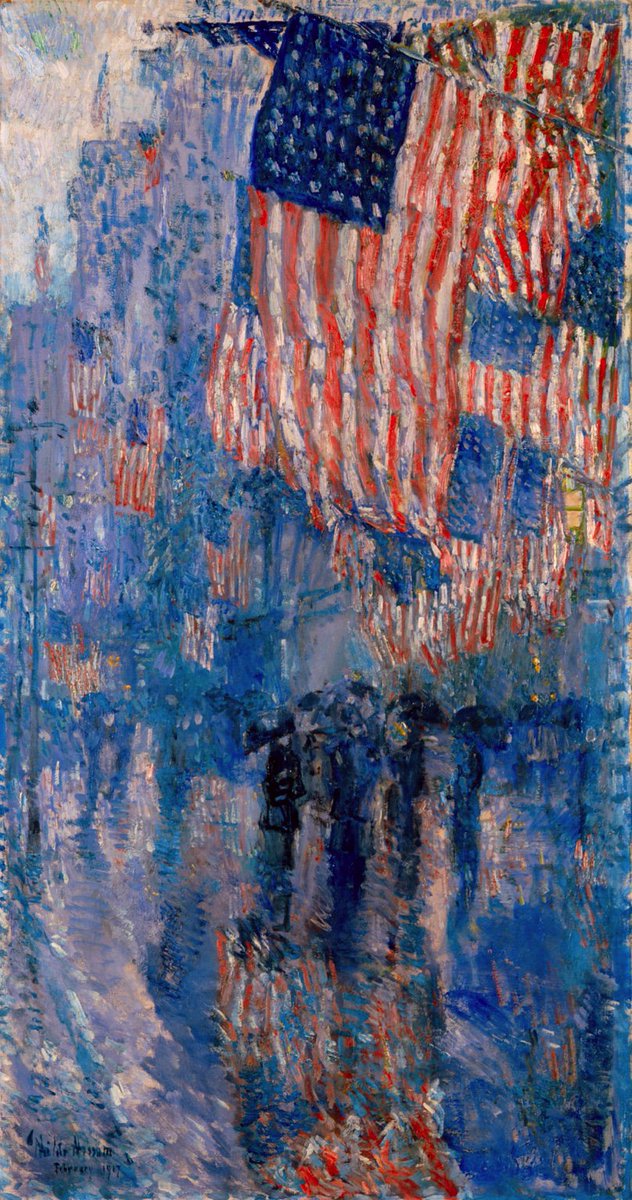
  Childe Hassam, The Avenue in the Rain, 1917

Song For America on Independence Day

From America's Progressive Rock Band Kansas (all the other 1970s Prog groups were either European, or Rush, Canadian).

This is a very cool tune; though the lyrics are kind of "down with America." Writer Kerry Livgren is now arch-conservative (as are some, though not all members of the band). I doubt he feels the same way now. Though a crunchycon, paleocon, yeoman farmer glorifying type could still get into the sentiment.

Sunday, July 3, 2016

Indy Eve

The Christian Roots of the Founding

As Matt Barber noted in his article at the unabashedly right-wing World News Daily:

“The general principles on which the fathers achieved independence were the general principles of Christianity,” observed John Adams, our second U.S. president. “I will avow that I then believed, and now believe, that those general principles of Christianity are as eternal and immutable as the existence and attributes of God.”

So what were these general principles, and what's so "Christian" about them?  As modern day philosopher Jürgen Habermas [who describes himself as a "functional atheist"] notes:

Egalitarian universalism, from which sprang the ideas of freedom and social solidarity, of an autonomous conduct of life and emancipation, of the individual morality of conscience, human rights and democracy, is the direct heir of the Judaic ethic of justice and the Christian ethic of love. This legacy, substantially unchanged, has been the object of continual critical appropriation and reinterpretation. To this day, there is no alternative to it. And in light of the current challenges of a postnational constellation, we continue to draw on the substance of this heritage. Everything else is just idle postmodern talk.

Unfortunately, many who seek to control our historical narrative today seem unaware of these theological and philosophical underpinnings of the American experiment, that of fundamental equality. The mentions of God in the Declaration are not to be minimized or waved away, for without
We hold these truths to be self-evident, that all men are created equal, that they are endowed by their Creator with certain unalienable Rights
the Declaration is merely the political manifesto that today's secular revisionists sometimes make it out to be.

"And can the liberties of a nation be thought secure when we have removed their only firm basis, a conviction in the minds of the people that these liberties are of the gift of God?," asked another Founder.

We seem increasingly determined to find out.

Praying to the Same God during the Revolutionary War

Every July 4th many articles appear attempting to tell us what the Declaration of Independence and American Revolution stood for. Christian nationalist sites will tend to offer explanations that support their thesis. See for instance, this one by Matt Barber which features a lively commentary section.

One of the commenters aptly noted that:
The British believed in the same god and went to the same churches the colonists did. Both sides prayed to the same god with the same prayers and rituals and expected the same god to be on their side. Whether British or colonial born, the burial rituals for the dead - civilian or military - were the same and with the same expectations of heaven for the just. The same can be said of their marriage rituals, as well.
This is true. It foreshadows President Lincoln's observation that the men who fought on opposite sides of the Civil War believed in and prayed to the same God.

The Declaration of Independence is not a Christian document. It's a generically theistic document. It mentions a God of some sort in 4 different places. It doesn't mention Jesus, the Trinity, or quote verses and chapters of scripture for its authority.

Yet the masses in both Great Britain and America at the time accurately are described as "Christian." As the previous article Tom Van Dyke discussed argued, God was invoked in America's DOI for reasons of necessity (I'm not arguing the beliefs were insincere).

Lino Graglia, in a somewhat cynical sense, described the necessity:
What [the Declaration] is, of course, is a document meant to justify revolution -- that is, illegal action. Having no human law to rely on -- being in defiance of authority -- revolutionaries necessarily come to rely on the law of God, who, happily, rarely issues a protest.
Even if we do not concede the unlawfulness of the American Revolution, it's hard to argue with the notion that when you go to war, especially against a greater power, it helps to have or think you have God on your side. It's not that there are no atheists in foxholes. It's that there aren't that many of them.

A Marxist like political movement fueled by sincerely held liberation theology, in my opinion, will be fought at the ground level with more motivation than an atheistic fueled Marxism. (Most perhaps the vast majority of communist soldiers were not atheists regardless of what their governments' official creed posited.)

Christians have fought wars on behalf of Christianity and against other religions. That's not what was going on in the American Revolution (obviously). Christians have also fought sectarian wars against one another. Like the Catholics and Protestants fighting in Ireland. That's not applicable to the American Revolution either.

Great Britain was (and still in a sense is) a more "officially" Christian nation than American in that it had (has) an established Anglican Church. But the American Revolution could hardly be seen as a war against Anglicanism in that, ironically, so many of America's revolutionary figures were themselves Anglicans. George Washington, Thomas Jefferson, James Madison, Patrick Henry, John Jay and others.

[Perhaps it was a war against a particular kind of Anglicanism: doctrinaire high church Anglicanism which basically taught Toryism as a political theology. But that Church in both Great Britain and America, thanks to its latitudinarianism, contained a great deal of members who didn't believe in such. Otherwise all of those above mentioned revolutionary figures would have fought for the other side.]

Both Great Britain and America had a plurality of Christian sects. GB handled it by privileging Anglicanism but tolerating the others. America handled it at the state level.

Thus, the American Revolution was not about Christianity or religion, one way or the other.

Saturday, July 2, 2016

Comments on WHY GOD IS IN THE DECLARATION BUT NOT THE CONSTITUTION

A recent discussion with historian John Ragosta at the
Page one of the original Constitution of the United States. (U.S. National Archives)

  JOHN RAGOSTA
Good piece. Many sources note that the state constitutions included various religious tests when the U.S. Constitution was adopted, but far fewer note that the states uniformly moved in the direction of a clear separation of church and state. This was not to create an empty, godless public square, but to get government out of religion and religion out of government. See Religious Freedom: Jefferson’s Legacy, America’s Creed.
  • but far fewer note that the states uniformly moved in the direction of a clear separation of church and state. This was not to create an empty, godless public square, but to get government out of religion and religion out of government
    But what even fewer note is that the Constitution does not require such strict separation! Contrary to prevailing opinion and current judicial interventions, it was up to the individual states to decide how more or less religious they would be.
    That is the point of reminding folks that religion was left up to the states, something even Jefferson acknowledged.
    “This results not only from the provision that no law shall be made respecting the establishment, or free exercise, of religion, but from that also which reserves to the states the powers not delegated to the U. S. Certainly no power to prescribe any religious exercise, or to assume authority in religious discipline, has been delegated to the general government. It must then rest with the states, as far as it can be in any human authority.”
    –Letter to Rev. Samuel Miller, 1808
    And FTR, Jefferson’s context of “church and state” was sectarianism, that the ruling Congregationalists might mess with Danbury, Connecticut’s Baptists. A long way from the current crisis.

Wednesday, June 29, 2016

American Creation Helps Keep Scholars and Others Honest on America's Founders' Religion

Long story short. Back in February an historian from Biola named Susan Lim wrote a more or less fair and good article on the topic for "Christianity Today." Like David McCullough, she left out John Adams' unitarianism from the story, giving the impression he was a "Puritan." A PhD named Matthew Hunter caught this and contacted her. And he cited both me and co-blogger Tom Van Dyke (you can read Dr. Hunter's post to find out which America Creation posts he cited). John Fea tells us about it.

I think David McCullough is a fine scholar. Perhaps he wrote on Adams with a disinterest in the finer theological details of things and expected his popular audience to share that disinterest. The readers of "Christianity Today" and scholars at Biola aren't, I don't think, supposed to share such disinterest. Dr. Lim followed the same path that the pious pastor named Joel Mark I discussed the issue with years earlier in that linked to AC post did: Read David McCullough's account of John Adams and assume he was a pious Christian of the Puritan persuasion.

(As for the title to Dr. Lim's article, she noted this about Alexander Hamilton's faith: "Like most faith journeys, Hamilton’s ebbed and flowed between skepticism and belief." She could have elaborated further that while he rose to fame and did his "work" founding the nation he wasn't an orthodox Christian, but that "other" in between category. He didn't convert until after his political life came crashing down and his son died.)

Tuesday, June 28, 2016

A note to our readers: Never Mind—The Constitution is Obsolete

What a relief!  As it turns out, this has all been a gigantic waste of time.  As celebrity intellectual and federal judge Richard Posner writes at the leftist website Slate:

And on another note about academia and practical law, I see absolutely no value to a judge of spending decades, years, months, weeks, day, hours, minutes, or seconds studying the Constitution, the history of its enactment, its amendments, and its implementation (across the centuries—well, just a little more than two centuries, and of course less for many of the amendments). Eighteenth-century guys, however smart, could not foresee the culture, technology, etc., of the 21st century. Which means that the original Constitution, the Bill of Rights, and the post–Civil War amendments (including the 14th), do not speak to today. David Strauss is right: The Supreme Court treats the Constitution like it is authorizing the court to create a common law of constitutional law, based on current concerns, not what those 18th-century guys were worrying about.
In short, let's not let the dead bury the living.

About time the Left were honest with us about what they really think.  Screw the Constitution and the horses it rode in on.  Let the good times roll!

Saturday, June 25, 2016

Popes & Persecutors of Rome, England, Holland or Geneva

The charge I make against William Livingston -- that he was a member of the Presbyterian Club, but disagreed with its doctrines -- is one I need to further explore. I spent a few hours tracking down the quote I put in the title.

It occurred in his "A Vindication of the Moravians, against the Aspersions of their Enemies,” The Independent Reflector, January 4, 1753.

He refers to "Popes" and "Persecutors" as being from "Rome, England, Holland or Geneva." The first two refer to Roman Catholic and Anglican Churches. The latter two refer certainly to Calvinistic Presbyterians and perhaps (Dutch) Arminians.

Livingston was already at this time -- when he defended "primitive Christianity" against "orthodoxy" -- formally/nominally affiliated with the Presbyterians. He joked about this when he wrote his satirical attack on the Anglicans' 39 Articles of faith and prefaced it with the aside:
It is well known that some have represented me as an Atheist, others as a Deist, and a third sort as a Presbyterian. My creed will show that none have exactly hit it. For all which reasons, I shall cheerfully lay before you the articles of my faith. * * *
Livingston's "articles" were written around the same time as his defense of the Morvaians, 1753.

I don't see any evidence he changed his position over time. I have shown Livingston continued to dislike the Athanasian Creed until the end of his life. I have also shown that in 1778, while Governor of New Jersey, Livingston is describing himself as "more than half a Quaker" while decrying Protestant Popery that persecutes.

I briefly encountered some sources, while researching this post, that spoke of a Presbyterian-Quaker "meeting of the minds" theology that occurred during this time. I'm still trying to wrap my mind around that one. But then again, the Presbyterians gave birth to both the Socinian Joseph Priestley and the Calvinist turned Arminian turned Universalist Benjamin Rush.

William Livingston Hated Creeds & St. Athanasius' as of 1787

Doctrinaire Calvinists, as good "reformed Protestants" adhere to, among others, the Athanasian Creed. William Livingston, one of America's Founders, was born in 1723. I have written much about William Livingston's "primitive Christianity" that included, among other things, his personal rejection of official Presbyterian doctrine, even though ironically, Livingston was a member of the Presbyterian Club.

So a blogger takes issue my understanding here and here. He argues Livingston a genuine orthodox Calvinist Presbyterian and notes 1. My understanding of Livingston's religion comes from his writings in the Daily Reflector written when Livingston was 27; 2. that "Livingston never rejected the [A]thanasian [C]reed"; and 3. that if Livingston "was [A]rminian, it's a bigger scam than what [M]adoff did."

Well, Livingston rejected the Athanasian Creed in in November 1787  at age 64 (or almost) roughly three yeas before his death, just like he did when he was in his 20s. That Livingston rejected the Calvinism of the Presbyterian Church with which he was affiliated doesn't necessarily make him an "Arminian." The distinction between the two could be a false dichotomy if presented in an either/or sense.

But if Livingston being affiliated with a church, even in a mighty leadership position, in whose official doctrines he didn't believe makes him a "Madoff," that's not my judgment to make. I will just note the record shows he did indeed reject the official doctrines of said Presbyterian Church.

Primitive Christianity, Reformation, Restoration, Scripture & Canon

Wow, lots of words there.

As it relates to the American Founding, I've noted the Quakers, Christian-Deists & Unitarians, and perhaps some of the orthodox Christians had an affinity for "Primitive Christianity." What it means is that Christianity before it was corrupted by the clerical class. The Roman Catholic Church were the biggest villains. But Anglicans, Calvinists and others -- especially if they were "fundamentalist" on their churches' doctrines and creeds -- were suspect.

All sincere believers wish to "get it right." And they all agreed it was "right" when Jesus existed and instructed His followers. So to the extent that others have it wrong, everyone wants to "restore" the original teachings and practices of Jesus to correct other people's errors (or at least not be personally subject to them).

To the extent that things went wrong, it came shortly thereafter.

My research shows however, that those who endorsed "Primitive Christianity" thought that by the time the Council of Nicea occurred (325 AD) the Church was already "corrupted." Martin Luther wouldn't be a good "primitive Christian." He thought that the early church during this period was doing the right thing in "filling out" the faith with doctrine. Ditto with Calvin.

They were "reformers" who wished to "reform" the "catholic" (universal) church into something layered with sophisticated doctrine, just correct Rome's errors. 

Interestingly, "the Bible" as a canon was not fully settled until around the late 4th Century. Believers always had books of scripture they thought inspired. But the Early Church Fathers dickered on the exact details. And even when they "settled" it by writing the Vulgate, disputes continued and continue to this day regarding which exact books belong. (The Catholic, Eastern Orthodox and Protestant Bibles all contain different numbers of books.)

So to a primitive Christian, what we think of as "The Bible" would have been compiled by a corrupted church. We should thus see how this could inspire the Christian-Deists and Unitarians to continue to "edit" the canon, with Thomas Jefferson as the most notorious example.

But because primitive Christians took their faith seriously, there would still be certain essentials of the faith that were non-negotiable. They wouldn't include orthodox Trinitarian doctrine or belief in the divine inspiration of every word "the Bible" (whichever canon one adheres to).

This is essentially (if I understand him right) what John Locke taught in "The Reasonableness of Christianity."

Finally, those anathematized by the Nicene and Athanasian Creeds have incentive to look before to a golden era of "primitive Christianity" in order to justify their beliefs. This would include not just Christian-Deists and Unitarians, but also today's Mormons and Jehovah's Witnesses. And the Quakers who don't believe in creeds.

Wednesday, June 22, 2016

Hillsdale College Online Courses: "Was America Founded a “Christian” Nation?"

Check it out here. A taste:
Transcript:

John J. Miller:

Now, this is the most popular subject for debate on the discussion board. Let me boil it down to a simple question. Is America a Christian nation?

Mark Kalthoff:         

Well, that's a hot question. ...

Wednesday, June 15, 2016

Interview with Sam Haselby

Sam Haselby, historian and author of the book, The Origins of American Religious Nationalism, gave an interview with dailyhistory.org. 
A taste:
"I have argued that James Madison and Thomas Jefferson were visionary secularists and that they launched what was a historic, if ultimately faltering, and kind of feeble secularization project. That is true. Other notable Americans of the revolutionary era were acutely Protestant. Patrick Henry and John Jay, for example. They were deeply religious and wanted the US to be so too. So was Timothy Dwight. So were many, many others of the revolutionary generation. Most people probably wanted the US to be a devout country. But there was no agreement on what that meant. The range of positions was broad, very broad.
It is crucial however to understand that 'Christian nation' has always been a term of bigotry and exclusion. First, when Americans of the 18th and 19th century used the term they were saying Catholics were not Christians. Then--as now--most Christians in the world were Catholic. It makes no sense to call a country hostile to most of the world’s Christians a 'Christian nation.'”
You can read the rest of his interview here:

William Livingston, The Moravians, Primitive Christianity

In my last post I noted the Moravians might be like the Quakers in their belief in simplistic primitive Christianity. I crossed out that parenthetical clause because after researching them further, I'm not so sure. I don't know enough about them yet to make that assessment.

I do know that William Livingston, who loved the Quakers, also defended the Moravians. The Moravians were viewed as "heretics." Livingston was an anti-heresy hunter.

That was the point of "primitive Christianity." As George Washington once put it, "[I]n religion my tenets are few and simple."

It was this doctrinal indifference that permitted religious pluralism to flourish in the American Founding. That's the thesis to  Chris Beneke's "Beyond Toleration: The Religious Origins of American Pluralism."

Beneke argues that Livingston's proposed Christianity was "devoid of theological content." To Livingston "Christ was the promised Messiah" whose moral instruction ought to be followed. But the contents of that instruction could be "contained in a sheet of paper."

This was "primitive Christianity."