Thursday, June 10, 2010

Richard Hooker in the Declaration of Independence

The Founders stood on the Shoulders of Giants,
who stood on the Shoulders of Giants
by Tom Van Dyke


"This equality of men by nature, the judicious Hooker looks upon as so evident in itself, and beyond all question..."---John Locke, Second Treatise of Civil Government [1690]

"We hold these truths to be self-evident, that all men were created equal..."---the American Declaration of Independence [1776]


Upon those very few words and that proposition, that all men are created equal, America as we know it rests.

So who is this "judicious Hooker," who died in 1600? Not a fair-minded Lady of Delight, but a philosopher-theologian named Richard Hooker, formally Rev. Richard Hooker of Exeter, England, the "Father of Anglicanism."

As a theologian, he helped negotiate a "third way" for Anglicanism [Church of England, known as "Episcopal" in the US] between the reforms of Protestantism and the Roman Catholic origins of the English Church.

As a theologian, he came down Protestant; however, in his 1593 Of the Lawes of Ecclesiastical Politie, he was mellow about theological disagreements among Christians and made the theological argument for "tolerance" and against doctrinal "purity": basically, that God doesn't care all that much about which church believes what, that grace falls on all Christians, and he even planted the radical idea that non-Christians weren't necessarily Damned for All Time.

Back in 1593, Rev. Hooker was tracing the outlines of the American political theology almost 200 years later.

As a philosopher, Hooker was a follower of Aquinas' system, a "Thomist," or an "Aristotelian-Thomist," if one prefers. John Locke often used "the judicious Hooker" as his starting point in his writing. American Founder James Wilson, who signed the Declaration and was one of the major voices in the Framing, also referred to him as "the judicious Hooker."

Although Hooker opposed papism [the Roman Church], Pope Clement VIII himself said of his book: "It has in it such seeds of eternity that it will abide until the last fire shall consume all learning."

King James I, he of the "Divine Right of Kings" controversy: "I observe there is in Mr. Hooker no affected language; but a grave, comprehensive, clear manifestation of reason, and that backed with the authority of the Scriptures, the fathers and schoolmen, and with all law both sacred and civil."
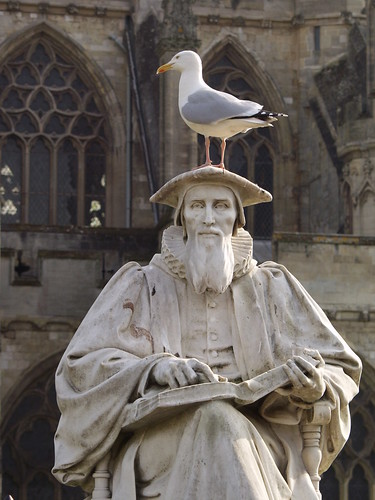


The statue of Richard Hooker in Exeter is revered by man and beast alike, and small wonder. Here was a giant, who's still studied for his brilliance [and kindness] in the 21st century by theologian and philosopher alike, upon whose shoulders Locke and Jefferson and the Founders, and we the living, still stand.

We can't tell the story of religion and the Founding without Richard Hooker, and there's so much more work to be done: how he was in the air, his thoughts taken for granted as self-evident.

Here was a man, a giant of a man. We breathe him, and stand upon him, even to this day.

Wednesday, June 9, 2010

We're Now On Twitter

I am pleased to announce that American Creation is now on Twitter! That's right, we've finally arrived in the 21st century. Follow us on Twitter at this link. You can also follow American Creation on Facebook by clicking on this link (where we have some excellent discussions as well). And again, thanks for all the support!

Without A Creed

Pages 79-81 of James H. Hutson's fine book of quotations list the Founding Fathers' view of creeds. Every quote he reproduces is negative towards the traditional orthodox creeds. And that includes those from Benjamin Rush and John Jay who are closer to orthodox Christian than are the "key Founders."

This is, my readers know, one reason I see Peter Lillback's case for George Washington's "orthodoxy" seriously flawed. Because Lillback can't prove GW's Trinitarianism from his own words he has to look at GW's church's creeds and confessions, to which GW at times took oaths. Yet, those creeds and confessions were tainted with Toryism which we know GW rejected. The larger reality is many Founders, including many who were more identifiably "orthodox Christians," couldn't care one whit about their church's creeds and confessions.

Now, like some of today's evangelicals, they could be orthodox without a creed on the basis that "the Bible teaches this." I don't need no stinkin' creed to prove the Trinity, etc.; it's in the Bible. That line of thought ignores the centrality that creeds played in establishing and maintaining orthodox Trinitarian doctrine.

And "orthodox without a creed" also permits "Christian Americanists" to glean from particular churches' teachings that which they value -- what they see as "biblical" -- and discard the rest. For instance, evangelicals generally don't value the residual Roman Catholic rituals contained in the creeds of the Anglican Church.

That's fine if you can prove with their own words that such a Founder believed in orthodox doctrine from their reading of Sola Scriptura. Or perhaps a Founder explained exactly what it was about their church's creed(s) that they valued, what they thought should be changed.

But, at this level of scrutiny, we lose the ability to use creeds and official doctrines of churches as "shorthand" for what a Founder believed. Without relying on official Anglican doctrine, there is no case for GW's orthodoxy. George Washington mentioned the words "Jesus Christ" only ONCE in all of his 20,000 pages of officially recorded words. And that was in a public address written by an aid.

Or what about John Jay, who is generally conceded as one of the more traditional Christian Founding Fathers? He too was a lifelong Anglican-Episcopalian.

But on the matter of creeds he wrote:

"In forming and settling my belief relative to the doctrines of Christianity, I adopted no articles from creeds, but such only as, on careful examination, I found to be confirmed by the Bible."


But such Sola Scriptura without creeds led Jay to doubt the Trinity. From the same letter to Samuel Miller, Feb. 18, 1822, Jay writes:

"It appeared to me that the Trinity was a Fact fully revealed and substantiated, but that the quo modo was incomprehensible by human Ingenuity. According to sundry Creeds, the divine Being whom we denominate the second Person in the Trinity had before all worlds been so generated or begotten by the first Person in the Trinity, as to be his coeval, coequal and coeternal Son. For proof of this I searched the Scriptures diligently -- but without Success. I therefore consider the Position of being at least of questionable Orthodoxy."


Bible minus creeds may lead some folks to orthodox Trinitarianism. But, without question, such risks a quasi-Quakerism where one becomes wishy-washy on orthodox Trinitarian doctrine.

(The Quakers distinguished themselves as "Bible believing Christians" who had no creed; they also, during the Founding era, were wishy-washy on the Trinity and did NOT hold it central to their form of Christianity.)

John Jay is exhibit A.

Tuesday, June 8, 2010

Repeal the 17th Amendment!

I ran across this riff on the internet a year or two ago. I laughed---more far-right swamp fever. Reverse the direct election of senators instead of the state legislatures appointing them. 17th Amendment, ratified 1913. Many Americans would be surprised we only voted directly for our senators since 1913.

"Let the state legislatures appoint the Senate," Virginia's George Mason urged at the Philadelphia Convention of 1787, lest a newly empowered federal government "swallow up the state legislatures." The motion carried unanimously after Mason's remarks.


Amending the Constitution has been a rare, well-considered, and largely successful thing. We've only had 27 amendments in 200+ years, and the first 10, The Bill of Rights, were pretty much a promised and required fix-it ticket to get the original Constitution ratified.

---The 12th fixed the technical problem of Aaron Burr and Thomas Jefferson getting the same number of votes in the electoral college. Nobody actually wanted Burr for president. Now, the electoral college must have two separate elections for president and vice president. No big deal there.

---The 13th freed the slaves. Cool.

---The 14th Amendment. Let's just say "original intent" might have phrased it better. Most constitutional hassles these days ride on whateverthehell it might mean.

---The 15th gave all males the right to vote, including ex-slaves. [The 19th, females, too.]

---The 16th established a constitutional right for the federal government to impose an Income Tax. Well, it was what it was and it is what it is. Any discussion of it is swamp fever. Sorry, Mr. Snipes.

---The 18th banned booze. The 21st repealed it. [Hurrah!]

---The 22nd, in reaction to FDR's 4 consecutive terms, limited presidents to only two. Questionable in some, many, or most quarters, since the only president it really affected was Bill Clinton, who would have run again. He loved being president. And despite his trevails in office, by any and all accounts would have defeated any GOP candidate and won a 3rd term.

---The amendments I skipped are largely procedural, like giving 18-yr-olds the vote [#26].

So, what of the 17th Amendment, you may ask, and surely you are by now if you've read this far. What the hell are you on about now, TVD?

I think it's the difference between democracy and republicanism. Before the passage of the 17th, most states appointed their senators, by vote of the state legislature. Representative democracy via representative democracy. Republicanism.

Full story at Wiki
, reasonably accurate.

Federalism, that senators were forced to be responsible to the concerns of their states, or at least those of their state legislatures. Devolvement of power, of demagoguery that's more suited to the House of Representatives, or just frustrating the will of the people by putting the pols in the state legislature in their way?

I don't have a clear and coherent opinion on this. I do know that a charismatic [or, wielding the power of incumbency] senator can win the popular vote most every time. By accumulating power and financial clout [contributions from outside his state], he can become invulnerable to election challenges, and accountability to the few in his state who actually pay attention to politics, and his record. No president enjoys such unaccountability to his constituents.

On the other hand, a senator is supposed to be a "cooling" force against the passions of the day. That's why James Madison---quite brilliantly in Federalist 63---set Senate terms at 6 years, even longer than the president's.

Anywayz, after poking through the history and the arguments, what I wanted to open is that "Repeal the 17th Amendment" isn't just swamp fever.

I thought Bill Clinton was a pretty good president. I don't think the question or clarion call will arise with President Obama, but mebbe we should repeal the 22nd, just in case another Bill Clinton shows up. As one wag once said, we could do worse, and often have.

ATTENTION: American Creation Blog Now Rated PG-13

From iowntheworld.com via Drudge:


Monday, June 7, 2010

John Adams, Zionist

In response to a recent inquiry in our comments section about Helen Thomas bringing a Jimmy the Greek-style close to a long career, one Founder's view:

"How is it possible [that Voltaire] should represent the Hebrews in such a contemptible light? They are the most glorious nation that ever inhabited this Earth. The Romans and their Empire were but a Bauble in comparison of the Jews. They have given religion to three quarters of the Globe and have influenced the affairs of Mankind more, and more happily, than any other Nation ancient or modern." [1808]


In 1819, Adams wrote to American Zionist Mordecai Manuel Noah:

"Farther I could find it in my heart to wish that you had been at the head of a hundred thousand Israelites . . . & marching with them into Judea & making a conquest of that country & restoring your nation to the dominion of it. For I really wish the Jews again in Judea an independent nation."


Of course, Adams rather impertinently continues that the Jews could then convert to his unitarian brand of Christianity, but that's John Adams:

"I believe [that] . . . once restored to an independent government & no longer persecuted they [the Jews] would soon wear away some of the asperities and peculiarities of their character & possibly in time become liberal Unitarian Christians for your Jeh-vah is our Jeh-vah & your G-d of Abraham Isaac and Jacob is our G-d."


"Asperities and peculiarities of their character." To a Jew. Ah, John Adams, the Joe Biden of his age, God love him.

All research by Michael Feldberg at sullivan-county.com.

George Washington Wouldn't Have Had a Problem with "The Shack"

From what I've read about it. I'm basing my views on the "orthodox" criticisms of this book. From the link:

For those who are unaware, it is critical to realize that William Paul Young espouses the heretical teaching known as Universal Reconciliation (condemned by the church since 533). This accounts for his heterodox views (e.g., faulty views of the Trinity, Biblical revelation, Christology, eternal punishment, etc…).


Every single above listed "heresy" was embraced by many "key American Founders" and the theologians and philosophers they followed.

I'm not sure if GW embraced "universal reconciliation"; I suspect he did. One thing we do know is he had absolutely no problem with those who did.

This is the link to the book's official website.

Sunday, June 6, 2010

Great Discussion on the Foundation of Rights

A good and productive discussion about the foundation of rights has broken out in the comments section of my last post. The following is a comment that was left by Chris that sparked the discussion:

"I don't think it's surprising that, at least in primary and secondary schools, the Schoolmen are "forgotten." They have two things going against them: 1.) They were writing within a fairly narrow context (everything was Christian and Paripatetic, and not necessarily in that order since their Christianity was so distinctly Greek), making their work somewhat esoteric to contemporary readers and 2.) While they were undoubtedly influential among the early moderns, the early moderns either altered their ideas or expressed them in a way that is much easier for non-experts today to make sense of; certainly easier than it is for them to make sense of Scotus or Bonaventure directly.
That said, I wonder who you're directing this sort of thing at. Historians of ideas have never doubted or underplayed the influence of the Scholastics on the early moderns. If intellectual historians of the American founding have, then that says all I need to know about that particular field's rigorousness. And if you're merely after the rabid "secularists" (seriously, how many of these are there? and how many as compared to the number of "Christianists"?), then you're plaints are likely to fall on deaf ears, as they are either well aware of the Christian dominance of western thinking even through the early modern period (seriously, you don't even need the Scholastics to point this out), but find it irrelevant to the larger point, or they are simply blinded by prejudice and beyond reasoning with."

I responded with this:

"My goal is to bring this history back into the light. It is the history of the birth of inalienable rights grounded in equality. There are some scary Scientists out there who cannnot coherently tell you what a human is in their worldview. I look at Rwanda, Nazi Germany, The Balkans and see that dehumanization is the foundation of genocide. We untie ourselves from our Christian sense of justice to our own peril."

Chris then responded with this:

"KoI, I couldn't disagree more, on so many grounds. One, inaleniable rights grounded in equality predates Christianity, as I am sure you know, and therefore doesn't logically require it. Two, while Christian does put its own spin on the metaphysical source of equality, this does not mean we can't learn from them (and Seneca, say), and ground it in something else. This is, in fact, what many if not most modern philosophical conceptions of justice have done, producing, some would argue, even better versions of equality and justice.  Next, not only do equality-bases inalienable rights predate Christianity, but so does the claim that separating these sorts of things from god/the gods. Read your Aristophanes. If separating them from Zeus and his ilk, or their Roman counterparts and their ilk, isn't metaphysically problematic, why should we believe that separating them from the Christian God would be?"
Tom Van Dyke provided a link to this enlightening article and the following comment that I think shows the slippery slope of rights not grounded in imago dei:

"The fact is that in a state with limited resources, the more that is spent on keeping alive the severely impaired, the less there is left for spending on schools and medical research. Tough choices have to be made. Many children, even in the developed world, have terrible upbringing and poor education. Devoting more funds to this would make a massive difference to those children’s lives. Given that a society cannot do everything, it is not entirely obvious that spending perhaps hundreds of thousands of dollars a year on keeping alive a single severely impaired person, rather than transforming the life chances of dozens of children, is the right thing to do."

FDR's D'Day Prayer

Doesn't have anything to do with early America but it is a president giving a prayer:

Saturday, June 5, 2010

The difference between a republic and a monarchy


"A monarchy is a merchantman, which sails well, but will sometimes strike on a rock and go to the bottom, whilst a republic is a raft which will never sink, but then your feet are always in water."

- Fisher Ames (1758-1808), American founding father.

Everything old is new again, part 2

The Washington Post is running a story on a series of classes being held around the country; the classes are based on the premise that the wisdom of the Founders contains the answers to the problems we face today.  Here's the story:  Conservative class on Founding Fathers' answers to current woes gains popularity.  (Hat tip to The Western Confucian.)

While the background and content of the courses looks more than a little dodgy, the impulse behind looking to the wisdom of the Founders is a recurring phenomena in American civic life, and is one of the reasons why balanced historical scholarship on the Founding period is so important.  Bad scholarship can lead us to draw the wrong conclusions about the past, and when we look to the past to guide us in future behavior, bad scholarship can lead us seriously astray.  While the idea of having civic groups meet to study the Founders' ideas and their relevance for today is a great one -- I wish these sorts of study groups were very common across the country -- they really won't do much good if all they offer is a candy-coated and ideologically-driven presentation of the Founders' ideas.

And of course, this isn't just a problem that bedevils conservative groups that are getting all the attention today.  The ideological manipulation of American history is as much a part of the tradition of the Left as it is of the Right.  And in either case, it isn't helpful.  Again, this doesn't mean that history can be presented in a completely neutral fashion -- but it does mean that a white-washed view of history, one that overlooks aspects of of the Founding period that is uncongenial to one's own ideological views, isn't being honest to the Founders as they actually were.

So, along with the good things about the Founders (however me might define those things), we need to address the bad things about them as well.  For every scrappy Alexander Hamilton working his way up from poverty to influence based on his wits and the sweat of his brow, there is an aristocrat like Thomas Jefferson propounding the principles of liberty while his slaves toil by the sweat of their brows to afford him the luxury of his principles.   We need to tell the full story, to see the Founders as great men, but like all men limited and frail and (if I am allowed to use some religious language) sinful.  Otherwise, in our ideological narrowness, we will miss some of the most important lessons that the Founders' have to teach us.

Thursday, June 3, 2010

George Washington's "Gods"

Boston 1775 has the 411. The post, I think, illustrates the perils of reading George Washington's (and other "Founders'") God terms too literally when looking to "find" a particular meaning in them. Using Peter Lillback's method, this letter of Washington's would positively prove that he was a polytheist.

Chris Rodda: No, Mr. Beck, Congress Did Not Print a Bible for the Use of Schools

See here.

Darryl G. Hart On If George Washington Is Orthodox, What About Barack Obama?

Here. Outstanding post. Barack Obama's words are far far more explicitly "orthodox Christian" than George Washington's were. If we do a Lillback to Obama, we could make him look like a conservative evangelical.

Wednesday, June 2, 2010

The Scholastics: A Forgotten History II

This essay by Lew Rockwell highlights some of the roots of free market ideology as expounded on by the late Scholastics at the School of Salamanca in the 16th Century. I understand that since most of the founders were anti-papists that many seem to doubt the influence of Roman Catholic thinking on American Creation. Nonetheless, the fact that much of this thought was produced in famous European universities would seem to point to it being in the air when many of the ideas that finally took root in the founding were being formulated. Either way, this essay directly challenges Goldstone's view of what the central characteristics of European history and culture were as quoted in one of my recent posts.

Here is a taste:

"Students of free enterprise usually trace the origins of pro-market thinking to Scottish professor Adam Smith (1723-90). This tendency to see Smith as the fountainhead of economics is reinforced among Americans because his famed book An Inquiry into the Nature and the Causes of the Wealth of Nation was published the year of American independence from Britain.
There is much that this view of intellectual history overlooks. The real founders of economic science actually wrote hundreds of years before Smith. They were not economists as such, but moral theologians, trained in the tradition of St. Thomas Aquinas, and they came to be known collectively as the Late Scholastics. These men, most of whom taught in Spain, were at least as pro-free market as the Scottish tradition came to be much later. Plus, their theoretical foundation was even more solid: they anticipated the theories of value and price of the “marginalists” of late-nineteenth-century Austria.[1]
If Italian city-states began the Renaissance of the fifteenth century, Spain and Portugal explored the new world in the sixteenth, and emerged as centers of commerce and enterprise. Intellectually, Spanish universities spawned a revival of the great Scholastic project: drawing on ancient and Christian traditions to investigate and expand all the sciences, including economics, on the firm ground of logic and natural law.
Because natural law and reason are universal ideas, the Scholastic project was to search for universal laws that govern the way the world works. And though economics was not considered a separate discipline, these scholars were led to economic reasoning as a way of explaining the world around them. They searched for regularities in the social order and brought Catholic standards of justice to bear on them.
The University of Salamanca was the center of Scholastic learning in sixteenth-century Spain. The first of the moral theologians to research, write, and teach there was Francisco de Vitoria (1485-1546). Under his guidance, the university offered an extraordinary 70 professorial chairs. As with other great mentors in history, most of Vitoria's published work comes to us in the form of notes taken by his students.
In Vitoria's work on economics, he argued that the just price is the price that has been arrived at by common agreement among producers and consumers. That is, when a price is set by the interplay of supply and demand, it is a just price. So it is with international trade. Governments should not interfere with the prices and relations established between traders across borders. Vitoria's lectures on Spanish-Indian trade—originally published in 1542 and again in 1917 by the Carnegie Endowment—argued that government intervention with trade violates the Golden Rule."
Maybe the Enlightenment did not drop in out of nowhere to set all the backwards Christians straight as some seem to imply? It also makes me wonder what the world would be like today if the great explorers of the 16th Century would have listened to Las Casas and his predecessors?  Cortes had the chance and dropped out.

The Scholastics: A Forgotten History

This essay by Leonard P. Liggio of the Acton Institute highlights some important parts of European history that seem to be absent in the modern classroom as I alluded to in my last post. Here is a taste:

"The Yucatan was the center point of one of the most im- portant moral debates in history. It can be summarized in the title of the book, In Defense of the Indians: The Defense of the Most Reverend Lord, Don Fray Bartolome de Las Casas, of the Order of Preachers, Late Bishop of Chiapa, Against the Persecutors and Slanderers of the Peoples of the New World Discovered Across the Seas. The Friar and Bishop, Bartolome de Las Casas, defended the Native Americans against the charge of those who wished to enslave them and kill them in the process–the charge being that Native Americans were not fully human, that they lacked the intellectual and religious capacity of Europeans.
The argument put forward by Las Casas is captured by the title of another book, All Mankind Is One (by Lewis Hanke), a study of the disputation before the Council of Castile between Bartolome Las Casas and his opponent Juan Gines de Sepulveda in 1550 regarding the intellectual capacity of the American Indians. Las Casas had introduced into Castile and Europe a new debate. Spain had recently witnessed the expulsion of two of the three cultures that had existed there for almost eight hundred years. The Crown of Castile completed the expulsion of the Spanish Jews and Moslems in 1492 because of their religious diversity, but there was no question of the intellectual equality, not to say superiority, of the Jews and Moslems over the Christians.
For one hundred years before Las Casas’s writings, Portugal had been in contact with African civilizations along that continent’s western coasts. By the beginning of the sixteenth century, the BaKongo kingdom of the Lower Congo not only exchanged diplomatic representatives with the Holy See and the kingdoms of Portugal and Castile, but the son of the BaKongo king was consecrated a bishop in Rome and returned to administer his diocese in the Congo. The glorious civilizations of the African kingdoms and the successful completion of theological studies by African priests left no question of the intellectual and religious equality of the African peoples.
Thus, the claim of the Castilian conquistadors that the Native Americans were intellectually and spiritually inferior was a new charge. Indeed, it was so novel that there were no traditions in Western thought to justify it. There was nothing in the Fathers of the church–Greek, Antiochan, Alexandrian, African, Roman, or Gallic–to justify it. Nor was there anything in the seventy-six volumes of the Abbe Migne’s Patrologia Latina, nothing in the writings of Tertullian, Augustine in Africa, the Italians, Ambrose, Jerome, or the Gaullic Pelagius."

I will leave his words unmolested.  More to come...

Tuesday, June 1, 2010

Does it Really Matter if George Washington Took Communion or Not?

The following was left by D.G. in the comments section of one of Jon Rowe's previous posts on Lilliback and "Sacred Fire" that seems to echo the question that Brad Hart recently asked in his post about Gordon Wood:

"Not to take issue with my friends, Mark David Hall or David Hall (should they form band, Hall & Hall?), I'm not sure what the point of this work of historical excavation. So, what if the American Revolution was Calvinist? What does that prove? That somehow America was Christian, or that liberals or secularists have no legitimate place in the U.S.? Or does it mean, as Barry Shain might argue, American liberalism is different from its 20th century version? I have no trouble telling the difference between John Adams and FDR. Do I need to know the Calvinist resistance literature to spot that difference?
This is what I don't get. There seems to be an agenda -- that if we get the founding right with its respect for religion, then we'll get X right today. What is the X?"

What we get wrong about the founding is highlighted in this statement from Ed Brayton yesterday at Dispatches From the Culture Wars:

"There isn't a single provision in the Bill of Rights that has any concept even remotely analogous in the Bible. The Bible does not say a word about political liberty or political rights."

Ed stated this in the context of Cynthia Dunbar's clever use of a prayer offered by Chief Justice Earl Warren that implied that the Bill of Rights came from the Bible. Ed is correct in that the Bill of Rights is not found in the Bible. What he ignores is that the chief concept that Western Christian thought ties inalienable rights to, imago dei, is in the Bible. I keep bringing these continued statements up because they help frame the most relevant battle going on in the culture wars of today.

This battle seems to be over what ideas were foundational to the creation of the most free and prosperous nation in the history of the world and where these ideas came from? Jack Goldstone, in his enlightening essay  How an Engineering Culture Launched Modernity,  lays down the gauntlet here in a Brayton-like manner with a quote from Joseph Priestley:

"Nature, including both its materials and its laws, will be more at our command; men will make their situation in this world abundantly more easy and comfortable, they will prolong their existence in it and grow daily more happy. . . the end will be glorious and paradisiacal beyond that our imaginations can now conceive."
Goldstone then added the following analysis:

"This was a radical departure from the belief of almost all civilizations (including that of the classical and medieval West) that humanity’s golden age lay in the past. Instead the new engineering culture proclaimed that an earthly paradise lay in man’s future, and that it would be brought about by mankind’s own progress in developing and applying new scientific knowledge rather than by divine redemption."
He then went on to say what was perhaps the chief catalyst in the acceptance and spread of this new engineering culture:

"What I believe is most critical to insist upon is the degree to which Europe itself had to repudiate central elements of its own history and culture — the absolute authority of hereditary rulers, the prohibition of diverse religious beliefs in any one society, the elevation of the rights and needs of political and social status elites above those of ordinary inhabitants — in order to develop and implement the idea of society as a community of free individuals sovereign over a limited state. Yet this was necessary if the marriage of engineering culture and entrepreneurship was to survive and flourish, and produce the economic and technological miracles of the last two centuries."

In short, Goldstone argues that our prosperity the last 200 or so years resulted from the idea of "free individuals sovereign over a limited state" and a repudiation of the "central elements" of European history and culture: "the absolute authority of hereditary rulers." 

What he ignores is other European ideas that were foundational to the development of the idea of "free individuals sovereign" that he credits with being the chief catalyst to "the economic and technological miracles of the last two centuries."  Ideas that were central to streams of Western Christian thought. These are the ideas of men like Aquinas, Bellarmine, Hooker, Rutherford and others before them.

These ideas led to the Magna Carta, constitutional government in Aragon and other Mediterranean nations, The School of Salamanca, the protests of Las Casas over the treatment of the Aztecs, and the English Civil Wars against despotism.  Things that are not taught in school today and are generally unknown to or ignored by most cultural warriors.

When we put the American Creation into the larger context of the history of ideas and bring to light the often ignored history of Europe we begin to see a different picture than the one Gladstone and Brayton paint. One that needs to be revisited as we move from one era of human history to another. Lest we remove the moorings from the foundation and see the entire building fall as we cut ties with the Judeo-Christian aspects of our intellectual roots.

So I ask this:

In the light of all I just stated, does it really matter whether George Washington took communion or not?

From the Vault: Lillback's Sacred Fire and Washington's "God Talk"

***With the recent flood of Lillback posts here at AC, I thought I might resurrect this post that I did from a while back and see what people had to say now.***

Perer Lillback, author of the book George Washington's Sacred Fire, makes the assertion that America's first President and Commander-in-Chief was, "an orthodox, Trinity-affirming believer in Jesus Christ" (27). Lillback, who received his Ph. D. in Theology from Westminster Theological Seminary, is only the latest in a series of religious figures who have crossed over into the field of history, in an effort to "save" American history from the hands of secularists.

In Sacred Fire, Lillback presents to the reader a large collection of sources, which he feels help to prove his thesis that Washington was a devout orthodox Christian. In addition, Lillback presents evidence to counter the argument that Washington was a Deist. And while I am in complete agreement with Lillback's assessment that Washington was far from being a Deist, I still remain unconvinced of his orthodox Christian leanings.

In "Appendix Three" of Sacred Fire, Lillback puts together a collection that he calls "George Washington's Written Prayers." In reality, this collection of documents are not actual prayers but instead are an assortment of letters, general orders and presidential declarations, which Lillback passes off as Washington's "written prayers." Lillback then asserts that these "prayers" serve as concrete proof that Washington was indeed a Christian. As Lillback states at the beginning of this appendix:
One of the elements of the Christian faith that was suspect, and eventually abandoned by Deists, was the practice of prayer. This was logical since there was little purpose in speaking to a Deity who on principle had abandoned all contact and communication with his creation.

Given this understanding, Washington's lifetime practice of prayer, illustrated by these more than one hundred written prayers, is an undeniable refutation of his alleged Deism...The sheer magnitude of the umber of prayers, coupled with the expansive topics included in his prayers, give substantial credence to the universal testimony of Washington's contemporaries of his practice of corporate and private prayer.

This underscores how misplaced contemporary scholars have been in claiming that Washington was a man of lukewarm religious faith
.
(761).
With this in mind, I decided that it would be worthwhile to dissect the various "written prayers" that Peter Lillback sites in his book. After all, the language that Washington used in these prayers should be a valuable tool in determining Washington's actual beliefs.

Here are the actual phrases that Washington used in his "written prayers" to describe divinity, along with the number of times they were used:

"Providence" - 26 times
"Heaven" -25 times
"God" - 16 times
"Almighty God" - 8 times
"Lord" - 5 times
"Almighty" - 5 times
"Author of all Blessings" - 3 times
"Author of the Universe" - 3 times
"God of Armies" - 3 times
"Giver of Victory" - 3 times
"Great Ruler of the Universe" - 2 times
"Divine Protector" - 2 times
"Ruler of Nations" - 2 times
"Particular Favor of Heaven" - 2 times
"Divine Author of Life and Felicity" - 2 times
"Author of Nations" - 1 time
"Divine Being" - 1 time
"Allwise Dispenser of Human Blessings" - 1 time
"Supreme giver of all good Gifts" - 1 time
"Sovereign Dispenser of Life and Health" - 1 time
"Source and Benevolent Bestower of all good" - 1 time
"Power which has Sustained American arms" - 1 time
"Allwise Providence" - 1 time
"Infinite Wisdom" - 1 time
"Eye of Omnipotence" - 1 time
"Divine Author of our Blessed Religion" - 1 time
"Omnipotent being" - 1 time
"Great Spirit" - 1 time
"Glorious being" - 1 time
"Supreme being" - 1 time
"Almighty being" - 1 time
"Creator" - 1 time
"Jesus Christ" - 0
"Messiah" - 0
"Savior" - 0
"Redeemer" - 0
"Jehovah" - 0


With such a large assortment of phrases, I find it amazing that Lillback does not provide a single example of where Washington prayed to Jesus specifically or directly. In fact, the only time the word "Christian" is mentioned in all of appendix three is on page 775. In a letter to the king of France, Washington begins the letter by writing, "To our great and beloved Friend and Ally, his Most Christian Majesty." [My emphasis added].

Despite these obvious discrepancies in his argument, I must also point out the fact that Lillback provides AMPLE evidence to support his claim that Washington was NOT a Deist. The simple fact that these prayers exist is sufficient proof of this fact. Regardless of who Washington was praying to, the fact remains that he did, in the end, pray regularly.

In addition, there are a number of statements in Washington's "written prayers" that seem to suggest at least a possible allegiance to Christian philosophy. For example, Washington regularly issued thanksgiving and fasting proclamations, which seem to petition God for a forgiveness of sin. Phrases like, "we may unite in most humbly offering our prayers and supplications to the great Lord and Ruler of Nations and beseech him to pardon our national and other transgressions" (Source here). Or other instances where Washington states, "Instant to be observed as a day of 'fasting, humiliation and prayer, humbly to supplicate the mercy of Almighty God' that it would please him to pardon all our manifold sins and transgressions" (Source here). Clearly there is AT LEAST a remnant of Christian belief, and possibly a sincere devotion to Jesus as the savior of mankind.

Regardless of what we may insinuate from these various statements, the fact remains that there are NO specific public or private records showing Washington in prayer to the Christian God. While I will agree that Washington is far from a Deist and that he did pray and believe in a great deal of Christian doctrine, I remain unconvinced that he was an ORTHODOX Christian as Lillback suggests.

Gregg Frazer on Lillback's Sacred Fire

Dr. Frazer has written a review on parts of "George Washington's Sacred Fire." He emailed me:

I received my copy of Lillback’s book in the mail today. Obviously, it will take some time to do it justice, BUT: I turned to the chapters on communion to get a glimpse of his argument in that area. I am profoundly UNimpressed. It seems to me to be much smoke and not much “sacred fire.”

His arguments are supposition based on 3rd & 4th hand accounts decades after the fact. So-and-so’s grandson told of what his mother told him of what his grandmother told her 50 years after the fact. And then Lillback says they had no motivation to make it up – no motivation? Has he missed the whole hagiography associated with GW and the mythologization? Is he not familiar with (for example) post-election poll results which show that thousands more people report voting for the winner than the number who actually did? Or people remembering non-existent personal contact with people with whom they went to college – once that person becomes famous? His argument for oral history is actually (unbeknownst to him) hurt by his reference to Homer and Herodotus. No historian of ancient Greece considers Homer’s accounts to be historically reliable – especially in details – but as myth. Likewise, even Herodotus warned: “my duty is to report all that is said; but I am not obliged to believe it all alike – a remark which may be understood to apply to my whole history.” Herodotus used much oral history, as Lillback suggests, but he understood the profound limits of its value – which Lillback apparenty does not (unless it’s Boller using it).

Dr. Abercrombie & Bishop White are the ones who had no motive to “sully” the reputation of the Father of the Country – and they wrote 1st-hand accounts at the time. Nelly Custis had no motive to sully the reputation of her beloved “grandfather.”

As to references to a “bitter cup”: there are plenty of other allusions which might be apt for that time and culture. Especially, a reference to TEA, which was often referred to as a bitter cup. Lillback desperately wants the reference to be to communion – and it would be such a reference for him (and therefore reasonable to him), so it must be that. But, even if the reference is to the communion cup, that says nothing about whether he partook or not – only that he was familiar with that cultual allusion (which ANYONE would have been in that culture/time). I may refer to doing surgery or to a sports metaphor for a sport I do not play or many other cultural allusions – but that says nothing of whether I’ve done surgery or played the sport. In particular, I’ve used war metaphors hundreds of times, but I’ve never been in the military!

Finally, almost all of the footnotes (if one can find them and read them in pt. 2 font) are to secondary sources and 19th-century sources – often those of the hagiographers to which I referred above! One gets the impression that he would consider Parson Weems to be a reliable source!

There’s also a significant amount of circular logic. To wit: we may not have any real evidence of GW taking communion or giving a reasonable explanation for why he didn’t; but, from what we’ve already supposed and imagined about his piety – doesn’t this creative idea sound plausible? And, if it’s plausible and fits with what we’ve already decided (without demonstrating), then it must be true. He falls victim to that of which he accuses Boller, in particular.

At first blush, it appears to me to be argument by intimidation: “I bet I have more pages and more footnotes than you.” The issue is quality, though, not quantity. So far I don’t see much of that.

My Review of Lillback's "George Washington's Sacred Fire," For Religion in American History

Here.

Update: I reproduced the review for Amazon here.