... Since I wrote to him, I discharged 37 Square feet of coated glass through the head and tail of a CAT three or four years old. She was instantly seized with universal convulsions, then lay as dead a few seconds....
Monday, April 5, 2010
Joseph Priestley Kills His Cat
PETA isn't going to like this one. Joseph Priestley experimented with, shocked and killed a cat, all for scientific progress:

Saturday, April 3, 2010
"I Am The Resurrection And The Life...": Washington's Very Christian Tomb
 There has been considerable debate here at American Creation over whether George Washington was a genuine, authentic Christian -- a debate that is of course not limited to this site. Many claim Washington was a Deist. Some, while acknowledging "Deist" is a bit extreme, say Washington was only nominally a Christian, and that, in all likelihood, he never really embraced the deity of Jesus Christ or the orthodox tenets of the Christian faith.
One thing is certain, though: The tomb which currently contains the remains of George and Martha Washington is very Christian.
The Washington Family Tomb
When George Washington died in 1799, his remains were placed temporarily in a family burial vault that was in a state of disrepair. In his will, Washington directed that a new tomb be constructed "at the foot of what is commonly called the Vineyard Inclosure."
The project was delayed for several years, but in 1831, the remains of George and Martha Washington were finally moved to their new resting place. Work on the tomb, particularly its majestic brick enclosure, were concluded in 1835. Today, twenty-five Washington family members are at rest in the tomb.
The Washington Tomb's Christian Message
Visitors to Mount Vernon have the opportunity to look into the tomb containing the remains of George and Martha Washington, along with those of several other members of the Washington family. Standing just a few feet away from the actual remains of our nation's First Couple is something that's quite impressive to any true history buff.
 And those who carefully study the back wall of the open vault will find an inscription that quotes some of Jesus' most famous words: "I am the resurrection, and the life: he that believeth in me, though he were dead, yet shall he live: And whosoever liveth and believeth in me shall never die."
This quote is taken from John 11:25-26, where Jesus tries to assure Lazarus' family that his earthly death is not the end.
The inclusion of John 11:25-26 unmistakably associates the Washington family, including George and Martha, with the promise of the resurrection of the dead, the central claim of Christianity.
Christianity's Resurrection Claim
Since this blog is read by people from many different faiths, it's not my intention to preach. And since it's more about the study of early American history, I won't provide any kind of detailed explanation of the Christian belief in resurrection. Nevertheless, in order to understand the rationale behind the inscription on the Washington tomb, some explanation is in order.
In I Corinthians 15, Paul emphasizes the promise of life after death, tying its credibility to the resurrection of Jesus Christ. What's more, Paul makes clear that he's not offering some kind of poetic platitude designed to make people feel good. He truly believes in the reality of the Christian faith and elevates Christianity above any exercise in wishful thinking.
**See "Paul And The Deity of Jesus" over at Suite101 Protestantism
The fifteenth chapter of Paul's first letter to Corinth declares the resurrection of Jesus to be an actual event and claims that over five hundred people (many of whom still alive at the time of his writing) saw Jesus alive after his crucifixion. In between the lines, he is essentially daring those who are skeptical to seek out those eyewitnesses.
It's because of this resurrection, Paul writes, that Christians can believe in the "resurrection of the dead." And, says Paul, if somehow the resurrection didn't happen (if it was a hoax), then "our preaching is useless and so is your faith" (I Corinthians 15:12-14).
In his letter to Rome, Paul similarly writes that belief that "God raised [Jesus] from the dead" is essential to one's salvation (Romans 10:9-10).
It is this resurrection that Christians celebrate every Easter, and it's this resurreciton that gives Christians everywhere the assurance of their faith and validates the promises of eternity with God (John 3:16; Romans 3:22-26).
Washington's Christian Faith
Was the decision of Washington's family to put John 11:25-26 above his and Martha's remains reflective of the general's faith? Did George Washington believe in the "resurrection of the dead"? Did Washington believe in Jesus' resurrection?
Joseph Ellis, in his Washington biography His Excellency, concludes that based on the lack of clergy present and/or any recorded overt declarations of faith in Jesus, George Washington "died as a Roman Stoic rather than a Christian saint."
Of course, as Michael and Jana Novak point out in Washington's God, there is "not really a contradiction between being a Stoic and a Christian...regarding key virtues of daily living." Nevertheless, Ellis joins the ranks of many scholars and everyday Americans who argue that George Washington was not really a Christian.
It should also be noted that, one month after his husband's passing, Martha Washington wrote Jonathan Trumbull: "When the mind is deeply afflicted by those irreparable losses which are incident to humanity, the good Christian will submit without repining to the dispensations of divine Providence, and look for consolation to that Being who alone can pour balm into the bleeding heart, and who has promised to be the widow's God."
Martha's note reflects a biblical knowledge of God's promises regarding grief, widows, and sovereignty. She clearly casts herself as a Christian, striving to be a "good" one. Given Martha's use of the word "Providence" (her husband's favorite word for God) and the closeness of their marriage, is it too much to conclude that George and Martha Washington had more in common in their understanding of God and Christianity than not?
Nelly Custis-Lewis wrote that George and Martha Washington "were so perfectly united and happy that he must have been a Christian" and that Martha "had no doubts, no fears for him" as she "resigned him without a murmur into the arms of his Savior and his God, with the assured hope of his eternal felicity." Ms. Custis-Lee should know. She was Martha's granddaughter and adoptive daughter to both George and Martha, upon her father's untimely death. It should also be noted that Nelly was the wife of Lawrence Lewis, the Washington nephew who oversaw construction of the tomb.
It is true that George Washington made few public statements, verbally or in writing, in which he mentioned the name of Jesus Christ. This isn't to say that Washington never mentioned Jesus (as some who challenge Washington's Christian faith allege), but it's true that Washington kept public pronouncements about Jesus to a minimum. It's also true that Washington so frequently refused to partake of Communion that many biographers have concluded he rarely (if ever) took Communion.
John Marshall, a Washington friend and future Chief Justice of the U.S. Supreme Court, argued that this shouldn't be used as evidence against Washington's Christian beliefs. Marshall explained: "Without making ostentatious professions of religion, [George Washington] was a sincere believer in the Christian faith, and a truly devout man."
Nineteenth century histian Jared Sparks bluntly declared: "To say that [George Washington] was not a Christian would be to impeach his sincerity and honesty."
Whatever the degree of George Washington's personal belief in Jesus Christ, the Washington tomb, completed in 1831, points to the central promise of Christianity - the one that hundreds of millions of people around the world celebrate each and every Easter, including this one:
"I am the resurrection, and the life: he that believeth in me, though he were dead, yet shall he live: And whosoever liveth and believeth in me shall never die."
Happy Easter!
Fischer on America's non-Christian Founding
Claude S. Fischer, Professor of Sociology at the University of California, Berkeley has a new book out where he makes his case for America's non-Christian Founding.
He writes a small post on his thesis at the Immanent Frame.
A taste:
As John Fea points out, his thesis isn't exactly novel.
Regarding the argument, I'd like to see more sociological data and analysis on Church membership and attendance. It may well be that mid to late 18th Century Americans were a distinctly un-churched people, full of nominal Christians. Or, these figures may be lowballs.
I have concluded that the "Christian Nation" thesis as the evangelicals tend to promote it is bunk. Evangelicals have a tight definition for what it means to be a "Christian" (not just orthodox, but "born again," regenerate), and there is not a shred of evidence that virtually all of the Founders and populace save a handful were "Christians" in this sense. In fact, there's no evidence that a simple majority of the FFs or the populace were "Christians" in this sense. Plenty of orthodox Anglicans, for instance, would not meet this standard (neither would Roman Catholics, who are also orthodox, but much fewer in number than Anglicans in 18th Century America).
And evangelicals, especially, should understand this as they teach the narrow gate.
Were a majority of the population/FFs "orthodox" in a way that not just evangelicals, but also Roman Catholics, Anglicans could pass (for instance, following Gregg Frazer's 10 point test for late 18th Century Christianity, or perhaps an even broader sense that requires simple belief in Nicene orthodoxy, not necessarily in doctrines like original sin or eternal damnation)?
Perhaps. But there are still reasons to doubt. This kind of orthodoxy dominated religious institutions by tradition and entrenchment. But, as noted, a great deal of FFs and members of the populace were affiliated with said churches in a formal or nominal sense without believing in their official doctrines like the Trinity or that the biblical canon is the inerrant, infallible Word of God.
He writes a small post on his thesis at the Immanent Frame.
A taste:
The impression of great piety among the settlers is a common view of the past, probably rooted in the outsize role that the Puritans play in our mental pictures of Early America. The Puritans, however, were an odd lot in America—the exception, not the rule. (They are a prominent exception, thanks to the cultural power of their New England descendants and the voluminous records they left. One historian has complained that we “know more about the Puritans than any sane person should want to know.”)
Over the wider American landscape, however, colonists were notably “unchurched” and “un-Christian.” Scattered around in separate households (unlike the Puritans who concentrated in villages), most Americans had no church to go to and little connection to what we would call organized religion. Even where there were churches to attend, many went either irregularly or simply because the church was one of the rare places—along with the tavern—to see people in a sparsely-developed society.
Stepahnie Wolf, in her study of Revolutionary-era Germantown, Pennsylvania, estimated that only about half of the residents attended church, and that is probably a high watermark, since the community was urban and well-off, and the period was one of religious enthusiasm.
Such waves of enthusiasm (“Awakenings”) in some places and at some times rallied some people to faith, but the clergy generally despaired of the heathens who had settled the new continent. One minister trying to save souls in the American heartland in the early 1800s wrote that “. . . there are American families in this part of the country who never saw a bible, nor heard of Jesus Christ . . . the whole country, from Lake Erie to the Gulf of Mexico, is as the valley of the shadow of death.”
Most early Americans were not believers in the sense that affirming Christians are today. They were likelier to understand spells, potions, and omens than theological doctrines. Almanacs sold briskly in part because they provided guides to the occult. It took a lot of hard missionary work to displace magic with Christ.
As John Fea points out, his thesis isn't exactly novel.
Of course such an argument is not a new. Jon Butler made it in Awash in a Sea of Faith. Mark Noll, Nathan Hatch, and others have made it as well. The Founding was not a Christian event, but clearly America had become a "Christian nation" or "evangelical empire" or "a spiritual hothouse" by the early 19th century.
Regarding the argument, I'd like to see more sociological data and analysis on Church membership and attendance. It may well be that mid to late 18th Century Americans were a distinctly un-churched people, full of nominal Christians. Or, these figures may be lowballs.
I have concluded that the "Christian Nation" thesis as the evangelicals tend to promote it is bunk. Evangelicals have a tight definition for what it means to be a "Christian" (not just orthodox, but "born again," regenerate), and there is not a shred of evidence that virtually all of the Founders and populace save a handful were "Christians" in this sense. In fact, there's no evidence that a simple majority of the FFs or the populace were "Christians" in this sense. Plenty of orthodox Anglicans, for instance, would not meet this standard (neither would Roman Catholics, who are also orthodox, but much fewer in number than Anglicans in 18th Century America).
And evangelicals, especially, should understand this as they teach the narrow gate.
Were a majority of the population/FFs "orthodox" in a way that not just evangelicals, but also Roman Catholics, Anglicans could pass (for instance, following Gregg Frazer's 10 point test for late 18th Century Christianity, or perhaps an even broader sense that requires simple belief in Nicene orthodoxy, not necessarily in doctrines like original sin or eternal damnation)?

Perhaps. But there are still reasons to doubt. This kind of orthodoxy dominated religious institutions by tradition and entrenchment. But, as noted, a great deal of FFs and members of the populace were affiliated with said churches in a formal or nominal sense without believing in their official doctrines like the Trinity or that the biblical canon is the inerrant, infallible Word of God.
Thursday, April 1, 2010
Book Introduction: The Myth of American Exceptionalism
 The following is a brief introduction to an interesting and controversial book that was recently published by Yale University Press. The Myth of American Exceptionalism by Godfrey Hodgson, a Fellow at the Rothermere American Institute, University of Oxford, takes a quasi-antagonistic stance against the idea of American povidentialism and its alleged impediment of America's true heritage and purpose. From Yale University Press:
The idea that the United States is destined to spread its unique gifts of democracy and capitalism to other countries is dangerous for Americans and for the rest of the world, warns Godfrey Hodgson in this provocative book. Hodgson, a shrewd and highly respected British commentator, argues that America is not as exceptional as it would like to think; its blindness to its own history has bred a complacent nationalism and a disastrous foreign policy that has isolated and alienated it from the global community.Hopefully one of our contributors/readers will have the time to read this book and give us a brief review. It should be interesting to see how Hodgson's work is received.
Tracing the development of America’s high self regard from the early days of the republic to the present era, Hodgson demonstrates how its exceptionalism has been systematically exaggerated and—in recent decades—corrupted. While there have been distinct and original elements in America’s history and political philosophy, notes Hodgson, these have always been more heavily influenced by European thought and experience than Americans have been willing to acknowledge.
A stimulating and timely assessment of how America’s belief in its exceptionalism has led it astray, this book is mandatory reading for its citizens, admirers, and detractors.
New Jefferson Diary Uncovered!
Newly Dicovered Monticello Diary
Sheds Light on Jefferson's Religion
 I am assuming that some of you have already heard the news about the new Thomas Jefferson diaries that highlight the post-presidential years of the Sage Monticello. The news broke to the public at a press conference earlier today at Monticello where Jefferson historian, Dianne Swann-Wright expressed her excitement at having a new primary source on Jefferson:
"This is sure to cause quite a stir in the historical community" stated historian David McCullough.
HAPPY APRIL FOOL'S DAY EVERYONE!!!
Sheds Light on Jefferson's Religion
 I am assuming that some of you have already heard the news about the new Thomas Jefferson diaries that highlight the post-presidential years of the Sage Monticello. The news broke to the public at a press conference earlier today at Monticello where Jefferson historian, Dianne Swann-Wright expressed her excitement at having a new primary source on Jefferson:
This is a wonderful day for us here at Monticello and for American history enthusiasts everywhere...We look forward to reviewing and making these records available to the public. The revelations in this journal are extraordinary...We are gaining new insight into the man that before was nothing more than mystery in many ways.The Journal contains roughly 500 pages (all written by Jefferson himself). So far, historians at the University of Virginia (where the diary is being scrutinized in detail), have only released a few of its entries. For our blog's purposes, here are a few interesting entries regarding religion:
Tired and cold today. Ms. Hemmings and I in continual quarrel. Unable to strike reason into the woman. She is so incorrigible. I feel myself longing for the quiet seclusion that only the Bible can provide. I hope posterity will one day recognize that I hold the Bible to be the absolute, supreme and infallible word of God. It's best understood when completely and totally inebriated, which allows the Holy Spirit to bring enlightenment into my life...much in the same way that peyote brings about inspiration to the Indian, so does alcohol to the Christian.On October 30, 1788 Jefferson writes:
I am quite excited for Spring. I wish to run through the beautiful meadows between Virginia's Blue Ridge Mountains come this Spring. I will delight in frolicking like a young schoolgirl through the tulips. Ms. Hemmings finds my antics disturbing but it does me no sorrow.Incredible stuff! Who would have thought that Jefferson would mud wrestle James Madison and run in the nude! AMAZING!!!
"This is sure to cause quite a stir in the historical community" stated historian David McCullough.
HAPPY APRIL FOOL'S DAY EVERYONE!!!
Wednesday, March 31, 2010
Revisiting Charles Carroll
The most recent of the ISI Books "Lives of the Founders" series is a biography of Charles Carroll, the lone Catholic signer of the declaration of Independence. Written by Bradley Birzer, who is Catholic himself, the book really focuses on the impact of Carroll's religion on his political thought.
I hope to share several little excerpts over time, but I'll start with the following. While He may have been the only Catholic signer of the Declaration, his intentions and hopes for the document sound familiar. Carroll writes:
"To obtain religious, as well as civil liberty, I entered zealously into the revolution and observing the Christian religion divided into many sects, I founded the hope that no one [denomination] would be so predominant as to become the religion of the state."
What is most interesting about his point of view is that, of course, unlike the rest of the signers, Carroll's religion was essentially banned in his State, and indeed he had to go abroad to get a Jesuit education. He couldn't practice law in Maryland at times. His orthodoxy and genuine piety made religious liberty that much more urgent--not that it wasn't important to others, but Jefferson, for instance, would not have been too bothered in practice if his religion, whatever it was, was banned.
More about Charles Carroll later, the book is a good read.
Tuesday, March 30, 2010
Forgotten Founder, Drunken Prophet
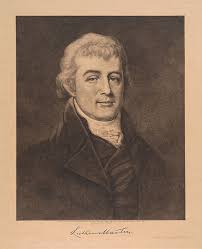
Drunken Prophet? Sounds like my kind of Founder.
A few snippets from Michael P. Orsi's review of Forgotten Founder, Drunken Prophet: The Life of Luther Martin, by Bill Kauffman:
Lost in the mists of our historical mythology is the fact that America's Constitution was not always the "sacred text" it has come to be considered. Indeed, among America's Founding Fathers there were many who had deep reservations about the Federalist conception of government developed between the opening of the Constitutional Convention in 1787 and the adoption of the Bill of Rights in 1791.
The principal fear of the anti-Federalists, as they were called, was that the rights of the individual states would be usurped by the central government. It has taken almost 220 years for their fear to be fully realized, but the surreptitious nationalism which they saw embedded in the Constitution's text has largely become a reality.
Bill Kauffman chronicles the life and career of one of the leading anti-Federalists in Forgotten Founder, Drunken Prophet: The Life of Luther Martin. Perhaps the foremost advocate of "states' rights" and the personal freedoms they were intended to ensure, Luther Martin was a true Founding Father -- though far from a model of the sobriety and rectitude usually ascribed to those men whose profiles grace our stamps, coins, and paper currency. Contemporaries spoke of him as "perpetually in his cups, coarse and gross, pedantic and long-winded, sedulous and acidulous."
They also saw him as "convincing" in his forceful arguments against the proposed Constitution. In September 1789, two weeks after leaving the Convention in Philadelphia for the last time, Martin charged that the new Constitution was:
...neither wholly federal, nor wholly national -- but a strange hotch-potch of both -- just so much federal in appearance as to give its advocates...an opportunity of passing it as such upon the unsuspecting multitude, before they had time and opportunity to examine it, and yet so predominantly national as to put it in the power of its movers, whenever the machine shall be set agoing to strike out every part that has the appearance of being federal, and to render it wholly and entirely a national government.
Kauffman lays this trans-mogrification of the American idea at the feet of Alexander Hamilton and James Madison, and he doesn't mask his feelings about these two "arch-nationalists." He charges that Madison, usually lionized as the father of the Constitution, actually desired "the total abolition and destruction of state governments."
Of Hamilton he laments, "Burr should have killed [him] sooner."
---Michael P. Orsi
Saturday, March 27, 2010
Benjamin Rush on Confucianism, Islam and Christianity
See here:
Rush was an interesting character. He was an orthodox Trinitarian Christian and said certain things which sound "Christian Nation" like. Yet, his orthodox Christianity was liberal and enlightened for the era. He was a theological universalist, believing all men would be saved through Christ's universal (as opposed to limited) atonement. And he thought the New Testament abolished the death penalty.
Rush described his creed as "a compound of the orthodoxy and heterodoxy of most of our Christian churches."
One thing that interests me about Rush's first quotation is his idea that Confucianism "reveals the attributes of the Deity, or a future state of rewards and punishments...." That was the deistic or theistic minimum that many key and non-key Founders -- not just the heterodox rationalist unitarians, but some/many orthodox figures as well -- believed most if not all world religions adhered to.
This was the idea of "natural religion" -- that all good men of all religions believe in Providence and a future state of rewards and punishments. That man's "reason" discovered this. And, as it were, such Providentialism existed beyond the Abrahamic, traditionally thought of monotheistic religions.
The way natural religion "fit" with Christianity was the Jewish and Christian scriptures helped to further clarify what man could discover from reason alone.
I question whether it's sound theology to "find" monotheism outside of the Jewish, Muslim, and Christian traditions (broadly defined). But they did. John Adams "found" Providentialism in, among other places, Hinduism and Greek God worship. Hinduism perhaps could be thought of as monotheistic. I've heard some Hindus argue their thousands of gods are really manifestations of the one God of the universe. This seems like Trinitarian logic taken to its ultimate extreme (instead of three manifestations of one God, it's thousands).
Also, for obvious reasons [Western Civ. has Greco-Roman along with Judeo-Christian origins AND the FFs highly venerated such Greco-Roman noble paganism], the way the Founders' universal monotheism fit with classical Greece and Rome interests me.
It may be a stretch to say, as John Adams did, Zeus worship is a "Christian principle." However, what about the ancient philosophers like Aristotle and Socrates or the Stoics of Rome like Cinncinatus, Cicero and Seneca?
It is my (albeit limited) understanding that many of these wise Ancients did not worship the city gods like Zeus or his Roman moniker Jupiter. Isn't that what Socrates was executed for?
Yet, they weren't atheists either? They did believe in some kind of metaphysical Providence?
So men like Aristotle, Socrates, Cicero and Seneca perhaps could be said to have worshipped the God of the Jewish and Christian Scriptures without knowing more about Him.
That's one way to view it.
I rarely, however, hear the evangelical promoters of the "Christian Nation" thesis expounding theology like this. Roman Catholics, maybe.
Evangelicals are more likely to say Aristotle, Cicero, the Hindus and Confucians DIDN'T worship the God of the Bible, were/are in a state of spiritual darkness period.
The Founders would have disagreed.
Such is my veneration for every religion that reveals the attributes of the Deity, or a future state of rewards and punishments, that I had rather see the opinions of Confucius or Mahomed inculcated upon our youth, than see them grow up wholly devoid of a system of religious principles. But the religion I mean to recommend in this place, is that of the New Testament.
Rush was an interesting character. He was an orthodox Trinitarian Christian and said certain things which sound "Christian Nation" like. Yet, his orthodox Christianity was liberal and enlightened for the era. He was a theological universalist, believing all men would be saved through Christ's universal (as opposed to limited) atonement. And he thought the New Testament abolished the death penalty.
Rush described his creed as "a compound of the orthodoxy and heterodoxy of most of our Christian churches."
One thing that interests me about Rush's first quotation is his idea that Confucianism "reveals the attributes of the Deity, or a future state of rewards and punishments...." That was the deistic or theistic minimum that many key and non-key Founders -- not just the heterodox rationalist unitarians, but some/many orthodox figures as well -- believed most if not all world religions adhered to.
This was the idea of "natural religion" -- that all good men of all religions believe in Providence and a future state of rewards and punishments. That man's "reason" discovered this. And, as it were, such Providentialism existed beyond the Abrahamic, traditionally thought of monotheistic religions.
The way natural religion "fit" with Christianity was the Jewish and Christian scriptures helped to further clarify what man could discover from reason alone.
I question whether it's sound theology to "find" monotheism outside of the Jewish, Muslim, and Christian traditions (broadly defined). But they did. John Adams "found" Providentialism in, among other places, Hinduism and Greek God worship. Hinduism perhaps could be thought of as monotheistic. I've heard some Hindus argue their thousands of gods are really manifestations of the one God of the universe. This seems like Trinitarian logic taken to its ultimate extreme (instead of three manifestations of one God, it's thousands).
Also, for obvious reasons [Western Civ. has Greco-Roman along with Judeo-Christian origins AND the FFs highly venerated such Greco-Roman noble paganism], the way the Founders' universal monotheism fit with classical Greece and Rome interests me.
It may be a stretch to say, as John Adams did, Zeus worship is a "Christian principle." However, what about the ancient philosophers like Aristotle and Socrates or the Stoics of Rome like Cinncinatus, Cicero and Seneca?
It is my (albeit limited) understanding that many of these wise Ancients did not worship the city gods like Zeus or his Roman moniker Jupiter. Isn't that what Socrates was executed for?
Yet, they weren't atheists either? They did believe in some kind of metaphysical Providence?
So men like Aristotle, Socrates, Cicero and Seneca perhaps could be said to have worshipped the God of the Jewish and Christian Scriptures without knowing more about Him.
That's one way to view it.
I rarely, however, hear the evangelical promoters of the "Christian Nation" thesis expounding theology like this. Roman Catholics, maybe.
Evangelicals are more likely to say Aristotle, Cicero, the Hindus and Confucians DIDN'T worship the God of the Bible, were/are in a state of spiritual darkness period.
The Founders would have disagreed.
Friday, March 26, 2010
Mark Noll on Providential History & the American Revolution
This was taken from a 2001 article at "Christianity Today":
Ordinary vs. providential
But what about God? Asked about the anti-supernaturalism of history, Noll made a distinction between what he called "ordinary" and "providential" history. Ordinary history, he said, limits itself to "evidence and causes and effects that almost everyone can be convinced might have taken place." While ordinary history might look quite secular, Noll sees it as fundamentally Christian in its presuppositions and worldview. He compared it to science. Christian scientists do their work with confidence because they believe that the world will make sense, and that God has made it possible for the human mind to understand the world.
So with the historian. "If I want to study the history of the American Revolution, I'm presupposing that something real took place, that the evidence left corresponds in some way to what really took place, that I'm intelligent enough to understand that evidence, that I'm able to put together a plausible explanation of cause and effect that might get us close to the truth," Noll said. "All those enterprises I see as implicitly dependent on a Christian view of God."
Noll seemed to imply that ordinary history, while it depended on God, would never have much to say about God. For as soon as someone contended that God had acted in a particular way, the subject would be too contentious to hope for general agreement.
I asked, therefore, about what Noll called "providential" history—history that assumed God's goodness to be at work in history and attempted to trace it. Noll resisted such an approach, saying he believed good providential history could be done, but that he has yet to see good examples of it. Providential history only made sense to "people who already shared your very specific religious position. If someone said the Reformation was God's way of bringing about a reform in the church, I knew that person wasn't a Catholic."
Noll's feelings stem partly from his early research in American history, when he studied how Christian ministers justified the Revolutionary War in their preaching. Most often they spoke of the Revolution as, literally, God's work. "When I really got into it, I came to the conclusion that this was hopeless, bogus. If you use Christian standards, it is very hard to say God brought the Revolution." American patriots painted England as the ultimate in godless tyranny, and drew parallels with the biblical escape from Egypt. Such arguments were nonsense, Noll says.
Noll warns that providential history must be driven by the best possible theology, which focuses on the Cross. "Very strange reversals take place in the Christian story focused on the Cross. The Christ is crucified. Good appears to fail. The monuments of historical goodness—Roman order, Jewish morality—conspire to do unspeakable evil. Good things come out of hopeless situations. Things that are not supposed to happen—the resurrection of the dead—happen, and happen at the center of the universe. If you think Christian theology has a lot of built-in reversals in it, then interpreting events becomes more complicated and not less."
Confucius, Baseball and Apple Pie
Ask an American what faith they profess and you’ll find Christians, Jews, Buddhists, Moslems, and Hindus in abundance, with a liberal sprinkling of Bahai’s, Sikhs, and Zoroastrians. But hardly anyone will confess to being a Confucianist.
That’s odd, because Confucius is as American as Motherhood and Apple Pie. Our nation’s founders admired him greatly. Thomas Paine listed the Chinese sage in the same category as Jesus and Socrates and a manual for public devotion that he helped devise omitted any Biblical passages but included proverbs from Confucius and other Eastern poets. James Madison, the father of the U.S. Constitution and the Bill of Rights, had a portrait of Confucius hanging in his Virginia
But it was Benjamin Franklin who first introduced Confucius to the American colonies. In 1737, Franklin Franklin
Holland Cotter summarizes the Confucian outlook in today’s New York Times as a pragmatic strategy of “you be nice to me and I’ll be nice to you,” getting along by going along. “He also believed that education, hard work and respect for the past were essential; that excessive anything — money, fun, religion — led to trouble; and that social harmony was best achieved when people interacted courteously, but basically minded their own business.”
Some doubt if Confucianism even qualifies as a religion, because it focuses mainly on ethics rather than on saving souls. Asked by a follower about life after death, Confucius supposedly replied, “Why worry about the next world when you haven’t yet learned how to live in this one?” For a founding generation of Americans tired of metaphysics, a practical religion that counseled public virtue and civic-mindedness while avoiding hair-splitting doctrine had a definite appeal.
As the father of a Korean son, I have come to appreciate Confucian culture more and more, as it helped to build civilizations that have endured for thousands of years—valuing decorum, promoting strong families, and instilling reverence for the highest standards of personal conduct.
So the next time I’m asked what religion I practice, I think I’ll answer “Confucian.” If it’s good enough for Ben Franklin, it’s good enough for me.
Good Discussion at Cato Unbound
In light of Tom Van Dyke's thought provoking and popular post on rights, I thought I would link to this month's debate at Cato Unbound about the difference between positive and negative rights. It is right in line with many of the questions that Tom asked and germane to the current national dialogue about the healthcare bill and the founding.
Monday, March 22, 2010
Unalienable Rights: Unenumerated or Innumerable?
Where did they start?
Where do they end?
by Tom Van Dyke
And no, one's nose has nothing to do with it, so don't even go there.
At the passage of the Patient Protection and Affordable Care Act, Speaker of the House Nancy Pelosi said:
Now, before anyone starts feverishly typing away on their comment before reading any further, this here American Creation blog is not about current issues, especially Dems vs. Reps. I warn y'all in advance, I'll delete anything that smells of Red State or Daily Kos.
[Although such folk have already stopped reading and started commenting. But I say this for the record, and for the regulars who know how we do things around here.]
This isn't about the health care thing, but it is about "rights." And "liberty," and the Founders and their understanding of both, since Speaker Pelosi brought up the subject. And her partisan opponents are arguing "rights" and "liberty" and the Founders in support of their position.
[Oh, go find your own link for the last bunch. It ain't very hard.]
In another forum I participate in, we're discussing the philosophical or even theological foundations for the idea of "rights" atall. Liberty, pursuit of happiness, the whole megillah. The Founding, Locke, the ancient Greeks, natural law, the moderns, Kant, Rawls, what have you.
We do a good job around here of discussing principles at arms-length from the issues, so I thought I'd take a chance with questions designed for clarity there that might be helpful here:
"Rights" is the most confusing and ambiguous word of our times. I thought we might seek a little clarity. It's the undercurrent of pretty much every post on this blog.
And this blog has been an oasis on the internet from the ignorant and partisan grenade-throwing, so I hope we can trust us with this---the questions underlying the questions. No bashing Obama or Pelosi or Beck. Use their arguments if you will, but leave them out of it. And no bashing Congress and the procedures about how the bill got passed. That's about politics, and about legalities, not about principles.
So, the genie's out of the bottle. But we've done a great job of managing Jeannie so far around here. Let's test our wheels. Let's test how 2010 matches up with 1776 and 1787.
Where do they end?
by Tom Van Dyke
And no, one's nose has nothing to do with it, so don't even go there.
At the passage of the Patient Protection and Affordable Care Act, Speaker of the House Nancy Pelosi said:
"In doing so, we will honor the vows of our founders, who in the Declaration of Independence said that we are 'endowed by our Creator with certain unalienable rights, that among these are life, liberty and the pursuit of happiness.' This legislation will lead to healthier lives, more liberty to pursue hopes and dreams and happiness for the American people. This is an American proposal that honors the traditions of our country."
Now, before anyone starts feverishly typing away on their comment before reading any further, this here American Creation blog is not about current issues, especially Dems vs. Reps. I warn y'all in advance, I'll delete anything that smells of Red State or Daily Kos.
[Although such folk have already stopped reading and started commenting. But I say this for the record, and for the regulars who know how we do things around here.]
This isn't about the health care thing, but it is about "rights." And "liberty," and the Founders and their understanding of both, since Speaker Pelosi brought up the subject. And her partisan opponents are arguing "rights" and "liberty" and the Founders in support of their position.
[Oh, go find your own link for the last bunch. It ain't very hard.]
In another forum I participate in, we're discussing the philosophical or even theological foundations for the idea of "rights" atall. Liberty, pursuit of happiness, the whole megillah. The Founding, Locke, the ancient Greeks, natural law, the moderns, Kant, Rawls, what have you.
We do a good job around here of discussing principles at arms-length from the issues, so I thought I'd take a chance with questions designed for clarity there that might be helpful here:
---Are all rights "natural," or are some political, civil, or "human"?
---Are rights innate or negotiated for in a contract with the state?
---Are rights innate or a matter of merit?
---What is the state of nature? What of liberty in the state of nature?
---What is the state of nature if man is a social animal [social "being," if we
prefer]? What becomes of liberty?
---What is liberty?
---If a social animal, and one incapable of self-sufficiency until age 5 or 7 or
so, what is his reciprocal obligation [duty?] to fellow man? To fellow man's
material estate? To fellow man's liberty? To fellow man's soul [if any]?
---By what right does one man rule another? Is man his brother's keeper?
---Are the laws of nature and the "natural law" the same thing?
---Is liberty a natural right?
---If so, is it limited by the social animal's duty or obligation to "society"
or the state?
---Or is "At the heart of liberty is the right to define one's own concept of
existence, of meaning, of the universe, and of the mystery of human life.
Beliefs about these matters could not define the attributes of personhood were
they formed under compulsion of the State." [?]
---Does "personhood" exist? Is there a "dignity of the human person"? Is that
dignity innate, or is it an assertion of a "convention"? Are "conventions" the
product of "social contract," and therefore by definition, arbitrary?
---Are positive laws [conventions, contracts] subject to validation first by any
higher laws [law of nature, "natural law"] or simply coeval laws [reason,
reasonableness], or, as the US Supreme Court answers, a blend depending on the
occasion where one "fundamental" right is in conflict with another: strict scrutiny, intermediate scrutiny, rational basis, and so on.
---What rights are absolute? All, many, some? Are all rights the same, civil rights, political rights, natural rights, human rights?
"Rights" is the most confusing and ambiguous word of our times. I thought we might seek a little clarity. It's the undercurrent of pretty much every post on this blog.
And this blog has been an oasis on the internet from the ignorant and partisan grenade-throwing, so I hope we can trust us with this---the questions underlying the questions. No bashing Obama or Pelosi or Beck. Use their arguments if you will, but leave them out of it. And no bashing Congress and the procedures about how the bill got passed. That's about politics, and about legalities, not about principles.
So, the genie's out of the bottle. But we've done a great job of managing Jeannie so far around here. Let's test our wheels. Let's test how 2010 matches up with 1776 and 1787.
Excerpt: Strangers and Pilgrims, Travellers and Sojourners
Leiden and the Foundations of Plymouth Plantation
by Jeremy Dupertuis Bangs
Guest Blogger
AC recently received a note about one of our discussions from Dr. Jeremy Dupertuis Bangs, award-winning scholar and author of the new Strangers and Pilgrims, Travellers and Sojourners---Leiden and the Foundations of Plymouth Plantation, a "vast re-analysis of the Pilgrims' early history," which can be ordered directly at (508) 746-5058.
Dr. Bangs is one of the world's leading scholars not only on the Pilgrims in America, but he's the founder of a museum in Leiden on their history in 17th century Holland before the Mayflower. To put this in context, Dr. Bangs writes:
BY GOING THROUGH THAT FULL RANGE OF AUTHORITIES FROM ALL VARIETIES OF CHRISTIANITY AT THE TIME I DEMOLISH ONE OF THE MAJOR IDEAS ABOUT PURITAN NEW ENGLAND---MORGAN'S AND FISCHER'S IDEA THAT THE EXPANDED HIERARCHICAL INTERPRETATION OF THE COMMANDMENT ABOUT FATHER AND MOTHER TO INCLUDE ALL CIRCUMSTANCES OF AUTHORITY IN SOCIETY IS UNIQUE TO THE PURITANS. THAT'S A PRETTY IMPORTANT ABOUT-FACE.
An excerpt, Chapter 10, pp. 361-368:
What Is Meant by Father and Mother?
By noting how widespread, or conversely how limited, particular ideas of marriage were we should be in a position to determine whether Puritan or Pilgrim ideas of family life, whether in Holland or New England, were distinctive. For that purpose, we shall review how the Fifth Commandment was explained by several Puritan and Reformed theologians, including John Cotton, Zacharias Ursinus, Jacobus Arminius, and Jean Calvin, as well as by Martin Luther, Desiderius Erasmus, Alexander Nowell, and the authors of the catechism issued by Pope Pius V.
Epitomizing Puritan thought, the minister John Cotton, taught that the Fifth Commandment (Ex. 20: 12), “Honor thy father and thy mother, that thy days may be prolonged upon the land, which the Lord thy God giveth thee,” comprised obligations of respect in all hierarchical relations of authority, including marriage. “What is meant by father and mother?” he asked in 1623. His answer was that “the Lord here meaneth all those whom himself hath made superiors unto us, whether in authority, such as parents are to children, husbands to wives, masters to servants in the family, ministers to people in the church, magistrates to subjects in the commonwealth, or in age, as [the] old are to the young, or in others gifts, as the rich are to the poor, the wise to the simple, christians of greater grace & riper years to babes in Christ.” Cotton is here giving an expanded list of explicit examples of relations of authority, providing particulars for the opinion expressed by Jean Calvin, that this commandment was a general rule of subjection to authority because God had ordained things to be the way they are, and consequently such relations were divinely predestined.[1] As we have seen, this expansion is suggested by Paul in the passages cited from Ephesians 6 and Colossians 3.
Cotton was not the first to reflect Calvin’s theological justification of existing ranks and obligations. The Geneva Bible’s marginal annotation explained the Fifth Commandment succinctly: “By the parents also is meant all that have authority over us.”
More and more specific examples were added to illustrate this basic synechdochal interpretive axiom. In 1602, Festus Hommius, later a Leiden professor and friend of John Robinson’s, published his translation of Zacharias Ursinus’ Treasure-Book of Christian Doctrine, that became the principal book of catechetical instruction in The Netherlands. Ursinus listed those in authority he thought were meant by the Fifth Commandment’s words “father and mother”: (1) parents, (2) guardians of orphans, (3) schoolmasters, teachers, and ministers of the church, (4) governors, both high-level and lower, (5) all old and aged people. A wife’s obligatory obedience to her husband was explicitly commanded elsewhere in the Bible.[2] Ursinus commented that while sometimes evil people, unworthy of honor, are placed above us, honor was due to their office nonetheless, as having been part of the hierarchical structure instituted by God. Citing Acts 5: 29, he said that it is well known that one should not obey them if they exceeded the limits of their office either through laxity in enforcing obedience to the Ten Commandments or through unrighteous and cruel tyranny.[3]
Jacobus Arminius held identical opinions about the Fifth Commandment, generally specifying the extrapolated subordinate relations as those arising in human society, whether in political situations, the church, school, or household, whether in time of peace or war, whether ordinary or extraordinary, permanent in authority or temporary, however short-term – in other words, always in all places.[4]
In 1604, John Dod and Robert Cleaver first published their commentary on the Ten Commandments (A Plaine and Familiar Exposition of the Tenne Commandements) that was so popular among Puritans it went through at least twenty-four editions. Two were issued in Leiden by William Brewster, who re-published Dod and Cleaver’s Tenne Commandements in 1617, in English and Dutch editions. Moreover, the book is listed in several Plymouth Colony estate inventories.[5] The Pilgrims’ evident enthusiasm for this book allows us to assume that they shared its viewpoint on most matters except the topic of Separation. The Pilgrims must have agreed, for example, with the opinion of Dod and Cleaver that if everyone (superiors, inferiors, and equals) properly obeyed the Fifth Commandment, there could be no sins against the remaining commandments forbidding killing, adultery, theft, false witness, and covetousness. “For all disorders in the other, do flow from hence, that either superiors are negligent in performing their duties of governing: or else inferiors are proud and stubborn, and refuse to obey their superiors; or equals be envious or ambitious between themselves.”[6]
The allusion to the possibility that the ordinary earnest Christian could determine when his political or social superior was “negligent in performing the duties of governing” carried with it, on the one hand, the hint of rebellion against royal authority that was an essential part of the Separatists’ claim to congregational autonomy for appointing their own ministers, and, on the other hand, implied the authority that justified wives’ complaints against mistreatment by their husbands. All were familiar with Acts 5: 29 (“We ought rather to obey God then men”), but to act on the conviction that a ruler was unjust required courage.
To emphasize this implication of the Fifth Commandment was to admit the possibility of righteous criticism against a ruler by any serious Christian, even to call for such criticism. John Gigordus, studying theology at Geneva under Calvin’s successors Theodor Beza and Antonius Faius (Antoine de la Faye), had explicitly defended this position about the Fifth Commandment, warning that “We are yet to take heed, that we yield not to our Parents, Magistrates, or yet to any man, more than is meet: that is, that we have them not in Gods stead. And therefore, they do grievously sin, who hold, that whatsoever pleaseth the Prince, ought to have the force of a Law.” Furthermore, “Yet can neither the subjects with a good conscience obey their Magistrates, when they command them things that are manifestly impious and unjust, nor the flocks yield obedience unto their false Pastors, who go astray from the will of God.” But, backing away from this firm call for personal responsibility to oppose injustice and defend the truth, Gigordus reined in his plea for the revolutionary duties of conscience and echoed Calvin by stating that open revolt was not directly authorized by the commandment. “Yet it is not lawfull for private men, to rise or oppose themselues violently against the Magistrates, that deal tyrannously with them: but it is their duty, when any such thing cometh to pass, either to betake themselves to prayers and patience, (which notwithstanding must not carry us away from that which God requireth of us,) or to fly unto them unto whom the Law hath given authority to bridle and to restrain such tyrants.”[7]
By analogy, a wife oppressed could ask the church to bridle and restrain a vicious husband, but she had to pursue the appropriate hierarchic channels within the church patriarchy. As Calvin put it, the fault of the husband did not absolve the wife of her duty of obedience. That, at least sometimes, appeals to church leaders evidently did succeed in curbing cruel husbands is seen in the records of Leiden’s Walloon Church consistory. The problem was not supposed to arise, however, for the ideal of Christian marriage was that there be mutual love and understanding, with no place for any such brutality. Wife-beating, like cruel treatment of children, was punished with excommunication.[8]
Calvinists thought hierarchical patterns of authority were established by God. This was, however, not a specifically Calvinist innovation; in fact, it was no innovation at all. A much milder, yet ultimately similar, version is seen in Martin Luther’s Larger Catechism (1530). Luther approaches the same commandment (following the alternate numbering, as the Fourth Commandment) with an emphasis on the love and honor due from children to their parents. Luther does mention rather far into his discussion that by analogy members of a household are to treat their master as in a child-father relationship, and that subjects owe similar honor to civil governors, and that church members owe such respect to their pastors. “Thus we have two kinds of fathers presented in this commandment, fathers in blood and fathers in office […] Besides these there are yet spiritual fathers […]” Luther does not discuss the subordination of wives to husbands in reference to this commandment. Nor does he, at this point, discuss the godly obligation to oppose tyranny, instead informing subordinates that rebels have no favor or blessing. No remedy is suggested besides the thought that rulers should be wise, just, and God-fearing, because God “does not wish to have in this office and government knaves and tyrants.”[9]
Again, the expanded interpretation of hierarchical relationships is part of Erasmus’ explanation of the Ten Commandments (1533). “This precept doth not only appertain to fathers & mothers: but also it appertaineth to bishops/ to teachers/ & to officers and rulers/ which after a certain manner do bear the room [place] and stead of parents.”[10] Alexander Nowell, author of the official catechism of the Church of England (1562, translated into English 1570), explained the scope of the commandment as extending beyond parents to “all those to whom any authority is given, as magistrates, ministers of the church, schoolmasters, finally, all they that have any ornament, either of reverent age, or of wit, wisdom, or learning, worship, or wealthy state, or otherwise be our superiors.”[11]
The Roman Catholic catechism issued in 1566 by Pope Pius V explains the “Fourth Commandment” by asserting that “We are bound to honour not only our natural parents, but also others who are called fathers, such as Bishops and priests, kings, princes and magistrates, tutors, guardians and masters, teachers, aged persons and the like.” This catechism instructs that wicked and unworthy rulers “should not be obeyed, since in such a case they rule not according to their rightful authority, but according to injustice and perversity.”[12]
Calvin, Erasmus, the Church of England, and the Roman Catholic Church thus agree on this wide-ranging interpretation of the commandment regarding hierarchic social authority, and Luther also eventually gets around to including some degree of assumption of the extrapolated expansion of the commandment. There is not and therefore cannot be anything distinctively Puritan in such an application of the commandment, where Edmund S. Morgan would have us see a salient characteristic contrasting, explaining, and defining Puritan family life in seventeenth-century New England.[13]
The pervasive assumption of the righteousness of hierarchic paternalistic authority underscores the extraordinariness of Robinson’s rigorous exegesis that led him to conclude that Paul had made a mistake in forgetting that women have an obligation to speak out in church under some circumstances, as discussed in Chapters 7 and 8.
This universal reverence for customary patterns of authority, when applied to marriage, led to John Cotton’s question and answer, “What is the honor which the husband & wife do equally owe the one to the other? To cleave one to another in delightful love, in trust, in care, to please one another in one house & in one flesh, to help one another in doing good & not evil, the one to the other, in soul, in body, in goods, & good name, in bearing the burdens one of another & in holding up, & ordering their family with both their hands together.”
______________________
Footnotes below, in the comments section.
Sunday, March 21, 2010
Robert Dale Owen on Romans 13
This is perhaps the first notable example of a freethinker using the revolution/Romans 13 argument, claiming the Founding for anti-biblical principles. Plenty of devout Christians during the American Founding thought the revolution sinfully broke Romans 13. And for that and other reasons they remained loyalists.
As he writes:
As he writes:
In Paul's epistle to the Romans, the thirteenth chapter, at the first verse, we read: "Let every soul be subject to the higher powers; for there is no power but of God; the powers that be are ordained of God. Whosoever, therefore, resisteth the power, resisteth the ordinance of God; and they that resist shall receive to themselves damnation."
I know not what the private opinions of those sturdy patriots were, who, in the old Philadelphia State House, appended their signatures to the immortal document. But this I do know, that when they did so, it was in defiance of the Bible; it was in direct violation of the law of the New Testament. This I know, that, if deity be the author of the Christian scriptures, the signers of the declaration resisted the law, not of the King of England only, but of the God of heaven.
Needs it to remind you how emphatically the text quoted supports the conclusions thus drawn? "There is no power but of God." The power of George III., then, was of God. "He that resisteth the power resisteth the ordinance of God." The great scene on the fourth of July, then, was A Resisting Of God's OrdiNances. Jefferson, Franklin, John Adams, John Hancock, and all the rest, fought against God. George Washington led on his troops against God. Every revolutionary blow was directed against God's anointed; it was a blow aimed against the divine authority—an act of rebellion, subversive of the ordinances of God. Ay, let us not veil the truth! If a being who cannot lie penned the Bible, then George Washington and every soldier who drew sword in the republic's armies for liberty, expiate, at this moment, in hell-fire, the punishment of their ungodly strife! Then, too, John Hancock and every patriot whose name stands to America's Title Deed, have taken their places with the devil and his angels! All resisted the power; all, unless God lie, Have Received To THEMSELVES DAMNATION!
The text is plain as language can make it; the conclusions irresistible. For my own part, did I believe the Bible and hope to reach heaven, I should feel certain not to find one revolutionary soldier there. ...
Saturday, March 20, 2010
The Opposite of the Lowest Common Denominator Approach
But it's still fair.
I am not a history teacher. I teach law, business and political science. And my training is in law and business (JD/MBA/LLM, all from Temple). The nice thing about a "JD" is that it's a doctorate without a dissertation. It permits you to be a lawyer. And the study of law has historical and political science overtones to it. No wonder there are a glut of JDs.
I suggested history teachers at the K-12 level focus more on getting the facts straight -- facts on which all sides could agree.
On NPR I heard a history professor (at NYU) suggest a different approach but still fair. He brought up Howard Zinn's "A People's History," and contrasted it with "A Patriot's History," and suggested students read BOTH books at the same time to see what the controversy is all about. He thought that superior to the more milquetoast teach the facts that everyone agrees on.
He may be right.
To use an example closer to home, assign students BOTH David Barton's books AND Chris Rodda's and see what they think.
He also noted history an imperfect science and that at bottom, much we don't know. On a related note, John Fea notes how the term "revision" properly understood is a good thing. Revision in history, means correcting old errors with better information.
To use an example that I have been involved in: Paul Boller's "George Washington & Religion" is probably the most influential book on GW's personal creed. This is the book Peter Lillback wrote his to refute. Lillback offered more quantity than Boller; but both have the basic facts. Both agree Washington believed in an active Providence. And we have speculations from Lillback (for instance on why GW avoided communion) that push GW in the "orthodox" box to counter speculations from Boller (on for instance why Washington let the one and only reference to "Jesus Christ" in a public address, written by an aide, pass when in all other instances he systematically did not discuss JC) that push Washington out of that box.
I was rereading GW & Religion at the David Library and I'm struck by how many times Boller invokes "Bird Wilson's" argument for why GW wasn't a Christian. The problem is, it wasn't Bird Wilson, son of key Founder James Wilson, but rather a Calvinist covenanter named James Renwick Willson.
If Lillback wanted to make Boller look like a real doofus, he could have pointed that out. But...Lillback makes the same error. And so did Michael Novak, Brooke Allen, David Holmes, and many others.
That was the standard belief among scholars. And the error didn't originate with Boller either.
The error was caught relatively recently by James Kabala, a Brown PhD in history and currently, a community college professor. He did manage to recently put that revision in a peer reviewed scholarly article. But that revision is still in the process of taking affect.
But because Boller's work was so influential and because the early 1830s dialog that occured among Origen Bacheler, Robert Dale Owen, Rev. James Renwick Willson and Rev. James Abercrombie is central to Boller's analysis, we should study the primary sources and arguments they used very carefully. You can read the debate between Owen and Bacheler here. You can read Abercrombie's smoking gun letter here. And you can read Willson's infamous sermon here.
Friday, March 19, 2010
Frazer On Rodda, Barton, & the Aitken Bible
Dr. Gregg Frazer sent me the following note, in response:
I haven’t taken the time to look at everything in this discussion – certainly not Ms. Rodda’s presentation (I’ve seen one of her videos) about the Aitken Bible – but I do have a couple of comments about it (the Aitken Bible).
As you know, I believe that the Left is just as wrong about the founders as is Barton; so if she’s claiming that they did not pass any resolutions favoring religion, she’s dead wrong and his photocopy of the resolution regarding that Bible is proof. They were not atheists or even rank secularists and they thought the promotion of religion (not necessarily Christianity) important to promote morality. If you want me to make this observation on the site to reassure Tom [Van Dyke] and others that I’m not (and never have been) arguing that there was no interest in or influence of religion, I will.
Re the Aitken Bible issue itself, I have a few observations:
1) the congressional resolution does not say anything about recommending them for schools, specifically (as Barton claims that it does on pg. 106 of The Myth of Separation and, I believe, in his videos). It supports the work in “the interest of religion, as well as the progress of arts” – but not, specifically, for schools.
2) the Congress did not authorize money to finance or purchase the Bibles, contrary to what I believe Barton has said on TV and (I think) on one of his videos. Again, on pg. 106 of The Myth, he says that Congress “approved his request” – but that’s not entirely true. He requested permission and funding – they granted permission, but not funding. This is a minor point, but it illustrates Barton taking some truth and magnifying it/expanding it to make it sound better for his position.
3) As Derek Davis points out in Religion and the Continental Congress 1774-1789, there may be another explanation for Congress’s action here than a desire to support the publishing of Bibles here in America: “Robert Aitken was the congressional printer who printed the Journals of Congress and, according to [Edwin] Rumball-Petre, undertook the publication of an American edition of the Bible at some financial risk [the financial risk is mentioned both in the committee’s report and the chaplain’s report]. When peace was proclaimed shortly after he published an unknown number of copies of his editions, the importation of cheaper Bibles was again made possible, and congressmen were among the first to realize that Aitken’s investment would be a loss.” Davis goes on the explain that the endorsement by Congress no doubt helped him “dispose of his published copies.”
4) The name of the committee may be an indication that Davis’s take is correct. They were called “a Committee of Congress on Mr. Aitken’s Memorial.” It appears that Mr. Aitken was the focus of their desired intent – not the Bible.
5) Finally, I would point out that the resolution highlights “the interest of religion” – but not the interest of Christianity.
Rodda Responds To Barton
Chris Rodda left this comment at American Creation, responding to David Barton's comment:
Mr. Barton (if you really are Mr. Barton) ...
You say in your comment:
"I also want to address the portion of this video clip where Glenn Beck and I very briefly mention the 1807 Thomas Jefferson letter. I did not have the time in that segment to go into detail but if I did, I certainly would have put it in context."
Well, I would certainly like to see you put that "letter" in context, too. That is, if you want to make an attempt to put in in some other context than the following.
First, let's start with the fact that the document isn't even a letter. It's part of a ships' papers.
These documents, which every ship leaving the United States had to carry, were a fill-in-the-blanks form with columns translated into several languages, and were printed in quantity. Each new president signed a big stack of these forms, leaving all the other information blank, and then the blank signed forms were sent to the officials at all the ports, where they were filled out as needed. So, Jefferson did not personally write the date "in the year of our lord Christ." He just signed a bunch of blank ships' papers that someone had dated that way.
Mr. Barton claims in his description of this form on his website that "this is the explicitly Christian language that President Thomas Jefferson chose to use in official public presidential documents," and on the Glenn Beck show that "Jefferson added in the year of our lord Christ." This is completely untrue. (I'm being nice and not using the word "lie.")
Jefferson absolutely did not choose the language on this form. It's exactly the same language as the ships' papers form signed by Adams, the president right before him, and Madison, the president right after him. (I have images of the same form as it was printed during the Adams and Madison administrations if anyone doubts this.) The only difference is that the printer changed the name of the president, which appears at the top of the form, to whoever the current president was. Obviously, anyone who knows anything about Jefferson would know that he wouldn't have wasted taxpayer money by demanding that the forms be reprinted because of the way the date was written.
I know it's hard to see the document in the video, but if you look at the image of it on the WallBuilders website -- http://www.wallbuilders.com/LIBissuesArticles.asp?id=22345 -- you can see it's the same document that Beck is holding in the video.
And, if it really is Mr. Barton who made the above comment, I'm still waiting for you to reveal the other alleged Jefferson document dated "in the year of our lord Christ" that you have long claimed to possess -- the one you've described as "his presidential act of October 18, 1804, from an original document in our possession."
Thursday, March 18, 2010
David Barton Apparently Responds to Chris Rodda
I say apparent because an anonymous commenter at American Creation claiming to be Barton left the response. Based on years of experience, I believe this really is Barton. But for obvious reasons, the qualification is necessary.
First, co-blogger Brad Hart did a post that showed a clip of Barton on Glenn Beck. Below, he posted a clip of Rodda criticizing Barton for balance. Rodda chimed in the comments section. Then Barton left the following note:
First, co-blogger Brad Hart did a post that showed a clip of Barton on Glenn Beck. Below, he posted a clip of Rodda criticizing Barton for balance. Rodda chimed in the comments section. Then Barton left the following note:
Ms. Rodda,
Let me first apologize for anything I may have said or done that offended you. It's obvious that you have been offended by something I either said or did so I just want to say that I have never meant any malice towards you in any way. I'm sorry if this was the case. Over the years I have grown accustomed to being ridiculed, but I try to apologize in person whenever the opportunity arises.
You have a nice blog here and I commend you for your interest in American history, so I hope what I have to say regarding this particular article will not increase your disdain for me.
What I don't understand is why you continue to insist that my research is unsubstantiated when I provide an endless list of footnotes to explain and defend my positions. This is especially true of the Aitken Bible. I would invite you and everyone else here on your blog to visit my website:
http://www.wallbuilders.com/LIBissuesArticles.asp?id=46
There you will see a photocopied document of Congress' official endorsement of Robert Aitken's Bible. Your attempt to libel me by saying that I cannot provide any actual documentation is false.
I also want to address the portion of this video clip where Glenn Beck and I very briefly mention the 1807 Thomas Jefferson letter. I did not have the time in that segment to go into detail but if I did, I certainly would have put it in context. I don't presume to think that Mr. Jefferson was a Christian. But I do think it is abundantly clear that he was not an atheist as many history revisionists claim.
I admit to not watching your entire video response but I will try to when time permits. I also hope that you and I will be able to come to some sort of an accord. I believe that people do not need to agree on everything in order to be friends.
All my best,
David Barton
A Blog Milestone: 1000 Posts!!!
 Ladies and gentlemen:
I am pleased to announce a HUGE milestone for our blog. We have officially reached 1,000 blog posts! That's right, in just under two years, our blog has reached an important milestone that I think we should be extremely proud of. As most of you know, the "blogosphere" is full of a wide variety of blogs that tend to come and go in the fast-paced world of the internet. Being able to maintain interest and active participation in a HISTORY BLOG of all things can be a difficult chore. But thanks to all of you we are still standing after 1000 posts! And make no mistake, it's because of all of our EXCELLENT contributors, readers, followers, etc. that American Creation is still going strong.
 And like any group that is passionate about its purpose, AC has had its ups and downs. Some days we all see eye-to-eye on things, some days we don't. But in the end it is my belief that this blog's greatest strength is its CLASHING of ideas and beliefs. Contrary to other sites where one is essentially required to be of one specific opinion or hit the road, American Creation encourages disagreement (and I for one love it). Sure, we may not be for the faint of heart and we may sound quite harsh every once in a while, but that's the price you have to pay sometimes to get at the truth.
So here's hoping for another 1,000...heck...10,000 posts! Thanks again to one and all for making this blog so much fun!
Subscribe to:
Posts (Atom)