Saturday, March 6, 2010

Franklin on Priestley and Vice-Versa

I just agreed to review Joseph Priestley and the Invention of Air for a national publication, available at most (though not all) Borders and Barnes & Nobles. I'll let you know more when the time of publication approaches.

In leafing through the book, I noted a great quotation of Franklin's on Priestley, one I had seen before but forgotten. It was to Benjamin Vaughan, October 24, 1788, the relevant part of which reads:

Remember me affectionately to good Dr. Price and to the honest heretic Dr. Priestly. I do not call him honest by way of distinction; for I think all the heretics I have known have been virtuous men. They have the virtue of fortitude or they would not venture to own their heresy; and they cannot afford to be deficient in any of the other virtues, as that would give advantage to their many enemies; and they have not like orthodox sinners, such a number of friends to excuse or justify them. Do not, however mistake me. It is not to my good friend's heresy that I impute his honesty. On the contrary, 'tis his honesty that has brought upon him the character of heretic. ...


Franklin admired men honest enough in theology to come to terms with their heresy.

Surprisingly, Priestley (probably mistakenly) concluded Franklin was a strict Deist or atheist (quotation forthcoming). Yet, in his letter to Ezra Stiles shortly before his death, Franklin expressed belief in a kind of "Christianity" that almost perfectly mirrored Priestley's:

Here is my Creed: I believe in one God, Creator of the Universe. That He governs it by his Providence. That he ought to be worshipped. That the most acceptable Service we can render to him, is doing Good to his other Children. That the Soul of Man is immortal, and will be treated with Justice in another Life respecting its Conduct in this. These I take to be the fundamental Principles of all sound Religion, and I regard them as you do, in whatever Sect I meet with them. As to Jesus of Nazareth, my Opinion of whom you particularly desire, I think the System of Morals and his Religion as he left them to us, the best the World ever saw, or is likely to see; but I apprehend it has received various corrupting Changes, and I have with most of the present Dissenters in England, some Doubts as to his Divinity: ...


"Corrupting changes" of course, refers to a term Priestley coined -- "the corruptions of Christianity." And it had specific meaning: 1) original sin, 2) trinity, 3) incarnation, 4) atonement, and 5) infallibility of the Bible. "The present Dissenters in England," of whom Franklin, following Priestley, considered himself like minded, "[d]oubt[ed] Jesus' [d]ivinity," and accordingly, rejected those "corruptions of Christianity," those five points, which to the orthodox formed the heart of "Christianity."

In the end, I think Priestley would be satisfied with the kind of "Christianity" Franklin, at his death, embraced.

Friday, March 5, 2010

The American Political Theology in a Nutshell

The Great State of Tennessee's constitution of 1870, still technically in force, albeit unenforceable under current jurisprudence per the 14th Amendment [Torcaso v. Watkins, 367 U.S. 488 (1961)]:

TENNESSEE CONSTITUTION - ARTICLE IX. DISQUALIFICATIONS

§ 1. Clergy; eligibility to serve in legislature

Whereas Ministers of the Gospel are by their profession, dedicated to God and the care of souls, and ought not to be diverted from the great duties of their functions; therefore, no Minister of the Gospel, or priest of any denomination whatever, shall be eligible to a seat in either House of the Legislature.

§ 2. Atheists holding office


No person who denies the being of God, or a future state of rewards and punishments, shall hold any office in the civil department of this State.

§ 3. Duelists holding office

Any person who shall, after the adoption of this Constitution, fight a duel, or knowingly be the bearer of a challenge to fight a duel, or send or accept a challenge for that purpose, or be an aider or abettor in fighting a duel, shall be deprived of the right to hold any office of honor or profit in this State, and shall be punished otherwise, in such manner as the Legislature may prescribe.

__________________

Holy rollers, moderns, and the generally quarrelsome need not apply. They're all threats to the polity. The Founding had no time for clergymen, always stirring up trouble about this dogma or that. Atheists, whatever. It's between you and your god or your no-God. Leave the rest of us out of it.

Duelists, well, they're a general pain in the ass, too, but fortunately most of them ended up dead before their time, law of averages. We get them once again on the internet these days, of course, except they're character assassins, mostly.
[Calling Brad DeLong.* Dr. J. Bradford DeLong.*]

Rather than pistols at dawn, for those folks, I favor Ben Franklin's "liberty of the cudgel":

"My proposal then is, to leave the liberty of the press untouched, to be exercised in its full extent, force, and vigor; but to permit the liberty of the cudgel to go with it pari passu. Thus, my fellow-citizens, if an impudent writer attacks your reputation, dearer to you perhaps than your life, and puts his name to the charge, you may go to him as openly and break his head. If he conceals himself behind the printer, and you can nevertheless discover who he is, you may in like manner way-lay him in the night, attack him behind, and give him a good drubbing."


[Italics are Franklin's.]
_______________

*This is a private joke between me & our blogchief Mr. Hart. I'll explain in a future post, but you can follow the link for the skinny. This post is about Tennessee's constitution, worthy to be discussed in its own right. They were on to something there. No time for the quarrelsome. Life's too short.

Wednesday, March 3, 2010

Religious Tolerance in a Christian Nation?

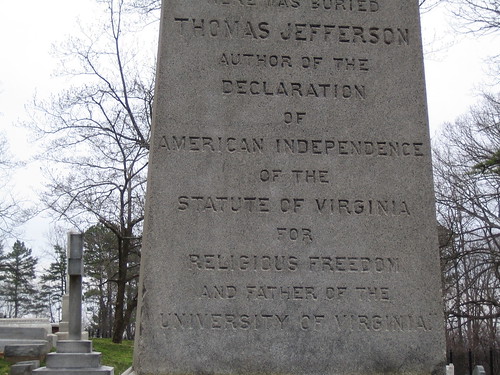
The Virginia Statute for Religious Freedom was one of Thomas Jefferson's proudest achievements, so much so that his tombstone reads

HERE WAS BURIED
THOMAS JEFFERSON
AUTHOR OF THE
DECLARATION
OF AMERICAN INDEPENDENCE
OF THE
STATUTE OF VIRGINIA
FOR
RELIGIOUS FREEDOM
AND FATHER OF THE
UNIVERSITY OF VIRGINIA
BORN APRIL 2, 1743 O.S.
DIED JULY 4. 1826


Of the statute, Jefferson wrote [and is often quoted]:


The bill for establishing religious freedom, the principles of which had, to a certain degree, been enacted before, I had drawn in all the latitude of reason & right. It still met with opposition; but, with some mutilations in the preamble, it was finally passed; and a singular proposition proved that it's protection of opinion was meant to be universal. Where the preamble declares that coercion is a departure from the plan of the holy author of our religion, an amendment was proposed, by inserting the word "Jesus Christ," so that it should read "a departure from the plan of Jesus Christ, the holy author of our religion." The insertion was rejected by a great majority, in proof that they meant to comprehend, within the mantle of it's protection, the Jew and the Gentile, the Christian and Mahometan, the Hindoo, and infidel of every denomination.


It's indisputable that the Virginia scheme was more or less followed in the states, that all religions were protected. But let's look closely at where this freedom comes from.

"Jesus Christ" is explicitly not added, perhaps for the reason Jefferson gives, that all religions are protected. But that's the "plan" of "the Holy author of our religion," a phrase that remains in the text of the statute.

Where as Almighty God hath created the mind free; that all attempts to influence it by temporal punishments or burthens, or by civil incapacitations, tend only to beget habits of hypocrisy and meanness, and are a departure from the plan of the Holy author of our religion, who being Lord both of body and mind, yet chose not to propagate it by coercions on either, as it was in his Almighty power to do...


One might argue that Virginia's statute [the least explicitly religious of all the states] had some other "author" and "religion" in mind than Jesus or the God of the Bible. Jefferson is well-known for his personal skepticism about that stuff.

But Who is this Holy author, and of what religion?

For George Washington's Circular Letter to the States[1783] that announced his stepping down as the Continental Army's commander-in-chief [the revolution was won!], uses "divine author of our blessed religion" in the clear context of Jesus Christ.

"Charity, humility and pacific temper of mind, which were the Characteristics of the Divine Author of our blessed Religion..."


And although it's true that Washington probably didn't personally write it, this indicates what the common meaning of the phrase was, and Washington did sign it in his own hand.

And even in Massachusetts, which had an officially established church, we see the orthodox Calvinist Samuel Adams write as early as 1772 that religious tolerance, via John Locke himself, has become a feature of Christianity:

In regard to religion, mutual toleration in the different professions thereof is what all good and candid minds in all ages have ever practised, and, both by precept and example, inculcated on mankind. And it is now generally agreed among Christians that this spirit of toleration, in the fullest extent consistent with the being of civil society, is the chief characteristical mark of the Church. Insomuch that Mr. Locke has asserted and proved, beyond the possibility of contradiction on any solid ground, that such toleration ought to be extended to all whose doctrines are not subversive of society.


And so, if it be argued that America's religious tolerance was the product of a rising secularism, it can also be argued that the prevailing sentiment of the day was that religious freedom was demanded and guaranteed by Christianity itself.

Regardless of Jefferson's personal theological beliefs, he couldn't avoid using Christian arguments, and that's what got Christians to sign on the dotted line.

Tuesday, March 2, 2010

Rev. Jesse Lee Peterson is Not a Christian?

According to orthodox definitions no. City Journal profiles the anti-Rev. Jesse Jackson. They note:

Take Peterson’s vision of restoring the lost black family, which is unflinchingly religious and traditional. “There is a spiritual order to life that was ordained by God,” he tells me. “And that order is God in Christ, Christ in man, man over woman, woman over children. And it’s not an ego trip, it’s just a spiritual order, that men are subject to Christ and women are subject to men.”

At this point on the interview tape, you can hear me start to stammer hilariously. I don’t agree with everything he says, but. . . . And yet, at the same time I’m stammering, several thoughts crowd in on me. First, Peterson’s traditionalism is only an echo of Paul’s advice to married couples in Ephesians, not to mention John Milton’s deathless description of Adam and Eve: “He for God only; she for God in him.”


Milton, purportedly an "Arian," may not have been a Christian according to this understanding either.

Here is the offending passage:

It was another radio preacher who changed Peterson’s direction: Roy Masters, a British convert from Judaism, who advocated praying to God for self-knowledge and listening quietly for God’s response. Such prayers led Peterson to confront his anger, not against whites, but against his own parents, so that he came to understand himself outside the context of his skin color. He visited his mother and forgave her for her anger. She cried. He visited his father and forgave him for his neglect. The older man was grateful. For Peterson, the experience was liberating and set him on the path of ordination and a successful, directed life.


Yet, Roy Masters doesn't believe in the Trinity, adds books of the Gnostic Gospels to the biblical canon and teaches reliance on a meditation technique which he claims is "Judeo-Christian," not Eastern or New Age, as essential for salvation. You can listen to it here.

Likewise one of Rev. Peterson's Bible experts shocked "Joe Kovacs, author of 'Shocked by the Bible: The Most Astonishing Facts You've Never Been Told'" in claiming Jesus was not God.

The late Bible answer man, the very "orthodox" Walter Martin, claimed Masters was not a Christian and that his philosophy is peppered with anti-biblical and anti-Christian teachings. You can listen to this very fun, illuminating debate here.

Most if not all orthodox Christians, according to Masters, are not saved, but deluded into believing they are saved. Masters also teaches, interestingly, anger is a sin and that saved Christians do not sin (and there are verses and chapters of scripture for both ideas especially the latter; see among others, Matthew 5:48, and 1 John 3:8-10).

(Masters also brags that he stopped having sex with his wife when he was in his mid 40s. He's over 80 and still married.)

Masters' teachings on anger are a little harder to glean from the Bible. However, he might note when the Bible speaks of God's wrath or vengeance, it speaks of something that differs in kind with the emotion of anger human beings are subject to. "Anger" is arguably a mistranslation if, when discussing God's attributes, that English word ever attaches to a biblical translation. And when Jesus chased the money lenders out, he did so not subject to what human beings understand as "feeling angry." He just did the right thing (as he always did) and chased them out.

Anger, accordingly, shouldn't be expressed or repressed (you are damned either way). Humans shouldn't be subject to it. And as long as they are, they aren't saved. Do the meditation and eventually you cease to react in an emotional way to the stresses of life.

I distinctly remember Roy's son David, to demonstrate that you don't need to be subject to anger to do whatever, i.e., take a stand, righteously strike someone (some people think they need to get mad as Hell before they can stand up for themselves), noted: He could come home, find a man raping his wife, pull his gun out and righteously execute the man in defense of his wife -- what he would do -- all the while not being angry or upset.

This is, accordingly, what it means to be saved.

Is this "Christian?" Is it "Judeo-Christian"? As with Mormonism, this reminds me of parallels to the American Founding. You have very "Christian" sounding terminology like "God in Christ, Christ in man, man over woman, woman over children" mixed in with other arguably "alien" elements so a new creature emerges over whose proper religious identity or label is arguable.

That's why the "orthodox" argue "Mormonism isn't Christianity" even though Mormons call themselves Christians. Or that Dr. Gregg Frazer calls what presented itself as "rational Christianity" during the American Founding as "theistic rationalism," not "Christianity."

Friday, February 26, 2010

Three Misuses of the American Founding & Religion For Political Purposes

The culprits are Tim Pawlenty, governor of Minnesota, Dan Kennedy, assistant professor of journalism at Northeastern University, and David Limbaugh, writer, author, attorney, and brother of Rush.

First, at CPAC, Pawlenty declared:

"... God is in charge ... In the Declaration of Independence it says we are endowed by our creator with certain unalienable rights. It doesn't say we're endowed by Washington, DC, or endowed by the bureaucrats or endowed by state government. It's by our creator that we are given these rights."


Pawlenty misused because he is a conservative evangelical Christian and the God of the Declaration of Independence is arguably not that of evangelicals and doesn’t vindicate their ideal vision for society. That document doesn't mention Jesus Christ or quote verses and chapters of scripture. Its call to revolution is arguably in tension with Romans 13. And it's not clear that other central principles enunciated in the Declaration have anything to do with the Bible.

Further, this speech was given at CPAC. God is not a member of CPAC or the conservative movement. Apparently, Pawlenty doesn't realize God is a libertarian. :)

Next we have Dan Kennedy's article on Pawlenty speech featured in the British newspaper The Guardian.

After making a number of good points, Kennedy finishes his article by quoting James Madison and writes:

"While we assert for ourselves a freedom to embrace, to profess, and to observe, the religion which we believe to be of divine origin, we cannot deny an equal freedom to them whose minds have not yielded to the evidence which has convinced us," wrote James Madison.

In contrast to Madison, the Republicans propose a theocracy of believers. It is an assault not just on anyone who isn't one of them, but on the American idea, and on liberal democracies everywhere.


Kennedy's misuse is characterized by the phrase "overstating your case" or "hyperbole."

Finally, Limbaugh's misuse:

Kennedy responds that Pawlenty misrepresented the founders' "intent" because Jefferson, the "primary author" of the Declaration, deleted all references to Jesus' deity from his personal Bible.

Jefferson's Christianity may be subject to debate, but it is clear that he didn't view himself as expressing his own views in the Declaration; rather, "it was intended to be an expression of the American mind." (The American mind, it should be noted, was decidedly Christian.) Plus, a congressional committee led by the devout John Adams made more than 80 changes, deleting nearly 500 words and adding two references to a providential God. The Declaration was a corporate statement of Congress. Also, Jefferson was not present at the Constitutional Convention. So Kennedy's reference to Jefferson is at best misleading, as is his convenient omission of many other relevant facts – including that 52 of the 56 signers of the Declaration and 50 to 52 of the 55 signers of the Constitution were orthodox Trinitarian Christians.


First, Jefferson may well have believed the DOI an "expression of the American mind." But nothing suggests Jefferson believed in an "expression" that at all contradicted his personal political theological convictions. Jefferson -- that unitarian rationalist he -- thought such an "expression of the American mind" entirely compatible with his personal theology that rejected every single tenet of Christian orthodoxy, the infallibility of the Bible, eternal damnation, etc.

Jefferson so embraced the final version of the DOI that he lists his authorship of it as one of his three proudest accomplishments on his tombstone.

Second, Limbaugh falsely contrasts John Adams' "devout" nature with Jefferson's. In reality, the two possessed the same unitarian rationalistic creed that rejected orthodox Christian doctrine, the infallibility of the Bible, eternal damnation, etc.

Finally, Limbaugh passes phony statistics about the "orthodox" nature of the signers of the Declaration and signers [sic] of the Constitution.

The notion that 50-52 of the men who attended to Constitution Convention (only 39 singed!) were "orthodox Christians" is bunk. A scholar -- the late ME Bradford -- asserted this and he based it entirely on some kind of formal or nominal connection to a Christian Church that professed "orthodoxy."

The three of Bradford's "Deists" -- Ben Franklin, James Wilson, and Hugh Williamson -- likewise possessed the same formal/nominal connections to Christian churches with an orthodox creed. As did Jefferson, and J. Adams (who weren't at the CC). And Washington, Hamilton, G. Morris, James Madison and a plethora of other Founders who are not provably "orthodox Trinitarian Christians." (Hamilton, in fact had NO connection to a Church that professed orthodoxy during the Framing of the Constitution.)

The 52 of the 56 figure that relates to the Declaration of Independence results (likely) from a mistake some activist made, confusing Bradford's "52 out of 55," that was meant to discuss the US Constitution, with the signers of the Declaration of Independence.

The truth is, we know a handful of very important Founders (Jefferson, J. Adams, Franklin,) explicitly rejected orthodox Christian doctrines, a handful of important Founders (Washington, Madison, G. Morris, Wilson, Hamilton before the end of his life) were, after meticulous study, not provably orthodox Christians during the time in which they founded America; they went out of their way not to give rope to hang their good reputations with (which leads me to believe they were close to the heterodox rationalist camp than the orthodox camp). And a handful of second tier Founders (Jay, Henry, Witherspoon, Boudinot, Sherman) were provably orthodox Christians (but even they flirted with heterodoxy and rejected Sola Scriptura). There were a number of important second tier Founders like Paine, Allen and Palmer who were strict Deists.

And with the great many of other lesser Founders, we just don't know enough to be certain. Proving they had some kind of connection to an orthodox Church -- as Bradford did to prove the Founders' "orthodoxy" -- shows nothing more than they could have been as orthodox as Patrick Henry or heterodox as Thomas Jefferson.

Thursday, February 25, 2010

Positive Liberty

In case anyone is interested, one of my group blogs, Positive Liberty, has, of late been going through technical problems. The site's founder, my friend Dr. Jason Kuznicki has given up, lest he pull all of his hair out and become bald like me, and joined this very estimable other group blog.

Check that link for more information. If you go to the site Positive Liberty, some squatter now resides there.

The good news is the rest of us libertarians (or is it "we" libertarians; I think this is a place where both "us" and "we" work within the prescriptive grammatical rules) who blog there plan to stick together.

We just aren't yet sure whether we will continue to use the name "Positive Liberty" because our URL has been hijacked.

I'll keep you posted.

....

Update: We are back for now. We will probably go through significant future changes. Again, I'll keep you posted.

Beware Academic Elitism

As we explore the concepts of religion and morality in early American history, to what experts or authorities should we turn? How do we decide whether a certain speaker, activist, or writer can be considered an "expert" or "authority"? Who deserves our attention and respect?

If you've spent much time here at American Creation, you've probably seen several cases where the above questions have been debated -- if not openly, at least in the subtext of the comments. How often have we read someone say that a certain activist, writer, or even blog contributor has dubious or suspect qualifications to address matters of history, because...well....he or she "is not a historian." Not a real historian anyway.

These kinds of exchanges raise some important questions. Does a person need to have a master's or doctorate in history specifically in order to warrant our respectful consideration? Or is a degree even enough? How many books must be published or awards received, before a person is considered sufficiently "credentialed" to warrant our respect?

My thesis is that a speaker, writer, or activist should not be judged (and certainly not dismissed) based solely or even primarily on his or her resume. A person should be evaluated based on character and performance, not on credentials. Having a resume full of degrees, awards, etc. doesn't give someone a monopoly on truth, nor does it exempt him or her from making mistakes or errors in judgment.

To dismiss someone out of hand for a lack of certain credentials can fairly be called "academic elitism" and it has unfortunately raised its ugly head on too many occasions in our society, including here at our American Creation blog.

Scholarship and Credentialism - They Are Not Always The Same

Effective, credible analysis of history requires patience, discipline, careful research, and some form of system designed to compensate for the individual's or group's bias. Regarding the latter, that a person or team will have a bias is natural. No one is free from some kind of bias. But it is possible to account for that bias and put in "checks and balances" to channel and control for it. Thus, it is not elitism to insist that a writer or reseacher employ such skills or disciplines.

On some occasions, activists have failed to employ these skills and have encountered reasonable criticism and scrutiny as a result. David Barton, for example, has acknowledged that his past use of quotes landed him in hot water, because he too casually accepted secondhand or thirdhand sources, rather than confirming the authenticity of the quotes themselves by combing through the original source material. It was a layman's error and a costly one, for it continues to dog his credibility in some circles to this day.

The Internet is full of examples where activists, on all sides of the political spectrum, have lifted quotes out of context or clipped quotes to suit their own purposes. This kind of shoddy, agenda-driven "research" should be called out.

Principles and practices of sound scholarship are certainly needed. But credentialed historians are just as capable of flawed or deceptive "scholarship" as any layperson. Remember Ward Churchill? And how about the late Howard Zinn? Both guys had the official credentials, but their "scholarship" left much to be desired.

It's one thing to demand sound, credible scholarship. It's another to demand that a writer or speaker have a certain resume before you'll give her a hearing!

The Dark Side of Elitism

In a recent article "Judge the Person: Not the Resume," film critic and conservative writer Michael Medved deplored elitism in American culture, writing: "The poisonous polarization of the culture has produced some ill-considered attacks that call into question one of the most fundamental American values: the notion that each individual deserves to be judged on ability, not background, and evaluated on performance rather than credentials.

K12 Academics, an education resource website, defines academic elitism as a belief that "only those individuals who have engaged in scholarship are deemed to have anything worthwhile to say, or do."

Once again, it's not unreasonable to demand that a person "engage in scholarship" insofar as his or her specific studies are concerned. But, all too often, a person is considered to have not "engaged in scholarship," unless he or she has the resume to prove it. Scholarship is too often based on resume.

I grant that a credentialed, professional historian deserves a certain presumption of respect. Nevertheless, a journalist, minister, philosopher, or even one completely outside of social studies can still offer something of value to the study and discussion of history. In fact, at times, such a contribution can be of great value.

David McCullough comes to mind. McCullough's award-winning books are well researched and immensely popular. Yet many deride McCullough, because he lacks a degree in history. To them, McCullough is not a REAL historian. Of course, what this usually means is that the Howard Zinns and quasi-Zinns of the historical scholarship community sneer at McCullough's unabashed patriotism. I mean, a historian - a REAL historian - would never be patriotic, right?

Can Ministers, Theologians, or Activists Offer Good History?

Let's take Dr. Peter Lillback, author of George Washington's Sacred Fire and several other books. A few here at American Creation have dismissed Lillback on the grounds that "he's not a real historian."

Well, Lillback is the president of the renowned Westminster Theological Seminary and head of the Providence Forum. He possesses three degrees: a Bachelor's from Cedarville University, a ThM from Dallas Theological Seminary, and a PhD from Westminster. In addition to serving as president of Westminster, he also teaches a class in historical theology.

It's true that Lillback doesn't have an advanced degree in history specifically, but I can tell you that a degree in religion or theology (and Lillback's degrees and schools are quite impressive in their own right) is similar to one in philosophy, political science, and, yes, even history. Not exact, mind you, but similar in some respects.

I would submit that a minister or theologian, with training in scholarship (be it in the form of an advanced degree or otherwise) can offer something of value to the study and analysis of history. As self-serving as this may sound, a minister or theologian should not be dismissed out of hand for their contributions to the field anymore than a philosopher, political scientist would be.

Of course, scholars like Lillback or activists like David Barton are often dismissed not simply for their lack of history-specific credentials (or lack of "sufficient" history-specific credentials), but because they....heaven forbid...have an agenda!

Anyone who dismisses Lillback or Barton because they have an agenda should never, under any circumstances, pick up a book written by the likes of Howard Zinn, Noam Chomsky, or Ward Churchill or ever watch a documentary by Michael Moore. If having an agenda disqualifies someone from being taken seriously, then, frankly, you're out of luck until Mr. Spock is born or we invent Data. (That's a wink at my fellow Star Trek fans. And frankly, even Spock and Data had agendas!).

So, knock off this nonsense about agendas! I have no problem with scholars having agendas. None whatsoever. And you shouldn't either.

What matters is how a person HANDLES his or her agenda. Are they honest, disciplined, reasonable, and rational in doing the research and laying the intellectual groundwork for the pursuit of their "agenda"?

Let's Not Forget Common Sense

And, frankly, while I agree that it's important for us to exercise some scholarly discipline in our exploration of these subjects. And I'd certainly hate to see American Creation degenerate into partisan mud-slinging or sloppy, superficial articles that are long on agenda and short on research. Nevertheless, let's not ignore the wisdom of common sense!

There are times when average, ordinary Americans without an Ivy League education have something to offer our society. In fact, there are a LOT of such times. I would submit that our greatest Presidents in American history (George Washington and Abraham Lincoln) were not intellectual giants, when it came to academic training and certainly not when it came to "credentials." But they possessed character, wisdom, and a driving desire to learn and grow. This made them great.

So, again, I am not devaluing the importance of knowledge, education, and wisdom. On the contrary, I'm a big believer in all those things, and in the need for honest, painstaking, disciplined research and analysis. But I categorically reject any implication, assumption, or tendency to automatically extend favor to those with certain CREDENTIALS at the expense of those who may not have them.

I'll allow the late conservative icon William F. Buckley, Jr. the last word. Alluding to the Left's unfortunate bias toward intellectual elitism at the expense of common sense, Buckley famously remarked: "I'd rather entrust the government of the United States to the first 400 people listed in the Boston telephone directory than to the faculty of Harvard University."

Tuesday, February 23, 2010

An Unchurched President?

Should our President go to church more often?

Candidate Obama held his first presidential debate in Rick Warren’s Saddleback Church. He worshiped regularly with his family at Chicago’s Trinity Church, until his fiery pastor Jeremiah Wright started sounding like an angry radical. But a recent news story on Boston.com headlines the President’s religion taking a private turn, reporting the family has attended church just four times in the year he’s held office.

The retreat from visible, public piety is drawing fire from some who voted for Obama on the basis of his Christian credentials. The Gallup Poll shows Americans becoming more tolerant in some respects, with larger numbers than in the past saying they might vote for a woman, an Hispanic, or a divorcee for President. But the majority still indicate they could not abide an atheist in the White House.

Apparently, voters want their Chief Executive to believe in God, or at least pretend to believe by warming a pew each week.

But one wonders whether the Founding Fathers would have ever been elected, had this standard been enforced. George Washington’s diaries, for example, indicate that in 1748, he spent 15 Sundays going to church, recording 49 days spent fox hunting, attending two balls, one play and receiving a reprimand from a Scotch Presbyterian acquaintance for spending too much time at the card table. In January the following year, he hunted on twelve days and went to church just once.

Shortly after being elected, President Washington was virtually “arrested” for not attending church, apparently detained by the local tithing man responsible for enforcing New England’s blue laws prohibiting travel on the Sabbath. Delayed and anxious to reach his destination in New York, he was intercepted on Sunday morning in the Connecticut village of Ashford and forced to halt. The President’s diary indicates that he used the interlude to rest his horses, but he found the tavern where he cooled his heels “not a good one” and the sermon of Mr. Pond, the parson of a nearby church, “very lame discourses.”

Some Presidents, like John Adams, attended church almost every Sunday of their lives. Others, like Jefferson and Madison, rarely bothered. But all of the nation’s first half dozen Presidents were enormously discreet about their personal spiritual lives. None would have engaged in the kind of “media spirituality” that voters seem to demand now.

Voters should judge their President on the basis of his economic policies, his ability to work with Congress to pass important legislation, and his strength in protecting America’s interests around the world. Obama’s church attendance (or lack thereof) is just not the public’s business.

Monday, February 22, 2010

State Lawmaker Wants to Amend Iowa's Constitution

Here's a January 11, 2010 online news story from Radio Iowa, Lawmaker restates her oath after “God” flap, by O. Kay Henderson:

A Republican legislator is unhappy the words, “so help me God,” have been dropped as Iowa lawmakers recite the oath of office to begin a new term in the legislature.

Representative Dawn Pettingill of Mount Auburn raised the objection after two new lawmakers were sworn in in the Iowa House in opening ceremonies earlier today. She says there’s a long tradition of appealing to the divine when taking office in Iowa.

“It has been said in the oath of office since 1939 here in Iowa and it’s included in the oath for federal senators and congressman,” Pettingill says. “I think we should have had a discussion before it was removed.”

Pettingill didn’t notice the change last year when all 100 newly-elected members of the Iowa House were sworn in using an oath without the words: “so help me, God.” Mark Bransgaard, the chief clerk of the House, says there was no conscious decision to drop the phrase.

“I didn’t have a copy of the oath so I went to the constitution and copied it, unawares that we’ve said, ’so help me God’ in the past,” Bransgaard says. “I mean, we can go back to saying that if the members choose to do that.”

Representative Pettengill took matters into her own hands and asked for time to speak on the House floor today so she could restate her oath and add: “so help me God.” Pettingill plans to sponsor a resolution to try to put that phrase in the oath for good.

This is the section of the Iowa Constitution outlining the oath of office members of the legislature are to recite:

Oath of members. SEC. 32. Members of the general assembly shall, before they enter upon the duties of their respective offices, take and subscribe the following oath or affirmation: “I do solemnly swear, or affirm, (as the case may be,) that I will support the Constitution of the United States, and the Constitution of the State of Iowa, and that I will faithfully discharge the duties of senator, (or representative, as the case may be,) according to the best of my ability.” And members of the general assembly are hereby empowered to administer to each other the said oath or affirmation.
[end article]

Lawmaker Dawn Pettingill may want to do some additional research before sponsoring "a resolution to try to put that phrase in the oath for good," because according to the 1857 Constitution of the State of Iowa, Article I, Section 5 that type of change would require a constitutional overhaul:
SEC. 4. No religious test shall be required as a qualification for any office, or public trust, and no person shall be deprived of any of his rights, privileges, or capacities, or disqualified from the performance of any of his public or private duties, ... in consequence of his opinions on the subject of religion, ... .

In a previous blog I pointed out how authors Kramnick and Moore were right to single out Utah as having a "unique State Constitution." I guess I need to take that back. The Iowa Constitution apparently protects religious liberty, as spelled out in Article I Section 4, just as well. The big differences between the two states seems to be that Utah office holders are aware of what their constitution says regarding the addition of "so help me God" to the end of their oath.

Unitarianism of the (Early Post) American Founding Era

Following up on TVD's post that features a letter of WILLIAM E. CHANNING, Minister of the Church of Christ in Federal Street, Boston (one of the most notable American Unitarians of that era) to TO THE REV. SAMUEL C. THACHER, circa 1815, I below feature a letter of Jefferson's discussing Channing and unitarianism.

As we know, to many of the "orthodox" of today and back then, unitarianism is not "Christianity" whatever it calls itself. Ironic in that many/most "Christian Nationalists" are orthodox Christians who likely would term non-Trinitarianism as "not Christian."

But if unitarians are "Christians" then that captures a lot more notable Founders (Jefferson, J. Adams, Franklin, probably Madison, and contemporaries of Channing, Joseph Story and Jared Sparks) as "Christians."

That would bring us closer to a "Christian" Founding.

Here Thomas Jefferson writes to Timothy Pickering (February 27, 1821) commenting on one of Rev. Channing's sermons:

....

I thank you for Mr. Channing's discourse, which you have been so kind as to forward me. It is not yet at hand, but is doubtless on its way. I had received it through another channel, and read it with high satisfaction. No one sees with greater pleasure than myself the progress of reason in its advances towards rational Christianity. When we shall have done away the incomprehensible jargon of the Trinitarian arithmetic, that three are one, and one is three; when we shall have knocked down the artificial scaffolding, reared to mask from view the simple structure of Jesus; when, in short, we shall have unlearned everything which has been taught since His day, and got back to the pure and simple doctrines He inculcated, we shall then be truly and worthily His disciples; and my opinion is that if nothing had ever been added to what flowed purely from His lips, the whole world would at this day have been Christian. I know that the case you cite, of Dr. Drake, has been a common one. The religion-builders have so distorted and deformed the doctrines of Jesus, so muffled them in mysticisms, fancies and falsehoods, have caricatured them into forms so monstrous and inconceivable, as to shock reasonable thinkers, to revolt them against the whole, and drive them rashly to pronounce its Founder an impostor. Had there never been a commentator, there never would have been an infidel. In the present advance of truth, which we both approve, I do not know that you and I may think alike on all points. As the Creator has made no two faces alike, so no two minds, and probably no two creeds. We well know that among Unitarians themselves there are strong shades of difference, as between Doctors Price and Priestley, for example. So there may be peculiarities in your creed and in mine. They are honestly formed without doubt. I do not wish to trouble the world with mine, nor to be troubled for them. These accounts are to be settled only with Him who made us; and to Him we leave it, with charity for all others, of whom, also, He is the only rightful and competent Judge. I have little doubt that the whole of our country will soon be rallied to the unity of the Creator, and, I hope, to the pure doctrines of Jesus also.

....

Sunday, February 21, 2010

Locke, Noah and Man as the "Workmanship of God"

By King of Ireland with editorial suggestions by Jon Rowe.

Previously at American Creation, I asked two questions I think better frame the "Christian Nation" debate in clearer context. They are:

1. Which Christian ideas, if any, helped bring us into the modern world?

And:

2. Which Christian ideas, if any, derail us from progressing toward the modern world?
Jack Goldstone's essay at "Cato Unbound" arguing "a community of free individuals sovereign over a limited state" created the engineering culture that launched the modern world, inspired my posts here.

Goldstone wrote:

"What I believe is most critical to insist upon is the degree to which Europe itself had to repudiate central elements of its own history and culture — the absolute authority of hereditary rulers, the prohibition of diverse religious beliefs in any one society, the elevation of the rights and needs of political and social status elites above those of ordinary inhabitants — in order to develop and implement the idea of society as a community of free individuals sovereign over a limited state. Yet this was necessary if the marriage of engineering culture and entrepreneurship was to survive and flourish, and produce the economic and technological miracles of the last two centuries."
I argue that Christianity, properly understood, provided the fertile ground that launched modernity, promoting the the idea of the free sovereign individual. And as such, those who invoke the authority of "science" and "rationality" should be less hostile, as many of them oft-seem, to what I term "rational Christianity," a theological system that helped bring about science, rationality and political liberty.

In this vein, I argue "rational Christianity" and the "rational Judaism" that preceded it, grounds inalienable rights in the notion that man is the workmanship of God and His property. Genesis 1 first discussed this notion when God states man is made in His image. Later in Genesis, the idea is further expounded when God tells Noah it is wrong for man to murder man because he is made in God's image.

This notion was promoted by medieval Roman Catholic Canon Law, most notably by St. Thomas Aquinas, and later by the Anglican natural law theologian Richard Hooker. Citing Hooker, John Locke's Second Treatise directly influenced the Declaration of Independence.

Locke's Second Treatise stresses that inalienable rights exist because man is God's Workmanship and as such, His property.

With that, ladies and gentlemen, John Locke:

"This equality of men by Nature, the judicious Hooker looks upon as so evident in nature and beyond all question, that he makes it the foundation of that obligation to mutual love amongst men on which he builds the duties they owe one another, and from whence he derives the great maxims of justice and charity. His words are:

'The like natural inducement hath brought men to know that it is no less their duty to love others than themselves, for seeing those things which are equal, must needs all have one measure; if I cannot but wish to receive good, even as much at every man's hands, as any man can wish unto his own soul, how should I look to have any part of my desire herein satisfied, unless myself be careful to satisfy the like desire, which is undoubtedly in other men weak, being of one and the same nature : to have anything offered them repugnant to this desire must needs, in all respects, grieve them as much as me; so that if I do harm, I must look to suffer, there being no reason that others should show greater measure of love to me than they have by me showed unto them; my desire, therefore, to be loved of my equals in Nature, as much as possible may be,imposeth upon me a natural duty of bearing to fbemward fully the like affection. From which relation of equality between ourselves and them that are as ourselves, what several rules and canons natural reason hath drawn for direction of life no man is ignorant.'

But though this be a state of liberty, yet it is not a state of license; though man in that state have an uncontrollable liberty to dispose of his person or possessions, yet he has not liberty to destroy himself, or so much as any creature in his possession, but where some nobler use than its bare preservation calls for iw The state of Nature has a law of Nature to govern it, which obliges every one, and reason, which is that law, teaches all mankind who will but consult it, that being all equal and independent, no one ought to harm another in his life, health, liberty or possessions; for men being all the workmanship of one omnipotent and infinitely wise Maker; all the servants of one sovereign Master, sent into the world by His order and about His business; they are His property, whose workmanship they are made to last during His, not one another's pleasure.

And, being furnished with like faculties, sharing all in one community of Nature, there cannot be supposed any such subordination among us that may authorize us to destroy one another, as if we were made for one another's uses, as the inferior ranks of creatures are for ours. Every one as he is bound to preserve himself, and not to quit his station wilfully, so by the like reason, when his own preservation comes not in competition, ought he as much as he can to preserve the rest of mankind, and not unless it be to do justice on an offender, take away, or impair the life, or what tends to the preservation of the life, the liberty, health, limb, or goods of another."

Who Were the Unitarians?

Much has been written here about the "unitarians" of the Founding era. John Adams averred he was one, as did Abagail Adams. But were they Christians?

Well, they certainly considered themselves Christians, and protested quite vociferously when accused of not being Christians, usually by competing "orthodox" clergy.

It all came to a head around 1815, when William Ellery Channing---generally regarded then (as now) as exemplary of that era's unitarianism [Abigail Adams specifically endorsed Channing theologically]---answered some prevailing charges against unitarianism in

A Letter to the Rev. Samuel C. Thacher on the Aspersions Contained in a Late Number of the Panoplist, on the Ministers of Boston and the Vicinity
.

Now, perhaps the defining feature of unitarianism was that it didn't believe in the Trinity---1 + 1 + 1 would equal Three, not One. Hence the term "unitarian."

There were other orthodox doctrines rejected, too, namely, as Channing wrote:

"I fear, that the Author of the Lord's prayer will, according to this rule, be driven as a heretick from the very church which he has purchased with his own blood. In that well known prayer I can discover no reference to the "inspiration of the holy scriptures, to the supreme divinity of the Son and Holy Ghost, to the atonement and intercession of Jesus Christ, to the native and total depravity of the unregenerate, and to the reality and necessity of special divine grace to renew and sanctify the souls of men;" and these, let it be remembered, are _five_ out of the _six_ articles which are given by the Reviewer as fundamental articles of a christian's faith."


So that's what they didn't believe. So what did they believe? Channing wrote:


"The word UNITARIANISM, as denoting this opposition to Trinitarianism, undoubtedly expresses the character of a considerable part of the ministers of this town and its vicinity, and the commonwealth...We both agreed in our late conference, that a majority of our brethren believe, that Jesus Christ is more than man, that he existed before the world, that he literally came from heaven to save our race, that he sustains other offices than those of a teacher and witness to the truth, and that he still acts for our benefit, and is our intercessor with the Father. This we agreed to be the prevalent sentiment of our brethren."


Is that Christian enough? Certainly not to the orthodox clergy and various laymen of the time who stood in opposition to them.

Probably not Christian enough for most Christian theologians of any stripe today, certainly not evangelical or orthodox.

But perhaps Christian enough for the sociologist or the historian. "Unitarian Christian" is my own preference, both descriptively and definitively, at least for our best understanding in this day and age. [Channing and others used "'rational' Christians," but in our day, I'm not sure that's helpful or descriptive enough, although it's certainly a proper term. Channing himself published a popular tract in 1819 called Unitarian Christianity.]

Do read Channing's letter for yourself, as there's more than can be sketched or excerpted here. It offers an excellent window into what is called the Unitarian Controversy today, and clearly outlines the issues and the players, a clarity we need to consider the unitarians properly in the scheme of things.

Saturday, February 20, 2010

Competing Definitions of "Deism" and "Christianity"

During America's Founding era, and today, "Christianity" and "Deism" didn't have univocal meanings, part of what makes the "Christian Nation" debate tough but interesting.

A friend emailed arguing for a broader definition of "Deism." Indeed, scholars have used terms like "warm Deism," or "Providential Deism" to describe the religion of Washington, Franklin, etc.

Thomas Jefferson, from what little he wrote on Deism, seemed to endorse a very broad understanding of Deism, that is belief in one God. He wrote of the "Deism" of the Jews.

In an 1803 letter to Dr. Benjamin Rush, Jefferson wrote:

II. JEWS. 1. Their system was Deism; that is, the belief of one only God. But their ideas of him & of his attributes were degrading & injurious.

….

1. [Jesus] corrected the Deism of the Jews, confirming them in their belief of one only God, and giving them juster notions of his attributes and government.


According to Jefferson, Jews, Muslims, Unitarians, Christians are all "Deists," because they all worship one God. Well...maybe not Trinitarians because they worship three gods. :)

Jefferson's understanding of "Deism" is arguably too broad to be meaningful. And, also arguably, an understanding of "Christianity" that holds anyone who calls himself a Christian (even if an agnostic or an atheist) is too broad to be meaningful.

Scholars can also unfairly play the broad/narrow game to unfairly claim the religion of the American Founders for the side they desire.

As I wrote on Secular Right's website comment thread:

... One unfair thing scholars from both sides do is read one term broadly and the other narrowly to try and “capture” a Founder for each respective side.

The broad understanding of Deism includes belief in an active personal Providence. The broad definition of Christianity includes anyone who call himself a Christian or is formally/nominally associated with a Christian church.

The narrow definition of Deism means belief in a non-intervening God. The narrow definition of Christianity requires strict adherence to the orthodox Trinitarianism found in, for instance, the Nicene Creed.

Broadly understood, the “key FFs” (the first 4 Presidents, Ben Franklin and a few others) were both “Christians” and “Deists.” Hence David Holmes’ term “Christian-Deism” to describe their creed. Narrowly understood they were neither. Hence terms like “unitarianism” or “theistic rationalism” to describe this creed.

Important "Christian Nation" Question

Here at American Creation, Tom Van Dyke asks them. Of them:

---And the old standby, What is "Christian?" Can you be "Christian" if you believe the Bible is the direct Word of God? If you believe Jesus is the Messiah, although not the Second Person of the Holy Trinity?
---And who decides the answer to this question? Trinitarian clergy? Theologians? Sociologists? Historians?

---Was there a God of the Founding?
---Was His name Providence?
---Is this "theism," or is "theism" just a slippery term for what is the uniquely monotheistic, providential Creator-God who endowed men with certain unalienable rights, one who is unmistakably "Judeo-Christian," at least compared to all of man's other gods?
---What might Judeo-Christian mean? Anything? Everybody seems to know what it means, so does that mean anything?


I focused on these because they parallel questions James Madison asked in his notes preparing for the Memorial and Remonstrance. Madison asked:

3. What is Xnty ? Courts of law to Judge.

4. What edition: Hebrew, Septuagint, or Vulgate ? What copy what translation ?

5. What books canonical, what apocryphal ? the papists holding to be the former what protestants the latter, the Lutherans the latter what the protestants & papists ye former.

6. In what light are they to be viewed, as dictated every letter by inspiration, or the essential parts only ? Or the matter in general not the words ?

7. What sense the true one for if some doctrines be essential to Xnty those who reject these, whatever name they take are no Xn Society?

8. Is it Trinitarianism, Arianism, Socinianism ? Is it salvation by faith or works also, by free grace or by will, &c., &c.

9. What clue is to guide [a] Judge thro' this labyrinth when ye question comes before them whether any particular society is a Xn society ?

10. Ends in what is orthodoxy, what heresy. Dishonors Christianity.


By this time many leading light "Protestants," Madison perhaps among them, began to argue things like Arianism, Socinianism, salvation through works, and a Bible where only the "essential" parts (not the whole thing) were inspired, under the auspices of "Christianity."

Yet others -- the "orthodox" -- maintained believers in these positions "whatever name they take are no Xn Society."

Madison didn't want judges resolving this issue. And they would if government gave aid to "Christianity" generally but not "other" religions.

[This is, ironically, exactly what happened in Mass. and what led to their disestablishment, the last state to do so. In the Dedham decision, Unitarian judges decided Unitarianism was "Christianity" and hence eligible for state establishment aid. To the orthodox that poisoned the well; so they got rid of their state establishment of "Protestant Christianity."]

If the Supreme Court ruled the Constitution permits aid to "Christian" but not other religions, one easy solution would be simply call yourself a "Christian" and get that aid. You can be an atheist, a Muslim, a Jew, just call yourself a "Christian" and you are eligible for government support.

And that relates to another dynamic behind the "Christian Nation" debate. No one argues America wasn't and isn't a "Christian nation" in a nominal or demographic sense. No one argues, for instance, the Founders were predominantly Muslim.

98% of Americans thought of themselves as "Christians" as do roughly 80% today. These include, not just Pat Robertson and the Pope, but Chris Hedges, Andrew Sullivan (who it might surprise you, is orthodox in his Christology), Barack Obama and Mitt Romney.

Plenty of deistic and agnostic minded folks consider themselves "Christians" for heritage, cultural and demographic reasons. I am a baptized Roman Catholic (but went no further). Arguably, I could, but I don't, call myself a "Christian-Agnostic." Or a non-practicing Roman Catholic-agnostic.

Rather, we argue over a tighter, more meaningful definition of "Christian," AND how "Christianity" (however that theology defines) informed the principles of the Declaration of Independence, the US Constitution, and Federalist Papers and other aspects of life during Founding era America. Further, we argue over how the Founders THOUGHT government and religion should intersect.

Friday, February 19, 2010

Chris Rodda on Barton & Beck

Check out her latest Huffington Post entry here.

A taste:

On October 25, 2008, I attended a presentation given by Barton. After his presentation, I approached him and gave him a copy of my book, Liars For Jesus: The Religious Right's Alternate Version of American History, a book debunking many of his lies, as well as those of a number of his fellow revisionists.

On January 16, 2009, I became the subject of a segment on Barton's WallBuilders LIVE! radio show, in which he lied about me, my book, and our encounter at his presentation.

Rather than just write about the lies Barton told about me on his show, I decided to make a little video with iMovie, something I've never tried to do before. I ended up getting a bit carried away, making a video that's over an hour long, but once I got started, I wanted to address not just the lies Barton told about me on his show, but also the lies he told in the presentation I attended.

For those unfamiliar with Barton, he is not only the most popular of all the Christian nationalist history revisionists, but a former vice-chair of the Texas Republican Party who was used by the GOP in recent elections to travel the country stumping for their "family values" candidates, and is very well connected with the far right members of Congress. In 2005, was named one of the 25 most influential evangelicals in America by Time Magazine. But, outside of evangelical Christian circles, and those of us who fight the religious right, few people know who he is.

Barton's pals in Congress, who regularly appear on his radio show to push their far right agenda, include Michele Bachmann (R-MN), Randy Forbes (R-VA), Mike Pence (R-IN), Louie Gohmert (R-TX), Joe Pitts (R-PA), Trent Franks (R-AZ).

Another one of Barton's buddies, described by Barton as "One of the Really Cool Guys," is Louisiana governor Bobby Jindal. During Jindal's gubernatorial campaign in 2006, Barton appeared with him at churches in Louisiana, and, on October 18 and 19, 2006, had him on his radio show for a two part interview. Referring in the opening comments of the program to Jindal's election to Congress two years earlier, Barton remarked, "That is the election in which we saw a huge increase in Christian voter turnout, and he is part of that product of what we were able to put in office in 2004."

Barton is currently joining forces with Newt Gingrich and his newly launched Renewing American Leadership organization. According to a March 20 U.S. News & World Report article, "This spring, Gingrich will speak to a handful of large gatherings for politically conservative clergy that have been organized by David Barton, an influential evangelical activist who spearheaded the Republican National Committee's rigorous outreach to pastors in 2004."

Gary Scott Smith on "How Christian Were the Founders?"

Check it out here.

A taste:

Conservative Christian authors such as David Barton, Peter Marshall Jr., and Tim LaHaye contend that most of the founders were devout Christians who sought to establish a Christian nation. Isaac Kramnick and R. Laurence Moore in “The Godless Constitution” and Brooke Allen in “Moral Minority: Our Skeptical Founding Fathers” counter that very few founders were orthodox Christians. They and others often generalize from famous founders, such as George Washington, Benjamin Franklin, John Adams, Thomas Jefferson, James Madison, and Thomas Paine, to argue that most founders were deists who wanted strict separation of church and state.

The truth lies between these two positions. Almost every major founder belonged to a Christian congregation, although a sizable number of them were not committed Christians whose faith strongly influenced their political philosophy and actions. Two recent books edited by Daniel Dreisbach, Jeffry Morrison, and Mark David Hall—“The Founders on God and Government” and “The Forgotten Founders on Religion and Public Life”—carefully explained the religious backgrounds, convictions, and contributions of numerous founders. They show that many who played leading roles in the nation’s Declaration of Independence, the Continental Congress, and the devising and ratification of the Constitution were devout Christians, as evident in their church attendance, commitment to prayer and Bible reading, belief in God’s direction of earthly affairs, and conduct....

Even many of those often labeled as deists—Washington, Franklin, Adams, Jefferson, Madison, and Alexander Hamilton—do not fit the standard definition of deism, which asserts that after creating the world, God has had no more involvement with it. Deism views God as a transcendent first cause who is not immanent, triune, fully personal, or sovereign over human affairs. All of these founders, however, repeatedly discussed God’s providence and frequently affirmed the value of prayer. Their conviction that God intervened in human affairs and directed history has led some scholars to call these founders “warm” or “enlightened” deists, but these terms seem like oxymorons. A better label for their position is theistic rationalism. As Professor Gregg Frazer explains, this hybrid belief system combines elements of “natural religion, Protestant Christianity, and rationalism—with rationalism as the controlling element.” Those espousing this perspective believed in a powerful, benevolent Creator who established the laws by which the universe operates. They also believed that God answered prayer, that people best served Him by living a moral life, and that individuals would be rewarded or punished in the afterlife based on their earthly deeds. Only a few founders, most notably Thomas Paine and Ethan Allan, can properly be called deists.

Washington Supreme Court rules that the 2nd Amendment is incorporated against the states

This story is a bit off-topic since it doesn't deal with religion and the founding, but I thought it might be of interest to our readers because of the significance of the court's ruling, dealing as it does with one of the most controversial components of the Bill of Rights.

Here's some analysis of the Washington supreme court's decision in State v Sieyes, courtesy of the informative Washington State Supreme Court Blog, a website run by the Evergreen Freedom Foundation. The case represents a major victory for gun-rights, although interestingly enough it was a defeat for the appellant in the case before the court.  For what it's worth, I think that Justice Stephens had the better approach; the state supreme court probably should have refrained from addressing the issue of incorporation until the federal Supreme Court decided the issue. But that's a question of prudential judgment. I think the majority's opinion is pretty persuasive.

Here's my favorite line from the majority's opinion:
Accordingly we regard the history, lineage, and pedigree of the Second Amendment right to bear arms necessary to an Anglo-American regime of ordered liberty and fundamental to the American scheme of justice. It is deeply rooted in this Nation’s history and tradition.
Amen to that.

Of course, as the Washington supreme court points out in its ruling, the Washington constitution itself provides significant protections for gun owners. In article 1, section 24 the state constitution explicitly states that:
The right of the individual citizen to bear arms in defense of himself, or the state, shall not be impaired, but nothing in this section shall be construed as authorizing individuals or corporations to organize, maintain or employ an armed body of men.
The Washington constitution makes clear that the right to keep and bear arms, at least under state law, is a right designed not only to allow for a state controlled militia, but also for personal defense.

Which makes me wonder, couldn't the court have decided the case on narrower grounds, basing its decision on the Washington constitution alone, without addressing the question of the 2nd Amendment? This is why I think Justice Stephens' more prudential approach has merit. Why decide a question federal constitutional law if it isn't necessary to do so? And why decide a question of federal constitutional law that is currently before the federal Supreme Court? Wouldn't it have been better to wait to see what the federal Supreme Court will do?

Thursday, February 18, 2010

Was America Founded as a Godless Nation?

Finding the truth of the Founding is
all about asking the right questions
by Tom Van Dyke


Friend-of-the-blog Dr. John Fea is currently writing "Was America Founded as a Christian Nation?: An Historical Primer"
scheduled for publication in 2011.

But is that the proper question? It's always posed in those exact words, with no variation. Some very religious folks answer yes, but on the whole, even for those who argue for America's Christian, or "Godly," heritage, most admit it was not "Founded" as a "Christian Nation," if that means any level of theocracy.

Nor do they wish a "return" to theocracy. Settled early on in the debates in Virginia and elsewhere is that Baptists would rather not be ruled by Presbyterians, and nobody but nobody wanted to be ruled by Roman Catholicism.

Y'see, "Was America Founded as a Christian Nation?" is usually the formulation used by those whose answer is emphatically "NO!"

And so, I submit we must ask better questions to get to the bottom of things, and here are a few:


---Was America founded as a secular nation, then?
---An agnostic nation?
---Since it's said we have a Godless Constitution, was America founded as a Godless Nation?


---And what do we mean by "Founded," anyway? 1787, the ratification of the Constitution? July 4, 1776, which America celebrates as its birthday?
---Was America America yet under the Continental Congress, which called itself the Congress of the United States?

---What is a "nation?" The debates over the First Amendment discarded Madison's language against establishment of a "national" church, since it was to be a federal government. [Jefferson referred to it as the "general" government.]
---Was religion left to the states under federalism, then? Did the ratification of the Constitution and Bill of Rights change the status of Christianity anywhere in America?

---Was America already a Christian nation [at least in most states aside from Virginia] when the Constitution was ratified, and ratification changed nothing?
---Because what does "Founded" mean anyway? Oh, we already asked that one, but it seems proper to return to it here.

---And the old standby, What is "Christian?" Can you be "Christian" if you believe the Bible is the direct Word of God? If you believe Jesus is the Messiah, although not the Second Person of the Holy Trinity?
---And who decides the answer to this question? Trinitarian clergy? Theologians? Sociologists? Historians?

---Was there a God of the Founding?
---Was His name Providence?
---Is this "theism," or is "theism" just a slippery term for what is the uniquely monotheistic, providential Creator-God who endowed men with certain unalienable rights, one who is unmistakably "Judeo-Christian," at least compared to all of man's other gods?
---What might Judeo-Christian mean? Anything? Everybody seems to know what it means, so does that mean anything?


Until we answer each of these questions---and many more, like What is a Founder?---we haven't even scratched the surface. And the terms, my God, the terms. We can put "scare quotes" around each one of them, because each has an arguable meaning:

"America."
"Founded."
"Christian."
"Nation."


Per Dennis Prager, our motto around here is that we value clarity over agreement. As we can see, our national discussion is remarkably free of clarity, since few of us are using the same terms and meanings and are asking the same questions. This is one small vote for clarity.

Wednesday, February 17, 2010

Fea on Barton on Huckabee

Check out Dr. John Fea's reaction to David Barton's appearance on the Mike Huckabee show. Dr. Fea writes:

....

3). I have no idea where Barton gets the idea that 29 of the signers of the Declaration of Independence held "seminary" and "Bible school" degrees. How does he define "seminary" and "Bible school?" These kinds of institutions did not exist in the eighteenth-century.

....

5). One would be hard-pressed to call John Witherspoon the "best known gospel evangelist of his generation." It sounds like Barton wants to turn Witherspoon into some kind of southern revivalist preacher when in fact Witherspoon tended to downplay evangelism and even tried to squash a revival among the student body at Princeton in 1772....

6). Barton fails to mention that Benjamin Rush spent a portion of his adult life as a universalist.

....

8). Barton is wrong about the so-called "prayer meetings" at the Constitution. Franklin did call for prayer at the Constitutional Convention, but his proposal was rejected.

9). Barton is wrong when he claims that the 1782 Aitken Bible was printed by the Continental Congress. The Congress actually turned down a proposal to publish Aitken's Bible, but it did endorse it once it was published. It was not funded by Congress.

....

If you are interested in this kind of stuff, you might be interested in my forthcoming (probably January 2011) book: "Was America Founded as a Christian Nation: A Historical Primer."

Tuesday, February 16, 2010

Did Jefferson support public worship in federal buildings during his administration?

I'm not a fan of David Barton, for a variety of reasons.  To use a phrase from my grandmother, the kind of advocacy-oriented history that Barton (but not Barton alone!) engages in makes my feet itch.  That said, a question was raised in the comments to one of the posts below about a claim Barton made about the extent to which Jefferson supported public Christian worship in federal facilities.  Gordon Wood discusses this point about Jefferson in the latter part of Empire of Liberty and points out that Jefferson did in fact support such worship and even went so far as to specifically authorize church use in federal buildings controlled by the executive branch.  As Wood writes:
Jefferson very much wanted to win over to his Republican cause all those ordinary religious people who had voted for his opponent.  To do so he knew he had to offset the Federalist accusations that he was an enemy of Christianity.  Consequently, to the surprise of many Federalists, he had good things to say about religion in his first inaugural address.  He also knew very well that effect he as president would have when in January 1802 he attended a church service held in the chamber of the House of Representatives.  His attendance attracted wide public notice and astonished the Federalists.  Even though other churches were available, Jefferson continued to attend church services in the House chamber and made available executive buildings for church functions.  Sometimes the U.S. Marine Corps Band supplied music for religious services.  As president, however, Jefferson held to his vow never to call for any days of fasting and prayer as his two predecessors had done.  
Empire of Liberty, pgs. 586-87.  Now, as Wood points out, Jefferson did all this because he was trying to woo the mass of voters who were attached, with varying levels of devotion, to Christianity.  And there were limits to how far Jefferson was willing to pander -- he did not, as the end of the quote above indicates, call for national prayer and fasting on notable occasions.  However, Jefferson was quite willing to use federal facilities, and hence federal funds, to support public Christian worship. 

It was also around this time, according to Wood, that Jefferson began to work on his redaction of the Gospels, a work commonly known today as the Jefferson Bible.

As with most things involving Jefferson, he was not incapable of being duplicitous in order to get what he wanted.  Hypocrisy is the tribute vice pays to virtue, after all.

Related item:  don't forget Jefferson's letter to the Ursuline nuns upon taking over the Louisiana country.  He promises those nuns not just the protections of the Constitution, but the "patronage" of the U.S. government.  Here's a copy of the original letter, still treasured by the Ursuline religious community in New Orleans.  On an unrelated note, Jefferson had terrible handwriting...