Showing posts sorted by relevance for query sherman on morris. Sort by date Show all posts

Saturday, September 6, 2008

Gouverneur Morris, Theistic Rationalist

That's the title to a paper Dr. Gregg Frazer recently gave at the APSA 2008 Annual Meeting, Hynes Convention Center, Boston, Massachusetts. Luckily the entire paper is available online. At 30 pages, that's quite a bit about both Gouverneur Morris and theistic rationalism. Some highlights.

On Morris' importance as Founding Father:


Morris spoke more often than anyone at the Constitutional Convention and was an influential member of the critically important Committee of Style. In fact, Morris wrote the Preamble to the Constitution,...


On theistic rationalism:

Theistic rationalism was a hybrid belief system mixing elements of natural religion, Protestant Christianity, and rationalism – with rationalism as the decisive factor whenever conflict arose between the elements. Theistic rationalists believed that these three elements would generally be in accord and lead to the same end, but that reason was determinative on those relatively rare occasions in which there was disagreement. Rationalism as used here is the philosophical view that regards reason as the chief source and test of knowledge. Educated in Enlightenment thought, theistic rationalists were at root rationalists, but their loosely Christian upbringing combined with reason to convince them that a creator God would not abandon his creation. Consequently, they rejected the absentee god of deism and embraced a theist God of, to a significant extent, their own construction. Hence the term theistic rationalism.

An emphasis on reason had long been accepted in the Christian community, but in Christian thought, reason was a supplement to revelation, which was supreme. Theistic rationalism turned this on its head and made revelation a supplement to reason. In fact, for theistic rationalists, reason determined what should be accepted as revelation from God. Unlike deists, theistic rationalists accepted the notion of revelation from God; unlike Christians, they felt free to pick apart the Bible and to consider only the parts which they determined to be rational to be legitimate divine revelation. They similarly felt free to define God according to the dictates of their own reason and to reject Christian doctrines which did not seem to them to be rational.

The God of the theistic rationalists was a unitary, personal God whose controlling attribute was benevolence. Theistic rationalists believed that God was present and active in the world and in the lives of men. Consequently, they believed in the efficacy of prayer – that someone was listening and might intervene on their behalf. Theistic rationalism was not a devotional or inward-looking belief system; it was centered on public morality. God was served by living and promoting a good, moral life. The primary value of religion was the promotion of morality, and the morality generated by religion was indispensable to a free society. Since all of the religions with which they were familiar promoted morality, they held that virtually all religions were more or less equally valid and led to the same God who is called by many names. Theistic rationalists generally disdained doctrines or dogmas. They found them to be divisive, speculative, and ultimately unimportant since many roads lead to God.


This next passage is important because it clears up a source of confusion that has led to the inapt categorization of many theistic rationalists (like George Washington) as "Christians." Because the theistic rationalists thought Jesus a great moral teacher, they tended to be "pro-Christianity" without actually being Christians. Christianity was just great, as were most other world religions. The non-sequitur would be to conclude that the pro-Christian quotations of the theistic rationalists mean they themselves were Christians. As the paper notes:

In addition, deism was in many ways as much a critique of Christianity as a religion of its own. Deist thought rejected virtually every tenet and fundamental of Christianity and deists were generally critical of Christianity’s central figure: Jesus. In short, deists wanted nothing to do with Christianity or its Christ. While theistic rationalists shared some ideas with deists, they had a much greater regard for Christianity and for Jesus than did most deists.


On Morris' theistic rationalism, particularly his belief in an active God:

In my research, I encountered more than 40 references by Morris to God’s activity in the world, the nation, and the lives of individuals. Although he thought the decrees of Heaven and the ways of Providence “inscrutable by man,” Morris was confident that the “Almighty will work out his wise ends by the means of human folly.” In fact, Morris maintained: “I know that in the order of his providence, the wisest ends frequently result from the most foolish measures. It is our duty to submit ourselves to his high dispensations.” Furthermore: “In the great course of events, which divine Providence may have marked out, human wisdom can do but little.” On the large scale, Morris’s God actively ruled over this world and the universe: “My trust is not in a President, Senate, and House of Representatives, but in Him who governs empires, the world, the universe.” He concluded that “when you take occasion to pity the infirmity of human nature … you assail the wisdom of Providence in his moral government of the world.” He urged a correspondent: “Be persuaded, that, in spite of our feeble efforts and empty vows, events in this world, and in the thousands of worlds, which roll through the regions of space, will pursue the course marked out by Omnipotence. Every inferior intelligence, the greatest as well as the least, is but an instrument in his hand.”


On the God-words of Morris the theistic rationalist:

Because theistic rationalism was a sort of mean between deism and Christianity, Morris shared some beliefs with deism, as well. Like the deists, Morris “detested Calvinism.” Like the deists, Morris and other theistic rationalists used generic “God-words” rather than specifically Christian terms for God and studiously avoided references to “Jesus” or to “Jesus Christ.” As can be seen in the quotations above, Morris’s favorite terms for God were “Providence” and “the Almighty.” Most of the other “God-words” that Morris employed emphasize the deist triad of divine attributes: wisdom, goodness, and power. His third favorite term for God was “the Omnipotent” or “Omnipotence,” which, like Almighty, focuses on power. Morris regularly emphasized God’s wisdom, as well, including a reference to God as “the Fountain of supreme wisdom.” He also used a number of terms to emphasize God’s goodness. He called God “the great Parent,” “indulgent father,” “Comforter,” “the Giver of all good,” and “Creator” and spoke of “the kindness of that Being” and of His “paternal love.”


On why Morris probably wasn't a "Christian":

Turning to Morris’s relationship to Christianity, we know that Morris belonged to an Episcopalian church and that he attended it regularly when in New York. Beyond what may have been essentially club membership, however, there is little evidence connecting him to belief in Christianity. Of the ten fundamental doctrines of Christianity listed above, Morris only identified clearly with one of them: belief in a present, active Creator God; which is the least definitive of the doctrines. Speaking of Christianity, Thomas Jefferson testified: “I know that Gouverneur Morris, who pretended to be in his secrets & believed himself to be so, has often told me that Genl. Washington believed no more of that system than he himself did.” It is instructive to note that, at least in his writings, Morris never claimed to be a Christian and never put forward Christianity as a superior belief system – or even Protestant Christianity as a better religion than the Catholicism that he detested.


And finally, probably the most interesting part of the piece, Morris "immoral" conduct. He was certainly the kinkiest Founding Father:

There is another factor separating Morris from Christianity, or at least highly inconsistent with Christian faith – Morris’s immoral conduct. As to reputation, when he was nominated to be minister to France, Roger Sherman said of Morris that “with regard to moral character I consider him an irreligious and profane man.” James Monroe said: “Upon the grounds of character he was twice refused as a member of the Treasury Board.” Though he publicly defended his appointment of Morris, George Washington wrote to Morris about his “imprudence of conversation and conduct” and asked him to display “more caution and prudence” and “more circumspection.” A few years later, Monroe referred to Morris as “a man without morality.” Of course, this could have simply been a matter of political partisanship or personality conflict, but, in Morris’s case, the reputation was well-earned. Morris once threatened to kill a man if he spoke disrespectfully of him, and he frequently got “very drunk” while in France. His most conspicuous moral problems concerned women, however.

Morris had numerous illicit affairs with married and unmarried women and, by his own admission, was constantly trying to initate new ones. One of his earliest dalliances may have cost him one of his legs. One account of the loss of the leg, which is reported as fact by most biographers, is that it happened as a result of a cart accident. There is a good chance that this was merely a cover story, however. There is reason to believe that Morris lost his leg jumping from a window to escape a jealous husband. John Jay joked about it in a letter of consolation to Morris and Lord Palmerston testified that Morris told him the whole story at breakfast a decade later. There is also circumstantial evidence surrounding the woman involved which lends credence. Morris denied the story in a letter to Jay, but not very convincingly. If true, the unfortunate event did not dissuade Morris from similar activity in the future. In fact, he used the curiosity afforded by his one-legged status to attract and seduce other women.

Morris’s diary entries during his time in France are filled with sexual escapades. He had an ongoing affair with Madame de Flahaut for more than three years. She and Morris were eventually so “wanton and flagrant” that they engaged in intercourse “in the passage … at the harpsichord … downstairs ... the doors are all open,” and in a coach with the coachman staring straight ahead. They became so shameless that they engaged in intercourse inside a convent and even tried to conceive a child while she denied her husband conjugal rights. Morris’s diary contains at least eighteen references to their sexual liaisons, but Morris claimed that they had made love “several hundred” times. In addition to Madame de Flahaut, Morris reported having affairs with Madame Simon, an unnamed “damsel,” Madame de Lita, Madame de Crayen, Miss Matthiesen and her “young sister,” Miss Gehrt, and Mrs. Perez Morton. According to the diary entries, he tried to seduce – or thought of doing so – Madame de Flahaut’s niece, Lady Webster, the “daughter of a Frenchman,” Madame Foucault, the daughter of his landlord, Madame de Nadaillac, Madame de Fontana, and even Dolley Madison! Everyone except Jesus sins, but the extent, duration, and brazenness of Morris’s immoral conduct must call into serious question the idea that he was a Christian. Jesus said that a tree is known by its fruit.

Saturday, May 18, 2013

Christianity and prudence in the political theory of Gouverneur Morris

The always-interesting Imaginative Conservative blog has posted a solid essay by one of the great modern historians of the Founding period, Forrest McDonald, exploring the political theory of one of the most important Founders who is usually overlooked today:  The Political Thought of Gouverneur Morris.  While Morris has been largely ignored when compared to other major Founders, his impact on the Constitution and on the political debates of his day were crucial.  As McDonald notes, at the core of Morris's political theory was his Christian faith, although like most of the Founders he was not sectarian in his approach to religion:
The most pervasive influence on Morris’s thinking was the Christian religion. That statement would have met with shocked disbelief among his many enemies, if for no other reason than that his womanizing was well known. John and Samuel Adams and other New England arch-republicans despised him, and the rigidly puritanical Roger Sherman went so far as to say that “with regard to moral character I consider him an irreligious and profane man.” But no irreligious and profane man could have written, as Morris did to his Loyalist mother from whom he was separated during the war, “Let me earnestly recommend to you so much of religion, as to bear inevitable evils with resignation.” As for himself, he told her, “I look forward serenely to the course of events, confident that the Fountain of supreme wisdom and virtue will provide for the happiness of his creatures.” 
In the same vein, he wrote to a woman whose daughter had died, “Religion offers higher and better Motives for Resignation to the Will of our Almighty Father. Infinite Wisdom can alone determine What is best to give What to leave and What to take away. . .. Grief . . . turns our Affections from the World to fix them more steadily and strongly on the proper Objects and bends our Will to the Will of God.” Elsewhere he made numerous specific references to Jesus Christ as “Our Saviour.” 
Morris cared little for rituals and forms of religion, however, and he was extremely tolerant. Early in his career, in the convention that drafted the New York Constitution of 1777, he frustrated John Jay’s attempt to exclude Roman Catholics from a religious freedom clause. From France he wrote to Robert Morris that “I like real Piety as much as I detest the Grimace of that which is false. I think I have more Religion than formerly since I have been in Paris: perhaps because the People here have or appear to have so little.” He added that he did not consider himself “of sufficient Consequence to share in the immediate Attention of divine Providence,” but was confident of his own “good Fortune,” which, he said, was “but another Name for the same Thing.” In conversation with a Frenchman who insisted that every country had an established religion. Morris assured him that it was not so in America, and went on to “tell him that God is sufficiently powerful to do his own Business without human Aid, and that Man should confine his Care to the Actions only of his fellow Creatures,” leaving it to God “to influence the Thoughts as he may think proper.” 
As McDonald details, Morris believed that religion played a vital role in stabilizing the political order by instilling values and virtues in the people, as well as necessitating education of the populace.  Critically, religion reinforces the principle that rights and duties -- the constituent components of human liberty -- come not from the State but from a source transcendent to it. Liberty is not a gift from the government but from the hand of God.  As McDonald explains, for Morris there was a clear distinction between political liberty and civil liberty, public public government and private concerns. The ties that held the two in balance rest, in Morris' view, on "Obedience to the moral Law," a moral law that was geared towards human flourishing:
Morris believed that God gives every man the right to liberty (hence his regarding slavery as an abomination), and he believed that legitimate government derives its authority from the consent of the governed; but to these largely Lockean notions he added some fine distinctions to minimize their threat to political stability. He conceived of liberty as being of two orders. One was political liberty, meaning participation by the people in the enactment of legislation and in holding government accountable. The other was civil liberty, the right of individuals to be left alone, and especially to do with their property what they choose without interference from government. He saw political liberty as being necessary for the protection of civil liberty, but also as posing a danger to it: “Political Liberty considered seperately from civil Liberty can have no other Effect than to gratify Pride”; ”Where political Liberty is in Excess Property must be insecure and where Property is not secure Society cannot advance”; and ”A Nation of Politicians, neglecting their own Business for that of the State, would be the most weak miserable and contemptible Nation on Earth.” The remedy was to limit political liberty by checking the power of the legislative through the establishment of independent executive and judicial branches. This sounds quite Montesquieuan until one recalls that Montesquieu thought that free commerce would totally undermine a republic, whereas Morris believed that commerce, as the most dynamic part of civil liberty, was an indispensable agent promoting the advancement of civilization. Commerce, he said, “requires not only the perfect Security of Property but perfect good Faith,” and thus its effects were “to encrease civil and to diminish political Liberty.- For those reasons, and because the standards of behavior in commercial transactions were so high when conducted honorably, commerce could make possible an increase in the general stock of virtue and “Obedience to the moral Law,” which were “the best Means of Promoting human Happiness.”
Because human beings and human societies are different, there can be no one universal type of government for Morris.  Diversity in organization and political forms are a hallmark of human life, and thus no one form of government can be prescribed to guarantee human flourishing. Thus, Morris did not display reflexive hostility to monarchy, although like most of the Founders he did display misgivings about democracy's tendency for the population to be bought off by the powers that be. The corruption of government power to loot and redistribute wealth, whether from the few to the many or from the many to the few drew Morris's disdain. Honorable government and honorable individuals, acting in accord with virtue, were as McDonald explains, a key concept of political practice for Morris, and this concept linked Morris's ideas with those of Federalist Founders like Washington and Hamilton:
Morris, like Washington, Hamilton, and many another High Federalist. had as a polestar a principle that has generally been given rather short shrift by historians, namely honor, in the sense in which Joseph Addison used the term in his popular play Cato. True honor, Addison explained, operates out of desire for “the esteem of wise and good men.” He elaborated, “Religion embraces virtue, as it is enjoined by the laws of God; honour, as it is graceful and ornamental to human nature.” As a religious man as well as a man of honor. Morris was impelled by both. Hence he could write, in a letter to Senator Oliver Ellsworth thanking him for supporting the appointment as minister to France. “the favorable Sentiment of virtuous and judicious Men has ever appeared to me (next to an approving Conscience) the highest earthly Reward for our Exertions.” He could refuse to join a speculative enterprise that was certain to be profitable because it was based on inside information, say to one who talked of legal obligation that ‘There is a moral Obligation anterior and paramount to Law,” and tell another who was torn between the dictates of duty and conscience that he knew of “no Duty but that which Conscience dictates.” The sanctity of contracts, of giving one’s word, was integral to the concept of honor; early on. Morris wrote that among the French “there is one fatal Principle which pervades all Ranks. It is a perfect Indifference to the Violation of Engagements.”
McDonald's essay serves as a delightful short introduction to the thought of this important and yet overlooked American Founder.  Read it all.

Saturday, May 31, 2008

Sherman on Morris:

If I asked you to guess the randiest of America's founders, you'd probably guess Ben Franklin. Arguably you'd be wrong. Gouverneur Morris was an avid and unrepentant adulterer and fornicator. He attempted to seduce many married women including Dolly Madison. Arguably he was even more licentious than Franklin.

As his biographer Richard Brookhiser put it in this interview: "If you were broke, or in jail, or had lost the dearest person in your life, and you needed money, help, or consolation, the first Founder you would call would be Morris." Yet, Brookhiser joked, if you had him over for dinner you'd never seat him next to your wife or your daughter.

Sounds like "The Wolf" (Harvey Keitel's character) from Pulp Fiction.

On his religion he was either a theistic rationalist, or perhaps a strict deist. He certainly was no orthodox Christian. Morris was appointed US minister to France, in 1792. His fellow founder Roger Sherman, himself an orthodox Christian, testified about Morris' character, explaining why he opposed Morris' appointment:

Some observations respecting Mr. Morris' appointment having been already made, I shall explain the reasons why I shall not vote for his appointment, and that I may not be misunderstood I shall class my remarks under two heads, one having respect to Mr. Morris' natural capacity, & the other his moral character.

I ought in the first place to observe, that I bear Mr. Morris no ill will—1 have personally known him for several years; I have served with him in Congress, & was with him in the Convention of 1787. I have never been borne down by his superior Talents, nor have I experienced any mortifications from the manner in which he has treated me in debate. I wish him and all mankind holy and happy. I allow that he possesses a sprightly mind, a ready apprehension, and that he is capable of writing a good letter and forming a good Draft. I never have heard that he has betrayed a Trust, or that he lacks integrity—indeed I have not known him in any individually responsible station—In the State Legislature, in Congress, & in the Convention of 1787, he was one of many, and in the office of Finance his principal was responsible, and nothing for or against him can be inferred from these stations.

With regard to his moral character, I consider him an irreligious and profane man—he is no hypocrite and never pretended to have any religion. He makes religion the subject of ridicule and is profane in his conversation. I do not think the public have as much security from such men as from godly and honest men—It is a bad example to promote such characters ; and although they may never have betrayed a trust, or exhibited proofs of a want of integrity, and although they may be called men of honor—yet I would not put my trust in them—I am unwilling that the country should put their Trust in them, and because they have not already done wrong, 1 feel no security that they will not do wrong in future. General Arnold was an irreligious and profane character—he was called a man of honor, but I never had any confidence in him, nor did I ever join in promoting him. I remember he sued a man at New Haven for saying he had the foul disease—and it was urged that the Jury should give heavy damages, because Arnold was a man of honor and high-minded—but this same Arnold betrayed his Trust when he had an opportunity and would have delivered up the Commander in chief & betrayed his country. And the like has happened from other such characters ; and I am against their being employed and shall therefore vote against Mr. Morris. [My emphasis.]

Sunday, August 22, 2010

Gouverneur Morris, Theistic Rationalist

Another repost from The One Best Way here.

This is from Gregg Frazer on Morris' "kinky" behavior:

There is another factor separating Morris from Christianity, or at least highly inconsistent with Christian faith – Morris’s immoral conduct. As to reputation, when he was nominated to be minister to France, Roger Sherman said of Morris that “with regard to moral character I consider him an irreligious and profane man.” James Monroe said: “Upon the grounds of character he was twice refused as a member of the Treasury Board.” Though he publicly defended his appointment of Morris, George Washington wrote to Morris about his “imprudence of conversation and conduct” and asked him to display “more caution and prudence” and “more circumspection.” A few years later, Monroe referred to Morris as “a man without morality.” Of course, this could have simply been a matter of political partisanship or personality conflict, but, in Morris’s case, the reputation was well-earned. Morris once threatened to kill a man if he spoke disrespectfully of him, and he frequently got “very drunk” while in France. His most conspicuous moral problems concerned women, however.

Morris had numerous illicit affairs with married and unmarried women and, by his own admission, was constantly trying to initate new ones. One of his earliest dalliances may have cost him one of his legs. One account of the loss of the leg, which is reported as fact by most biographers, is that it happened as a result of a cart accident. There is a good chance that this was merely a cover story, however. There is reason to believe that Morris lost his leg jumping from a window to escape a jealous husband. John Jay joked about it in a letter of consolation to Morris and Lord Palmerston testified that Morris told him the whole story at breakfast a decade later. There is also circumstantial evidence surrounding the woman involved which lends credence. Morris denied the story in a letter to Jay, but not very convincingly. If true, the unfortunate event did not dissuade Morris from similar activity in the future. In fact, he used the curiosity afforded by his one-legged status to attract and seduce other women.

Morris’s diary entries during his time in France are filled with sexual escapades. He had an ongoing affair with Madame de Flahaut for more than three years. She and Morris were eventually so “wanton and flagrant” that they engaged in intercourse “in the passage … at the harpsichord … downstairs … the doors are all open,” and in a coach with the coachman staring straight ahead. They became so shameless that they engaged in intercourse inside a convent and even tried to conceive a child while she denied her husband conjugal rights. Morris’s diary contains at least eighteen references to their sexual liaisons, but Morris claimed that they had made love “several hundred” times. In addition to Madame de Flahaut, Morris reported having affairs with Madame Simon, an unnamed “damsel,” Madame de Lita, Madame de Crayen, Miss Matthiesen and her “young sister,” Miss Gehrt, and Mrs. Perez Morton. According to the diary entries, he tried to seduce – or thought of doing so – Madame de Flahaut’s niece, Lady Webster, the “daughter of a Frenchman,” Madame Foucault, the daughter of his landlord, Madame de Nadaillac, Madame de Fontana, and even Dolley Madison! Everyone except Jesus sins, but the extent, duration, and brazenness of Morris’s immoral conduct must call into serious question the idea that he was a Christian. Jesus said that a tree is known by its fruit.

Monday, January 26, 2009

The First Amendment Debates

A closer look at the genesis of the Establishment Clause
by Tom Van Dyke


As we know, George Mason, a "key" Founder and delegate to the Constitutional Convention of 1787, refused to sign the draft that came out of it because it lacked a Bill of Rights. So, even though he didn't work on it himself, the House and Senate set about working on one.

And so, the legislative history of the religion clause of what became the First Amendment:


* Mason's original conception: "All men have an equal, natural and unalienable right to the free exercise of religion, according to the dictates of conscience; and that no particular sect or society of Christians ought to be favored or established by law in preference to others."

* James Madison's draft, June 7, 1789: "The Civil Rights of none shall be abridged on account of religious belief or worship, nor shall any national religion be established, nor shall the full and equal rights of conscience be in any manner, nor on any pretext infringed. No state shall violate the equal rights of conscience or the freedom of the press, or the trial by jury in criminal cases."

* House Select Committee, JUL-28 "No religion shall be established by law, nor shall the equal rights of conscience be infringed..."

* Samuel Livermore, AUG-15 "Congress shall make no laws touching religion, or infringing the rights of conscience."

* House version, AUG-20 "Congress shall make no law establishing religion, or to prevent the free exercise thereof, or to infringe the rights of conscience." (Moved by Fisher Ames)

* Initial Senate version, SEP-3 "Congress shall make no law establishing religion, or prohibiting the free exercise thereof."

* Final Senate version, SEP-9 "Congress shall make no law establishing articles of faith or a mode of worship, or prohibiting the free exercise of religion."

* Conference Committee: "Congress shall make no law respecting an establishment of religion, or prohibiting the free exercise thereof."


Philip Hamburger, very good, on what was on Madison's mind during the debates in the House.

Some notes:

a) The Virginia Declaration of Rights was not the product of the Enlightenment-type secularists; Baptists and the Presbyterian laity [eventually joined by their clergy] wanted government to butt out of state-supported religion. It should be noted that Virginia was one of the more diverse states sect-wise: The [Anglican] Episcopalians were in the mix there, too. That the sects were in competition was key, and indeed Hamburger alludes to the thought that several sects might combine against the others.

b) Virginia isn't typical: the other states tended to be dominated by one sect or another.

c) Quotes from the House debates:

Mr. SYLVESTER had some doubts of the propriety of the mode of expression used in this paragraph. He apprehended that it was liable to a construction different from what had been made by the committee. He feared it might be thought to abolish religion altogether.

Mr. HUNTINGTON said that he feared, with the gentleman first up on this subject, that the words might be taken in such latitude as to be extremely hurtful to the cause of religion. He understood the amendment to mean what had been expressed by the gentleman from Virginia; but others might find it convenient to put another construction on it.


Hyuh, you got that one right, Messrs. SYLVESTER & HUNTINGTON.


But in fairness, although we cannot pick up the debate after it moved from the House to the Senate, because it seems there wasn't much of one, let's look at the record:

September 3, 1789--First Federal Congress


The Senate resumed the consideration of the Resolve of the House of Representatives on the Amendments to the Constitution of the United States.


The third article [which became the religion part of the First Amendment---TVD], as it passed the house, stand thus:

"Congress shall make no law establishing religion, or prohibiting the free exercise thereof; nor shall the rights of conscience be infringed."

On motion, To amend Article third, and to strike out these words. "Religion or prohibiting the free Exercise thereof," and Insert, "One Religious Sect or Society in preference to others,"

It passed in the Negative.

On motion, For reconsideration,

It passed in the Affirmative.

On motion, That Article the third be striken out,

It passed in the Negative.

On motion, To adopt the following, in lieu of the third Article, "Congress shall not make any law, infringing the rights of conscience or establishing any Religious Sect or Society,"

It passed in the Negative.

On motion, To amend the third Article, to read thus- "Congress shall make no law establishing any particular denomination of religion in preference to another, or prohibiting the free exercise thereof, nor shall the rights of conscience be infringed."

It passed in the Negative.

On the question upon the third Article as it came from the House of Representatives-

It passed in the Negative.

On motion, To adopt the third Article proposed in the Resolve of the House of Representatives, amended by striking out these words- "Nor shall the rights of conscience be infringed."

It passed in the Affirmative.


Since we respect the Framing/Ratification process as Madison asks us to, we can plainly see that the Senate wanted no part of overspecifying "religion" to merely mean preventing one Christian sect from gaining dominance over the others, although that meaning might be reasonably drawn from the House debates.

We should also note that just as Rep. LIVERMORE "was not satisfied with the amendment; but he did not wish them to dwell long on the subject," and Madison himself wrote privately that the Bill of Rights was a "nauseous project,"
so too, "after this the amendments to the Constitution sent from the House of Representatives...[t]hey were treated contemptuously by Izard, Langdon, and Mr. Morris. Izard moved they they should be postponed till next session. Langdon seconded, and Mr. Morris got up and spoke angrily but not well."

There were obviously many who were opposed or just bored with the idea of a Bill of Rights, and Sen. Robert Morris in particular was kinda wasted and going bankrupt by then. Sorta like now.


So, there's plenty of wiggle room for all.


But let's return to James Madison once more, which might explain the Senate's retisence to get involved at all:

Mr. MADISON said he apprehended the meaning of the words to be, that Congress should not establish a religion, and enforce the legal observation of it by law, nor compel men to worship God in any manner contrary to their conscience. Whether the words are necessary or not, he did not mean to say, but they had been required by some of the state conventions, who seemed to entertain an opinion, that under the clause of the Constitution, which gave power to Congress to make all laws necessary and proper to carry into execution the constitution, and the laws made under it, enabled them to make laws of such a nature as might infringe the rights of conscience, and establish a national religion; to prevent these effects he presumed the amendment was intended, and he thought it as well expressed as the nature of the language would admit.


Obviously, if the clauses barring "[o]ne Religious Sect or Society in preference to others" or "establishing any particular denomination of religion in preference to another" had been adopted, a majority of the states could still come up with a looser definition of Christianity and use it to gang up on a Quaker state or a Catholic one or a Unitarian one; surely it would make sense for the Senate to dodge the question entirely. Lord knows that Christianity had a long history of one set of Christians declaring another set of Christians to not be Christians at all.

And so, it might be useful at this point to revisit that link from Philip Hamburger on the Virginia debates. Sects/denominations "ganging up" on the others would be a real possibility, and would explain why the Senate wanted no part of that possible complication. In that case, the anti-sectarian argument for non-establishment still holds. Certainly those who argue from the lack of evidence for the Founders' orthodoxy would be hard-pressed to argue that the Founders contemplated any other religions than Christianity taking over, or even that they knew much about the other non-Christian religions.

In closing, I'd also submit that
any discussion of this matter must begin at the beginning, with "Congress shall make no law..." [Bold face mine.]

According to the record of the House debates, Roger Sherman, a "key" Founder who was also part of the committee of five who drafted the Declaration of Independence, and generally regarded as not only a thoughtful but very religious man, "thought the amendment altogether unnecessary, inasmuch as Congress had 'no authority whatever delegated to them by the Constitution to make religious establishments; he would, therefore, move to have it struck out."

Perhaps Rep. Sherman was right, and we are arguing about nothing, since by most understandings, religion was formally and purposely left out of the central government for the states individually to sort out for themselves.

Wednesday, July 11, 2018

Who Were the Founders?

We get a lot about certain "key" Founders, especially John Adams and Thomas Jefferson and their copious--and often post-presidential--writings, although much of their stature rests on becoming president after the US government was established by the Constitution, of which neither of them were "Framers." Nor did either actually fight in the Revolution. [Hamilton was a Revolutionary general and was one of the authors of the Federalist Papers; Madison of course is the "Father of the Constitution; and Washington won the war and chaired the Constitutional Convention!]   

With a HT to Mark David Hall, from Daniel Dreisbach of American University, Founders Famous and Forgotten:

Consider the political career of Roger Sherman of Connecticut (1721-1793), a largely self-taught man, devout Calvinist, and lifelong public servant. He was one of only two men who signed all three of the great documents of American organic law: the Declaration of Independence, the Articles of Confederation, and the Constitution. He was a delegate to the First and Second Continental Congresses. He was a member of the five-man committee formed to draft the Declaration of Independence and a member of the committee of thirteen formed to frame the Articles of Confederation. At the federal Constitutional Convention of 1787 he delivered more speeches than all but three delegates and was a driving force behind the Great (Connecticut) Compromise. He was a member of the first U.S. House of Representatives (1789-1791) and later of the U.S. Senate (1791-1793), where he played key roles in deliberations on the Bill of Rights and the creation of a national bank. If any man merits the mantle of “founding father,” surely it is Roger Sherman.

Yet few Americans recall, let alone mention, Sherman’s name when enumerating the founding fathers; even among those familiar with his name, most would be hard pressed to describe his role in the founding.


...

When asked to identify the “founding fathers,” Americans typically respond with a short list of a half dozen or so notables who have achieved iconic status in the American imagination and collective memory. This is true of even serious students of American history. The small fraternity of “famous founders” typically includes (in no particular order) Benjamin Franklin, George Washington, John Adams, Thomas Jefferson, James Madison, and Alexander Hamilton. To this short list, individual historians occasionally add a favorite figure or two.
There is, however, a much larger company of statesmen who made salient contributions in thought, word, and deed to the construction of America’s republican institutions. Unfortunately, many among the founding generation, whose contributions and sacrifices were consequential in the creation of a new nation, have slipped into unmerited obscurity, exiles from the elite fraternity of the famous. Why are some individuals, whose well-documented contributions were valued by their peers and celebrated in their time, largely forgotten in our time? Why are a few founders “famous” and others now “forgotten”?

...


According to a well-worn axiom, history is written by the victors. The reputations of several important founders have been damaged, one suspects, because they were on the losing side of great debates or controversies, especially the bitter debates over the declaration of American independence and ratification of the proposed national constitution. Consider, for example, the Quaker John Dickinson of Delaware and Pennsylvania (serving both states as the elected chief executive), who championed the cause of American liberties in aseries of brilliant “Letters from a Farmer in Pennsylvania” (1767-1768), and who was a delegate to the Stamp Act Congress where he drafted the “Declaration of Rights and Grievances” (October 1765), a member of the First and Second Continental Congresses where he was the principal draftsman of the “Declaration of the Causes and Necessity of Taking Up Arms” (6 July 1775), and one of Delaware’s delegates to the Constitutional Convention of 1787. In 1776, however, he spoke eloquently against and refused to sign the Declaration of Independence because he thought it premature and intemperate, and his reputation and public career suffered for it, despite commendable subsequent service to the nation. It has been said of George Mason that “His opposition to ratification of the federal Constitution— a document whose shape he helped mightily to craft—started his fall from the national memory.” The public standing of other vocal critics of the proposed Constitution was arguably diminished by their controversial stances in this most important national debate, despite the fact that some later became ardent admirers of the charter. Among the critics were Patrick Henry, Richard Henry Lee, Elbridge Gerry, Samuel Adams, George Clinton, Luther Martin, and John Francis Mercer. Other founders may have similarly fallen from public favor because of their advocacy of positions and causes that later proved unpopular.
The stature of some founders has risen and fallen with the vagaries of subsequent politics. As political parties emerged in the late eighteenth century and carved out well defined identities in the nineteenth century, partisans often appropriated selected founders as precursor spokesmen for, or ideological models of, their party perspectives, or as avowed opponents of some partisan position. The Jacksonian Democrats of the 1820s and succeeding decades, forexample, described themselves as inheritors of the Jeffersonian tradition and demonized Federalist party stalwarts, such as Alexander Hamilton, John Adams (an especially inviting target because his son, John Quincy Adams, was Andrew Jackson’s immediate foe), and John Marshall, for their opposition to Jeffersonian politics. (The reputations of other prominent Federalists— such as Fisher Ames, John Jay, Rufus King, Gouverneur Morris, and C.C. Pinckney—may have similarly suffered in the wake of their party’s demise and Republican ascendancy at the turn of the century.) Thus, Jefferson’s reputation as a founder flourished and Federalist founders’ reputations floundered as Jacksonianism ascended. The War Between the States and its aftermath prompted a reappraisal of Hamilton’s staunch advocacy of a strong national government, and, in the North at least, Hamilton eclipsed the states-rights Jefferson as a “revered figure in the minds of most Americans.” According to Merrill D. Peterson, “Jefferson’s reputation merely survived the War; Hamilton’s was remade by it.” In summary, political partisans of succeeding generations have promoted or demoted selected founders in the public mind depending on whether a founder’s views and associations advanced or impeded the goals of these latter-day partisans.
Another explanation focuses on certain founders’ unappealing personal traits, quirks or eccentricities, or alleged moral failings. George Mason’s truculent temperament and general aversion to public life almost certainly diminished his profile in the history of the founding era. He was a most reluctant public figure, eschewing the limelight and declining to pursue high office (although reluctantly accepting public office when called). An abrasive, egotistical personality did little to enhance Thomas Paine’s reputation, and pious Americans from his day to the present have reviled him for his heretical views on Christianity. John Adams described the radical pamphleteer as “the lying rascal,” and Teddy Roosevelt denounced him as that “filthy little atheist.”

And so the most influential polemicist of the age, renowned on both sides of the Atlantic, died in relative obscurity in 1809 without a eulogy from his former compatriots in the struggle for American independence. Gouverneur Morris’s well earned reputation as a profligate rake and lecher may have diminished his standing among prudish nineteenth-century Americans. In a very different vein, Aaron Burr’s widely publicized roguish, even “murderous,” and allegedly treasonous conduct has kept him alive in the public memory, but it has also demoted him from the pedestal of a venerated founder.

There is the tragic case of James Wilson, who died in ignominy in 1798 at age 56, fleeing from creditors for failed land speculation. He was buried in an obscure country graveyard in Edenton, North Carolina. Today, Wilson is virtually unknown to the American public, but he was among the most trenchant and influential minds at the Constitutional Convention (making more speeches than any other delegate, save Gouverneur Morris), and he stamped an indelible mark on American legal theory through his influential law lectures and tenure on the U.S. Supreme Court. Robert Morris, a signer of the Declaration of Independence, Articles of Confederation, and Constitution, a member of the first federal Congress, and the indispensable “financier of the Revolution”—a man who by any measure should be remembered as a founding father—similarly borrowed heavily and failed miserably in western land speculation. He languished for three and a half miserable years in a debtors’ prison and his reputation has never recovered.


Finally, there seems to be an inclination among modern scholars to dismiss, discount,or ignore the views of pious founders whose ideas and actions were shaped by deeply held religious convictions. Trained in the rationalist traditions of the academy, some scholars are unfamiliar or uncomfortable with or closed to religiously informed arguments and rhetoric; thus, they dismiss as serious thinkers or otherwise decline to engage founders whose worldview was profoundly religious. Founders steeped in the rationalist traditions of the Enlightenment are more familiar and accessible, and their exploits are advanced in modern scholarship. John Witherspoon’s faith based perspectives may have scared off more than one secular scholar; moreover, his clerical collar may have symbolically entangled church and state too excessively for modern sensibilities. The profiles of Samuel Adams, Roger Sherman, Oliver Ellsworth, John Jay, Elias Boudinot, and Isaac Backus, among others, may have been similarly diminished by modern scholars on account of their profoundly religious identities and perspectives.


Read the whole thing.

Sunday, June 28, 2015

Our Religious Founders: Forgotten or Intentionally Neglected?

From the invaluable Daniel Dreisbach, with a HT to friend-of-the-blog Mark David Hall:

Consider the political career of Roger Sherman of Connecticut (1721-1793), a largely self-taught man, devout Calvinist, and lifelong public servant. He was one of only two men who signed all three of the great documents of American organic law: the Declaration of Independence, the Articles of Confederation, and the Constitution. He was a delegate to the First and Second Continental Congresses. He was a member of the five-man committee formed to draft the Declaration of Independence and a member of the committee of thirteen formed to frame the Articles of Confederation. At the federal Constitutional Convention of 1787 he delivered more speeches than all but three delegates and was a driving force behind the Great (Connecticut) Compromise. He was a member of the first U.S. House of Representatives (1789-1791) and later of the U.S. Senate (1791-1793), where he played key roles in deliberations on the Bill of Rights and the creation of a national bank. 
If any man merits the mantle of “founding father,” surely it is Roger Sherman. Yet few Americans recall, let alone mention, Sherman’s name when enumerating the founding fathers; even among those familiar with his name, most would be hard pressed to describe his role in the founding. Why is it that a man of such prodigious contributions to our country is today an all but forgotten figure? 
The same question could be asked about many other patriots— John Dickinson, Elbridge Gerry, John Jay, Richard Henry Lee, George Mason, Gouverneur Morris, Charles Pinckney, Benjamin Rush, John Rutledge, James Wilson, and John Witherspoon, just to name a few—who labored diligently to establish an independent American republic.
When asked to identify the “founding fathers,” Americans typically respond with a short list of a half dozen or so notables who have achieved iconic status in the American imagination and collective memory.
This is true of even serious students of American history. The small fraternity of “famous founders” typically includes (in no particular order) Benjamin Franklin, George Washington, John Adams, Thomas Jefferson, James Madison, and Alexander Hamilton. To this short list, individual historians occasionally add a favorite figure or two.  There is, however, a much larger company of statesmen who made salient contributions in thought, word, and deed to the construction of America’s republican institutions. Unfortunately, many among the founding generation, whose contributions and sacrifices were consequential in the creation of a new nation, have slipped into unmerited obscurity, exiles from the elite fraternity of the famous.
Why are some individuals, whose well-documented contributions were valued by their peers and celebrated in their time, largely forgotten in our time? Why are a few founders “famous” and others now “forgotten”? Separating the famous from the now forgotten founders may erroneously convey the notion that the founders were a much more single-minded, monolithic fraternity than they really were. Our understanding of the delicate balance of personalities, perspectives, and experiences so vital to the success of the founding generation is obscured when we train our sights on a select few famous founders and disregard the rest. 
As previously noted, for example, the most orthodox Christians among the founders (Samuel Adams, Elias Boudinot, Oliver Ellsworth, Patrick Henry, John Jay, Roger Sherman, and John Witherspoon) are rarely counted among the company of famous founders, despite their substantial contributions to the new nation, suggesting, perhaps, that the founders (and, more important, their ideas) were more heterodox than they really were. The contributions of traditional Christian thought to the American founding are, in large measure, diminished in the process.
These distortions, unfortunately, are sometimes translated into modern law and policy. Judicial interpretations of the First Amendment illustrate the potential problems. The U.S. Supreme Court’s near exclusive reliance on the views of Thomas Jefferson and James Madison, two purported advocates of church-state separation, to divine the original understanding of the First Amendment, while ignoring the input of others who, in the deliberative process, championed an essential role for religion in public life, has arguably resulted in a distorted construction of the First Amendment.
Mark David Hall has recently documented that, in its recourse to legislative history, the U.S. Supreme Court has given inordinate attention to Jefferson and Madison. The focus on these two Virginians is odd, if not counter-historical, because Jefferson was, at most, only indirectly involved in framing the First Amendment (he was serving as the American Minister to France when the First Congress framed the amendment) and Madison suffered decisive defeats in his efforts to shape the content of the religion provisions. As Cushing Strout observed: “Madison did not carry the country along with Virginia’s sweeping separation of churches from the state: indeed, the country in some degree carried him.”

Read the whole thing.

Thursday, June 26, 2008

An American Tradition, Universally Understood?

When Pastor Peter Lillback, during the Q&A part of the National Constitution Center program, Washington: Devout or Deist, was confronted by Matthew Goldstein (see Comment from my previous blog) with the fact that there are several presidents who are known not to have added "So help me God" to their respective oaths, Lillback conceded that he was just repeating what he regarded as a "generally understood viewpoint." However, he went on to expand upon what he thought were the special circumstances surrounding Washington's inaugural ceremony in attempt to bolster his assertion that Washington had added "So help me God" to his presidential oath.

In his response, Lillback relied heavily on his observation that Washington was a Virginian, and as such he had likely repeated "ten or twelve oaths in his life," which concluded with the words, "So help me God." This is absolutely true, but only in the sense that all of these oaths took place during the colonial era when there was a congenital union between the English monarchy and the Anglican Church. What Lillback overlooks is that from the time starting with the American Revolution there does not appear to be a single documented instance where George Washington swore to an official oath in the service of our country that included a religious codicil.

We, also, need to consider that the Virginia Constitution of 1776 did not mandate a religious oath; and when it came to the to the Continental Congress, the Articles of Confederation did not even mention an oath as being necessary for its delegates. The United States Constitution does prescribe an oath for the president, but it omits any acknowledgement of a supreme being. This is also true for the legislated oath designated for all federal employees. When on June 1, 1789, President Washington signed An Act to regulate the Time and Manner of administrating certain oaths into law, it simply stated, "I, A. B. do solemnly swear or affirm (as the case may be) that I will support the Constitution of the United States." Most importantly, the Constitution also states that "no religious test shall ever be required as a qualification to any office or public trust under the United States" (Article VI. Section, III).

The first reported instance of Washington swearing to an oath in the post-colonial era occurred as a result of the Continental Congress passing a bill on 3 February 1778 that required all Continental Army officers to sign a certificate to "acknowledge the UNITED STATES of AMERICA, to be Free and Independent and Sovereign States, ... ." Washington signed this certificate without appending "so help me God," even though the legislation passed by the Continental Congress had included an optional use of the words "So help me God" by placing those words outside of the delimiting quotation marks. As can be seen, Washington did not append "So help me God" to his military oath of May 12, 1778.


George Washington signed this oath of allegiance on May 12, 1778 while at Valley Forge. The same document was executed by such others as Von Steuben and Alexander Hamilton. They are on display in the National Archives, Washington, DC. (Courtesy National Archives.)

Pastor Lillback continued with a second point by saying, "In fact, it [saying 'So Help me God' as was done in Virginia] was the American tradition, universally understood, because the word oath implied that you were saying this before God. And the words 'So help me God,' were not adding God to it. God was there when you took an oath. It was saying, I need help to keep what I just promised."

The problem here is that Lillback can only see George Washington as agreeing with his "universal understanding" as to what oaths meant during the colonial era. What this means, of course, is that Lillback has to turn a blind eye to what happened at the Constitutional Convention of 1787. In The Godless Constitution, Kramnick and Moore explain what happened this way:
While passionately debated in the new nation, the "no religious test" clause elicited surprisingly little discussion at the Philadelphia Constitutional Convention itself. It was introduced by Charles Pinckney, the governor of South Carolina, on August 20, whereupon it was immediately referred to the Committee on Detail without any debate among the delegates. The committee presented its general report on August 30 and made no reference to Pinckney's proposal. Not to be ignored, Pinckney moved it again to the floor. Roger Sherman of Connecticut, the committee chairman, held that the prohibition was unnecessary," the prevailing "liberality" being a sufficient security against such tests. Gouverneur Morris and General Charles Cotesworth Pinckney seconded Governor Pinckney's motion, however. It was then voted on and, according to the Maryland delegate Luther Martin, "adopted by a very great majority of the convention without much debate." No record of the exact vote, but Madison's personal notes of the convention report that North Carolina voted no and that Maryland was divided. According to Luther Martin, "there were some members so unfashionable [his italics] as to think that a belief in the existence of a Deity and of a state of future rewards and punishments would be some security for the good conduct of our rulers, and that in a Christian county it would be at least decent to hold some distinction between the professors of Christianity and downright infidelity or paganism.

Well might these 'unfashionable' members be surprised at the position taken so easily by the majority at the Constitutional Convention, for eleven of the thirteen states had religious tests for public offices in 1787. Even in Rhode Island, once the most religiously pluralistic and liberal state, where small numbers of Catholics an Jews freely worshipped, only Protestants could vote or hold office. New Hampshire, New Jersey, both Carolinas, Vermont, and Georgia also required officials to be Protestants. Massachusetts and Maryland insisted on belief in the Christian religion as a qualification for office. Pennsylvania required its officials to be Protestants who believed in God and the divine inspiration of the Old and New Testaments; in Delaware all elected and appointed public officials were required to profess 'faith in God the father, and in Jesus Christ His Holy son, and in the Holy Ghost, One God blessed forevermore.' Several state constitutions also required office holders to acknowledge that God was a 'rewarder of the good and punisher of the wicked.'"

What Lillback can't recognize, and what Professor Peter Henriques clearly
explained is this:
If you look at the evidence [as to whether Washington appended anything to his oath], and I don't want to take [more than] a short time, but the evidence for that is surprisingly weak. It's a case where people accept something, pass it on, but the actual evidence for it is not [there], and Washington is strict constructionist. He is not going to change the constitutional oath, at least, not without anyone mentioning it. Indeed the French Ambassador, who was there, and wrote down what he said, and wrote the oath, did not put it in.

The Senate, four days after Washington's Inauguration, passed an oath for Congressmen that specifically took out the words "So help me God" [from the ad hoc oath originally taken by the House members]. I can't imagine they would have taken that out of the oath if George Washington had done it, at least without any comment.

Monday, January 4, 2010

Letter to a "Christian Americanist"

David Barton won't debate but sometimes folks involved in the "Christian America" movement engage in dialog. What follows is my latest email to an unnamed Christian Americanist, involved in the movement. I don't need to reproduce the series. I think you can get the gist of what we've discussed from the context of my email:

Here's a problem I have with your response: You are engaging in what's known as the genetic fallacy/poisoning the well. You intimate that if I am not "Christian" I can't properly view the American Founding & religion. Not being a Christian may send me to Hell, but it detracts nothing from the facts I uncover or arguments I make on this issue. But even accepting your logical fallacy, many Christians whose orthodox and evangelical bona fides are beyond reproach, view the American Founding the way I do (or vice versa). Indeed, they, not [David] Barton, are the cutting edge scholars on Christianity and the American Founding. These include men like Mark Noll, Gary Scott Smith, Gregg Frazer and many others. Of them, I've gotten to know Dr. Frazer and believe me, you don't have to warn me about Hellfire because he has on our American Creation threads.

In addition to him, whose work we feature regularly at AC (he's been invited as a frontpage blogger but declined) Rev. Brian Tubbs (a front page poster) is an evangelical minister and, Dr. John Fea, our regular reader and friend, is an evangelical and historian at Messiah College.

Gregg Frazer (who, as I've told you, is John MacArthur's key historian/political scientists on these issues at his church and college) would, as a fellow evangelical WARN YOU about corrupting the purity of the Bible's message by incorporating non-Christian, Americanist theology into the pulpit! You are the one, from the perspective of evangelical biblical Christianity, bringing down the Bible's message with impurity.

I don't know who the Deist big three or four are. The Deists, as I recognize them, are Thomas Paine, Ethan Allen and Elihu Palmer. And though they did important work, in part because of their outspoken Deism, they were not "key Founders." The key Founders are the first 4 Presidents, Ben Franklin and a few others. And although, if your religion is true, as mere men, they had no real power to TOUCH God's Word, they indeed ATTEMPTED to turn Christianity into a generic moralizing creed and succeeded in establishing THEIR man made creed -- which was neither Deism nor orthodox Christianity -- as the political-theological foundation of America.

The problem with trying to get a hold of the beliefs of the 200 or so FFs, taken as a collective, all we have are minimalistic connections to Christian churches for virtually all of them. On the surface both Jefferson and Patrick Henry were Anglicans/Episcopalians. The other supposed "Deist" (which he was not) Franklin likewise has a minimalistic connection to Presbyterianism and Episcopalianism. We need carefully examine their writings. And unfortunately there are question marks with most of them. That's why we focus carefully on the writings of the first and second tier Founders [the first 4 Presidents, Ben Franklin, Hamilton, G. Morris, Wilson, Sherman, Mason, Witherspoon, Jay, Henry.] But we also welcome religious explications from more forgotten Founders as well. Ultimately they were a mixed bag and Barton's formulation that 4 or 5 were deists, the rest "Christians" is false.

Re Henry (and yes I know he "smelt a rat" at the Constitutional Convention) what I said about him is fact: Though an orthodox Christian, his "give me liberty or give me death" line was taken, not from the Bible or a "Christian" source, but from Addison's Cato.

On Witherspoon, terming his writings in Lectures On Moral Philosophy, "Catholic" is probably the most charitable "Christian" reading you can given them. His "Lectures" are important because THAT and not Calvinism is what he taught his Princeton political students like James Madison. Witherspoon PURPOSEFULLY ignores the Bible in Lectures and the entire work is a defense of arguing metaphysical truths from reason/rationalism, not the Bible. It's Scottish Enlightenment 101. But my conservative Roman Catholic friends tell me Scottish Enlightement looks a lot like Aristotelian-Thomism.

Now, Witherspoon's Lectures are available online for free [hyperlink not in my original email]. Do you want me to direct you to them?

Regards,

Jon Rowe

Friday, February 26, 2010

Three Misuses of the American Founding & Religion For Political Purposes

The culprits are Tim Pawlenty, governor of Minnesota, Dan Kennedy, assistant professor of journalism at Northeastern University, and David Limbaugh, writer, author, attorney, and brother of Rush.

First, at CPAC, Pawlenty declared:

"... God is in charge ... In the Declaration of Independence it says we are endowed by our creator with certain unalienable rights. It doesn't say we're endowed by Washington, DC, or endowed by the bureaucrats or endowed by state government. It's by our creator that we are given these rights."


Pawlenty misused because he is a conservative evangelical Christian and the God of the Declaration of Independence is arguably not that of evangelicals and doesn’t vindicate their ideal vision for society. That document doesn't mention Jesus Christ or quote verses and chapters of scripture. Its call to revolution is arguably in tension with Romans 13. And it's not clear that other central principles enunciated in the Declaration have anything to do with the Bible.

Further, this speech was given at CPAC. God is not a member of CPAC or the conservative movement. Apparently, Pawlenty doesn't realize God is a libertarian. :)

Next we have Dan Kennedy's article on Pawlenty speech featured in the British newspaper The Guardian.

After making a number of good points, Kennedy finishes his article by quoting James Madison and writes:

"While we assert for ourselves a freedom to embrace, to profess, and to observe, the religion which we believe to be of divine origin, we cannot deny an equal freedom to them whose minds have not yielded to the evidence which has convinced us," wrote James Madison.

In contrast to Madison, the Republicans propose a theocracy of believers. It is an assault not just on anyone who isn't one of them, but on the American idea, and on liberal democracies everywhere.


Kennedy's misuse is characterized by the phrase "overstating your case" or "hyperbole."

Finally, Limbaugh's misuse:

Kennedy responds that Pawlenty misrepresented the founders' "intent" because Jefferson, the "primary author" of the Declaration, deleted all references to Jesus' deity from his personal Bible.

Jefferson's Christianity may be subject to debate, but it is clear that he didn't view himself as expressing his own views in the Declaration; rather, "it was intended to be an expression of the American mind." (The American mind, it should be noted, was decidedly Christian.) Plus, a congressional committee led by the devout John Adams made more than 80 changes, deleting nearly 500 words and adding two references to a providential God. The Declaration was a corporate statement of Congress. Also, Jefferson was not present at the Constitutional Convention. So Kennedy's reference to Jefferson is at best misleading, as is his convenient omission of many other relevant facts – including that 52 of the 56 signers of the Declaration and 50 to 52 of the 55 signers of the Constitution were orthodox Trinitarian Christians.


First, Jefferson may well have believed the DOI an "expression of the American mind." But nothing suggests Jefferson believed in an "expression" that at all contradicted his personal political theological convictions. Jefferson -- that unitarian rationalist he -- thought such an "expression of the American mind" entirely compatible with his personal theology that rejected every single tenet of Christian orthodoxy, the infallibility of the Bible, eternal damnation, etc.

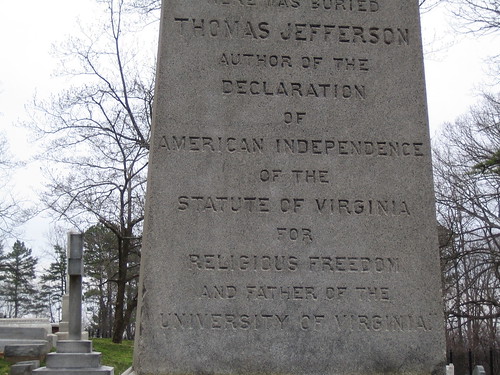
Jefferson so embraced the final version of the DOI that he lists his authorship of it as one of his three proudest accomplishments on his tombstone.

Second, Limbaugh falsely contrasts John Adams' "devout" nature with Jefferson's. In reality, the two possessed the same unitarian rationalistic creed that rejected orthodox Christian doctrine, the infallibility of the Bible, eternal damnation, etc.

Finally, Limbaugh passes phony statistics about the "orthodox" nature of the signers of the Declaration and signers [sic] of the Constitution.

The notion that 50-52 of the men who attended to Constitution Convention (only 39 singed!) were "orthodox Christians" is bunk. A scholar -- the late ME Bradford -- asserted this and he based it entirely on some kind of formal or nominal connection to a Christian Church that professed "orthodoxy."

The three of Bradford's "Deists" -- Ben Franklin, James Wilson, and Hugh Williamson -- likewise possessed the same formal/nominal connections to Christian churches with an orthodox creed. As did Jefferson, and J. Adams (who weren't at the CC). And Washington, Hamilton, G. Morris, James Madison and a plethora of other Founders who are not provably "orthodox Trinitarian Christians." (Hamilton, in fact had NO connection to a Church that professed orthodoxy during the Framing of the Constitution.)

The 52 of the 56 figure that relates to the Declaration of Independence results (likely) from a mistake some activist made, confusing Bradford's "52 out of 55," that was meant to discuss the US Constitution, with the signers of the Declaration of Independence.

The truth is, we know a handful of very important Founders (Jefferson, J. Adams, Franklin,) explicitly rejected orthodox Christian doctrines, a handful of important Founders (Washington, Madison, G. Morris, Wilson, Hamilton before the end of his life) were, after meticulous study, not provably orthodox Christians during the time in which they founded America; they went out of their way not to give rope to hang their good reputations with (which leads me to believe they were close to the heterodox rationalist camp than the orthodox camp). And a handful of second tier Founders (Jay, Henry, Witherspoon, Boudinot, Sherman) were provably orthodox Christians (but even they flirted with heterodoxy and rejected Sola Scriptura). There were a number of important second tier Founders like Paine, Allen and Palmer who were strict Deists.

And with the great many of other lesser Founders, we just don't know enough to be certain. Proving they had some kind of connection to an orthodox Church -- as Bradford did to prove the Founders' "orthodoxy" -- shows nothing more than they could have been as orthodox as Patrick Henry or heterodox as Thomas Jefferson.

Friday, April 24, 2015

Hall on Stewart's "Nature's God"

Mark David Hall has published a piece for the Spring 2015 issue (pp. 285-291) Christian Scholars Review entitled "A Failed Attempt at Partisan Scholarship." It reviews Matthew Stewart, Nature’s God: The Heretical Origins of the American Republic.

We get an exclusive preview. See below:
Matthew Stewart is upset.  It seems there have been many attempts, “most of them misinformed, some shamelessly deceitful,” to deny the “basic fact” that America’s founders embraced a version of deism that is “functionally indistinguishable from what we would now call ‘pantheism’; and pantheism is really just a pretty word for atheism” (4-5).  “Christian nationalists” such as David Barton, Gary DeMar, John Eidsmoe, and “Tim La Haye” [sic] who challenge this reality not only “misread the American Revolution . . . they betray it” (445).  
Given this complaint, one might think that Stewart would engage books written by these men.  But he ignores them.  Instead, he points to four volumes that provide “a good start on exposing the deceitful historiography of Christian nationalism” (445).  Of these books, Michelle Goldberg’s Kingdom Coming (2007), Jeff Sharlet’s The Family (2008), Rob Boston’s Why the Religious Right is Wrong about the Separation of Church and State (2003), and Chris Rodda’s Liars For Jesus (2006), only the latter—a self-published screed—comes close to meeting this description.  The others make occasional references to David Barton but are far more interested in revealing theocratic conspiracies by leaders of the religious right.
            In addition to popular Christian authors, “new Christian nationalists” are also a “powerful force” within the academy (445).  The only example Stewart gives of such a work is a volume I co-edited with Daniel L. Dreisbach and “Jeffery” [sic] Morrison entitled The Forgotten Founders on Religion and Public Life (University of Notre Dame Press, 2009).  We, in cooperation with contributors Mark Noll, Edith Gelles, Gary Scott Smith, William Casto, Gregg Frazer, Thomas Buckley, Jonathan Den Hartog, David Voelker, Kevin Hardwick, Robert Abzug, and Rosemarie Zaggari, succeed in “creating the illusion of a debate where in substance there is none” (445).  That Stewart considers any of these scholars to be “Christian nationalists,” new or otherwise, should give anyone familiar with the literature on religion and the American founding pause.  Many of these scholars have also written well-received books and articles on the subject, yet these are completely ignored by Stewart.  So are relevant works penned by Jane Calvert, Thomas Curry, John Fea, Nathan Hatch, James Hutson, Thomas Kidd, Donald Lutz, George Marsden, Vincent Philip Muñoz, Ellis Sandoz, and Barry Shain.   
            Stewart does mention books by Alan Heimert, Steven Waldman, Patricia Bonomi, T.H. Breen, and Jack Rakove that contend, in his estimation, that “the American Republic owes its independence and its individual freedom to its Protestant Christian legacy” (72, 460).  But he dismisses this view as getting “the history of ideas almost exactly wrong” (73).  These authors miss, in Stewart’s mind, the central truth that the “Reformed religion brought carnage to Britain and Germany in the seventeenth century and madness to America in the eighteenth because it was a symptom of modernity, not a cause—a pathology, not a theory” (73).[1]
            In contrast to “new Christian nationalists” and others who see the relationship between religion and the American founders as complex, Stewart much prefers the clarity of R.R. Palmer, who “could still write” as late as 1959 that, “[a]s for the leaders of the American Revolution, it should be unnecessary to demonstrate that most of them were deists” (445).  Those were the good old days.
Or were they?  It seems to me that it is still quite common for writers to echo Palmer’s assertion.  Included among their number are Brooke Allen, Edwin Gaustad, Steven Green, Richard Hughes, Susan Jacoby, Harvey Kaye, Steven Keillor, Isaac Kramnick, Frank Lambert, William Martin, R. Laurence Moore, Geoffrey Stone, John Wilsey, and Gordon Wood.[2]  If these authors bother to defend their claims, something R.R. Palmer did not do, they follow a distressingly common and problematic path.  In most cases they focus on the religious views of some combination of the following men: Benjamin Franklin, George Washington, John Adams, Thomas Jefferson, James Madison, Thomas Paine, and Alexander Hamilton.  On rare occasions they reach beyond this select fraternity to include another founder, and almost inevitably they concede that not all founders were as enlightened as the ones they profile.  However, they leave the distinct impression that most founders, and certainly the important ones, were deists.
            Stewart departs little from this pattern.  The vast majority of the examples he gives of founders rejecting orthodox Christian views come from five men: Franklin, Jefferson, Paine, Ethan Allen and Thomas Young.  Virtually no one—including popular Christian authors—denies that these men came to embrace heterodox views.  The first three are well known and are regularly discussed in books of this sort.  Stewart’s relatively minor deviation from the common approach is his heavy reliance on Allen and Young.
Ethan Allen is reasonably well known as the hero of Fort Ticonderoga, an important advocate for Vermont statehood, and the author of the first American book advocating deism, Reason the Only Oracle of Man (1785).  Even admirers recognize that Allen was a poor writer, that the book sold fewer than 200 copies, and that it had almost no influence.  After its publication he played virtually no role in American politics, which perhaps helps explain why writers who argue that America’s founders were deists do not spend a great deal of time discussing him.
          One contribution of Nature’s God is to introduce the deist founder Thomas Young.  Young is not unknown to students of religion and the founding, but he is usually described in passing as Ethan Allen’s mentor and the unacknowledged coauthor of Reason the Only Oracle of Man.  Stewart contends that Young was not, in fact, the volume’s coauthor.  As well, he does a good job of highlighting Young’s underappreciated contributions such as advocating resistance to perceived acts of British tyranny in Boston and helping to craft the Pennsylvania Constitution of 1776.  Yet Young died in 1777 and so played little role in the creation of America’s constitutional order. 
          No reasonable student of religion and the founding denies that the five founders regularly quoted by Stewart rejected orthodox Christian beliefs.  But the case is far more questionable with the other important founders Stewart claims as radical deists: Washington and Madison.  Indeed, Stewart gives no evidence that they rejected orthodox Christian ideas, to say nothing of embracing deism or pantheism.  Like other texts in this genre, the proof he offers is highly selective or misleading.
          For instance, Stewart writes: “Jefferson, Dr. Benjamin Rush, Gouverneur Morris, and possibly the Reverend Ashbel Green, Washington’s own minister . . . were convinced” that Washington was “a deist, not a Christian” (31).  As evidence he cites Jefferson’s diary entries for February 1, 1800, where he recalled that Rush told him that Green observed that Washington was not forthright about his religious views and a second entry where he reported that Morris told him that Washington was not a Christian.  It is noteworthy that there is no mention of anyone even suggesting that Washington was a deist, and contrary to Stewart, it is not clear from Jefferson’s “tone” what the Sage of Monticello thought (452).[3]  Using second and third hand accounts is inherently problematic, but if Stewart is going to do so, he should engage competing accounts.  For example, John Marshall, the great jurist who served on Washington’s staff during the War for Independence, wrote that the general was a “sincere believer in the Christian faith, and a truly devout man.”[4]  Similarly, a Frenchman who knew Washington said that “[e]very day of the year, he rises at five in the morning; as soon as he is up, he dresses, then prays reverently to God.”[5]  Yet Stewart ignores these accounts.
          Even more troubling, Stewart quotes Washington selectively and uses ellipses to remove problematic words in his quest to prove him to be a child of the Enlightenment.  Consider his use of Washington’s famous Circular to the States (1783), which he quotes to show that America’s first president joined the radical deistical project of discarding, in Stewart’s words, “the politically dangerous delusions that arise from the common religious consciousness” (389).  In a footnote to this sentence he concedes that Washington also gives credit for America’s progress to “the pure and benign light of revelation,” but dismisses this as “a characteristic gesture of Washington and the deistic Enlightenment—to give credit for pacifying the rebarbative masses…” (528).  But consider the sentence in full (passages quoted by Stewart in bold):
The foundation of our Empire was not laid in the gloomy age of Ignorance and Superstition, but at an Epocha when the rights of mankind were better understood and more clearly defined, than at any former period, the researches of the human mind, after social happiness, have been carried to a great extent, the Treasures of knowledge, acquired by the labours of Philosophers, Sages and Legislatures, through a long succession of years, are laid open for our use, and their collected wisdom may be happily applied in the Establishment of our forms of Government; the free cultivation of Letters, the unbounded extension of Commerce, the progressive refinement of Manners, the growing liberality of sentiment, and above all, the pure and benign light of Revelation, have had a meliorating influence on mankind and increased the blessings of Society.[6]
Given Stewart’s argument, it would seem reasonable for him to address Washington’s claim that “the light of Revelation” has had an influence “above all” other factors. 
          But things get worse (at least for Stewart’s argument) if one reads the last sentence in the Circular: 
I now make it my earnest prayer, that God would have you, and the State over which you preside, in his holy protection, that he would incline the hearts of the Citizens to cultivate a spirit of subordination and obedience to Government, to entertain a brotherly affection and love for one another, for their fellow Citizens of the United States at large, and particularly for brethren who have served in the Field; and finally that he would most graciously be pleased to dispose us all to do Justice, to love mercy, and to demean ourselves with that Charity, humility, and pacific temper of mind, which were the Characteristics of the Divine Author of our blessed Religion, and without an humble imitation of whose example in these things, we can never hope to be a happy Nation.[7]   
Do popular Christian authors make too much of this paragraph with its prayer, paraphrase of Micah 6:8, and reference to Jesus Christ (“the Divine Author of our religion”)?  Perhaps.  But a scholar interested in presenting an accurate account of Washington’s views should engage this part of the text, not simply ignore it.  It is ironic that Stewart’s use of primary sources, here and elsewhere, bears a strong resemblance to the worst practices of the popular Christian authors that he criticizes. 
          Stewart makes a weak case that Washington is a deist, and he offers even less reason to believe that Madison is appropriately labeled as such.  He does mention in passing a few other founders who held heterodox views, e.g., John Adams, Gouverneur Morris, Joel Barlow and Philip Freneau.  But rejecting some tenets of orthodox Christianity is not the same thing as embracing deism, a distinction that seems lost on Stewart.  Indeed, it is shocking how little evidence Stewart offers to support this affirmative claim.  
          Those who argue that America’s founders were deists often limit their claims to “key,” if unrepresentative, founders, but Stewart also contends that deism “spread in America far beyond the educated elite” (5).  He provides few examples of such deists, but he does offer several contemporary accounts.  For instance, he quotes the following passage from a 1785 evangelical petition against Patrick Henry’s general assessment bill: “Deism with its ballefull Influence is spreading itself over the state” (31).  But again, consideration of the full text from which Stewart is quoting tells a different story.  The full sentence reads: “But it is said Religion is taking its flight, and that Deism with its banefull Influence is spreading itself over the state.”[8]  Note that the authors are not themselves making the claim; they are referring to someone else, presumably supporters of the general assessment bill.  Advocates of government subsidies have an obvious incentive to exaggerate the problems they seek to address with taxpayer dollars.
          Many scholars who contend that the founders were deists understand the god of deism to be, in Stewart’s words, “a ‘watchmaker God’ who fashions a world of mechanical wonders and then walks away to the sound of ticking noises.  Deism, according to this line of interpretation, was just a watery expression of the Christian religion…” (5).  Stewart rejects this conventional view.  Instead, he contends that America’s founders embraced a form of deism that is “functionally indistinguishable from what we would now call ‘pantheism,’ and pantheism is really just a pretty word for atheism” (5).  America’s founders as functional atheists; now there is an interesting claim. 
          Stewart spends a good portion of Nature’s God examining the philosophical roots of America’s heretical origins.  He traces them to Epicurus and Lucretius, who developed a rationalist, materialist philosophy that looks to nature, not God, for guidance.  Their quest was embraced by modern thinkers such as Thomas Hobbes, John Locke, and Isaac Newton, but critical to this enterprise is the work of Benedict de Spinoza.  Spinoza, it turns out, is the “principal architect of the radical political philosophy that achieves its ultimate expression in the American republic” (147-48).  Stewart concedes that “[t]here was—and is—no meaningful evidence at all in revolutionary America” of Spinoza’s influence (3).  But this doesn’t matter as Locke embraced Spinoza, and Locke is “the single greatest intellectual influence on America’s revolutionaries” (141). We know this because Carl Becker told us so in 1922 (141).  Ah, the good old days.
          Stewart recognizes that Locke can be read as being more or less compatible with Christianity, but he dismisses this debate with the unsupported assertion that “by the time his work reached American ears, only the radical interpretation [of Locke’s works] mattered” (241).  Making almost no reference to what the founders (elite or otherwise) actually read or cited, he argues for a clear line of influence from Epicurus to Hobbes to Spinoza to Locke to the American founders.
          Stewart regularly makes sweeping statements that leave the impression America’s founders were radical deists who wanted to create a godless republic, but he occasionally offers the qualification that many Americans were traditional Christians and that intellectual traditions not antithetically opposed to Christianity may have had some influence as well (e.g. 32, 352).  But these qualifications are too few, faint, and far between.  By focusing on a handful of founders with radical religious views, some important—Franklin, Jefferson, and Paine—and others relatively unimportant—Allen and Young—he grossly distorts the founders’ religious views and political commitments.  Even brief consideration of a wider range of founders reveals a very different picture.[9]
          Before concluding, I should observe that Stewart’s grasp of basic political and constitutional issues in the era leaves much to be desired.  To give just a few examples, Pennsylvania’s Constitution of 1776 did not contain a “bristling array of checks and balances” (376).  James Wilson was the only delegate to the federal convention of 1787 to argue for the direct, popular, and proportional election of members of the House and Senate and the President, yet Stewart labels him the “personification of the ‘conservative’ side of the Revolution” (387).  Presumably to convince readers that Wilson was a conservative, Stewart notes that he was “the architect of the ‘three-fifths’ compromise that embedded the institution of slavery in the new Constitution” (387).  Wilson did propose this compromise in Philadelphia, but scholars have long debated who, exactly, should be considered its “architect.”  And if Wilson’s association with slavery makes him “conservative,” it should perhaps be noted that he voluntarily manumitted the one slave he owned, whereas “radical deists” such as Jefferson, Madison, and Washington felt no need to do the same (at least during their lifetimes) for their hundreds of slaves.  
          Nature’s God suffers from a number of serious flaws.  Stewart virtually ignores the vast literature on the role of religion in the American founding and he utterly fails to engage scholars whose works challenge his thesis.  He misuses and misconstrues primary sources and largely ignores founders (key and otherwise) who do not fit his thesis.  Alan Ryan, in a friendly blurb, describes the book as “partisan scholarship.”  It seems to me that Ryan is half right.  Readers interested in a polemical account of religion in the American founding almost completely ungrounded in history may enjoy this book, but anyone interested in a serious treatment of religion in the era should look elsewhere.

Mark David Hall
Herbert Hoover Distinguished Professor of Politics
Faculty Fellow William Penn Honors Program
George Fox University


[1] John Adams apparently made the same mistake when he wrote “I love and revere the memories of Huss Wickliff Luther Calvin Zwinglius Melancton and all the other reformers how muchsoever I may differ from them all in many theological metaphysical & philosophical points.  As you justly observe, without their great exertions & severe sufferings, the USA had never existed.”  John Adams to F. C. Schaeffer, November 25, 1821.  Quoted in Mark David Hall, Roger Sherman and the Creation of the American Republic (Oxford, 2013), 24, wherein I argue that Reformed political thought had a significant influence on large number America’s founders.
[2] Citations supporting this claim available upon request: mhall@georgefox.edu.

[3] Paul Leicester Ford, ed. Works of Thomas Jefferson, (G.P. Putnam’s Sons, 1905), 1: 352-53.  As Stewart acknowledges, Green later denied every questioning Washington’s orthodoxy (452).

[4] Marshall, The Life of George Washington (James Crissy, 1832), 2: 445
[5] Quoted in Gilbert Chinard, ed. George Washington as the French Knew Him: A Collection of Texts (Princeton University Press, 1940), 119
[6] Daniel L. Dreisbach and Mark David Hall, The Sacred Rights of Conscience: Selected Readings on Religious Liberty and Church-State Relations in the American Founding (Liberty Fund Press, 2009), 296-97.
[7] Ibid., 298.
[8] Ibid., 308.
[9] See, for instance, the approximately thirty-three founders and traditions profiled in Dreisbach, Morrison, and Hall, eds., The Founders on God and Government (Rowman & Littlefield, 2004), Dreisbach, Morrison, and Hall, The Forgotten Founders on Religion and Public Life, and Dreisbach and Hall, eds, Faith and the Founders of the American Republic (Oxford, 2014).