Matt,
History plainly is not your long suit. To claim your notion of “reality” is “indisputable fact” on which “[t]he historical record is unequivocal” is to reveal how little you know of what you speak.
For example, you make much of John Adams’s observation that the Constitution was made for a moral and religious people, yet make no mention of his signing (and the Senate’s unanimous ratification) of the Treaty of Tripoli, which declared in pertinent part that “the Government of the United States of America is not, in any sense, founded on the Christian religion.” Perhaps that historical record is a might more equivocal than your passion enables you to see. As a lawyer, you will appreciate too, I trust, that the Constitution provides that treaties, apart from the Constitution itself, are the highest law of the land. Appeals, no matter how often repeated, to unofficial, informal comments by some founders do not, indeed cannot, trump the declaration of the United States in a treaty that “the Government of the United States of America is not, in any sense, founded on the Christian religion.”
To go so far as to brand those seeing things differently than you as “un-American” and “anti-American” reveals only your odd notion of what it means to be American. You appear much keener on championing your religion than your country.
While many founders were Christian of one sort or another, care should be taken not to make too much of individual founder’s religious beliefs. In assessing the nature of our government, the religiosity of the various founders, while informative, is largely beside the point. Whatever their religions, they drafted a Constitution that plainly establishes a secular government in the sense that it is based on the power of the people (not a deity) and says nothing substantive of god(s) or religion except in the First Amendment where the point is to confirm that each person enjoys religious liberty and that the government is not to take steps to establish religion and another provision precluding any religious test for public office. This is entirely consistent with the fact that some founders professed their religiosity and even their desire that Christianity remain the dominant religious influence in American society. Why? Because religious people who would like to see their religion flourish in society may well believe that separating religion and government will serve that end and, thus, in founding a government they may well intend to keep it separate from religion. It is entirely possible for thoroughly religious folk to found a secular government and keep it separate from religion. That, indeed, is just what the founders did.
When you next presume to lecture others about American history, you would do well to drop the quotation you attribute to Patrick Henry. It’s fake.
Sunday, October 31, 2010
Doug Indeap's Note To Matt Barber
He informed me of it here. I'm reproducing it because it's a very good comment:

Where I think the Religious Left is more Biblical
I'm not going to reproduce the whole thing here, but this post I did deals with some issues that may relate to American Creation's purpose.
Quote:
Quote:
... Arguably Christianity had to "find" a way to reconcile itself with usury in order to usher in the modern world of material comfort. Arguably whenever Bible believers use their credit card, get paid interest on a cash bond or in a bank, they do a Thomas Jefferson and cut out those verses of the Bible which suggest it's sin. (Or do Bible believers repeatedly confess this as a sin?)
Saturday, October 30, 2010
Who Are the Righteous?
This post does not intend to be another "David Barton sucks" post. Rather it seriously asks what some of his more vocal critics have not: Who are the "righteous"?
In the most recent voter video Wallbuilders produces, Barton harps on Proverbs 14:34, "Righteousness exalts a nation," and asserts the Bible (and "coincidentally," America's Founders) teaches you need to get "the righteous" in power to enact "righteous" policy. Or else (you know).
I think I know what Barton means by "righteousness" -- his socially conservative fundamentalist understanding of what the Bible teaches that is amenable to what other religious conservatives (whether Jewish, Mormon, Roman Catholic, etc.) would, in large, support. (Abortion, same sex marriage, etc.)
But who are the "righteous"? Folks who support "right" policies whether they be Protestant, Catholic, Mormon, Jewish, Muslim or Atheist?
Or folks actually OF the "right" religion? And is it the case that you have to be of "the right religion" to govern effectively?
My biggest problem with Barton to date is his lack of clarity pertaining to these terms. And some of his (1) religiously conservative Christian (2) followers (I am neither) seem to be coming around. They see Barton in political-theological communion with the Mormon Glenn Beck, praying together, seemingly, to the same Providence? With the implicit suggestion that the "God" of the Declaration of Independence is One, non-descript enough that Christians, Mormons and who knows else equally can claim Him because of His non-descriptiveness? (Perhaps believers like Barton should believe the god of the DOI is a he not a He).
When Barton says the "righteous" should rule, I don't hear him saying someone who supports righteous policy as opposed to someone who is a "Christian" like him. Not that he rejects the votes of non-Christians who support his preferred policies. No, they can come along for the ride. But the "righteous" are the "regenerate." I don't want to put words in his mouth. He can clarify. That reading (as others) seems very plausible, to me.
Indeed, Barton uses the term "Christian" in a narrow enough sense to suggest he doesn't see President Obama or Speaker Pelosi as "Christians" even though they say they are. What about Glenn Beck? Where is the basis for the idea that if you are a socially conservative heretic, cult member (according to evangelical thought) you get to be "righteous" but if you are a political liberal, you are not even if you claim to be a "Christian"?
Please explain. That's all I ask.
I'll end with Roger Williams, no theological liberal, but a fanatical fundamentalist of the Baptist tradition. Yet, he understood religion & politics dramatically differently than did his fellow fundamentalists, the Puritans of Massachusetts.
Williams certainly wanted righteous policy, but made it clear that one's personal religious convictions had absolutely NOTHING to do with one's "fitness" to be a governor. And for that reason, he did away with religious tests in Rhode Island that he founded and, for the first time in Christendom (at least as it relates to America's lineage), formed a government that did not covenant with the Triune God.
As he put it, when he noted (in a novel revolutionary sense) that the UNREGENERATE and PAGANS were just as QUALIFIED to govern as "real Christians":
America's Founders, it should be noted, followed Williams in this regard (see Art. VI, Cl. 3 of the US Constitution). Does Barton?
In the most recent voter video Wallbuilders produces, Barton harps on Proverbs 14:34, "Righteousness exalts a nation," and asserts the Bible (and "coincidentally," America's Founders) teaches you need to get "the righteous" in power to enact "righteous" policy. Or else (you know).
I think I know what Barton means by "righteousness" -- his socially conservative fundamentalist understanding of what the Bible teaches that is amenable to what other religious conservatives (whether Jewish, Mormon, Roman Catholic, etc.) would, in large, support. (Abortion, same sex marriage, etc.)
But who are the "righteous"? Folks who support "right" policies whether they be Protestant, Catholic, Mormon, Jewish, Muslim or Atheist?
Or folks actually OF the "right" religion? And is it the case that you have to be of "the right religion" to govern effectively?
My biggest problem with Barton to date is his lack of clarity pertaining to these terms. And some of his (1) religiously conservative Christian (2) followers (I am neither) seem to be coming around. They see Barton in political-theological communion with the Mormon Glenn Beck, praying together, seemingly, to the same Providence? With the implicit suggestion that the "God" of the Declaration of Independence is One, non-descript enough that Christians, Mormons and who knows else equally can claim Him because of His non-descriptiveness? (Perhaps believers like Barton should believe the god of the DOI is a he not a He).
When Barton says the "righteous" should rule, I don't hear him saying someone who supports righteous policy as opposed to someone who is a "Christian" like him. Not that he rejects the votes of non-Christians who support his preferred policies. No, they can come along for the ride. But the "righteous" are the "regenerate." I don't want to put words in his mouth. He can clarify. That reading (as others) seems very plausible, to me.
Indeed, Barton uses the term "Christian" in a narrow enough sense to suggest he doesn't see President Obama or Speaker Pelosi as "Christians" even though they say they are. What about Glenn Beck? Where is the basis for the idea that if you are a socially conservative heretic, cult member (according to evangelical thought) you get to be "righteous" but if you are a political liberal, you are not even if you claim to be a "Christian"?
Please explain. That's all I ask.
I'll end with Roger Williams, no theological liberal, but a fanatical fundamentalist of the Baptist tradition. Yet, he understood religion & politics dramatically differently than did his fellow fundamentalists, the Puritans of Massachusetts.
Williams certainly wanted righteous policy, but made it clear that one's personal religious convictions had absolutely NOTHING to do with one's "fitness" to be a governor. And for that reason, he did away with religious tests in Rhode Island that he founded and, for the first time in Christendom (at least as it relates to America's lineage), formed a government that did not covenant with the Triune God.
As he put it, when he noted (in a novel revolutionary sense) that the UNREGENERATE and PAGANS were just as QUALIFIED to govern as "real Christians":
All lawful magistrates in the world...have, and can have not more power, than fundamentally lies in the bodies of fountains themselves, which power, might, or authority, is not religious, Christian, etc., but natural, human and civil. And hence, it is true, that Christian captain, Christian merchant, physician, lawyer, pilot, father, master, and (so, consequently,) magistrate, etc., is no more a captain, merchant, physician, lawyer, pilot, father, master, magistrate, etc., than a captain, merchant, etc., of any other conscience or religion... A pagan or anti-Christian pilot may be as skillful to carry the ship to its desired port as any Christian mariner or pilot in the world, and may perform that work with as much safety and speed....
America's Founders, it should be noted, followed Williams in this regard (see Art. VI, Cl. 3 of the US Constitution). Does Barton?
Email To Dave Welch
Pastor,
You write:
"If we give any credence to the architects of the structure, it is clear that they believed both design and Designer of our constitutional republic were 'self-evident.' They believed that the bedrock upon which rested its posterity is found in – and only in – the pages of Holy Scripture."
I've read the Constitution, notes on the Constitutional Convention and the Federalist Papers and they DO NOT ASSERT THIS. Certainly the Bible was *a* source of inspiration for the Founding Fathers (and even the Donald S. Lutz, et al., study shows the Bible was at its LEAST import when the Federalists WROTE and RATIFIED the Constitution). There were other sources of inspiration as well, in particular the noble paganism of republican Rome. The Founders adopted those surnames NOT Hebraic or biblical ones.
Likewise YOU may be able to connect separation of powers to the Bible. But the Founders DID NOT cite the Bible for the proposition, but rather, as you note, Montesquieu.
Regards,
Jon Rowe
You write:
"If we give any credence to the architects of the structure, it is clear that they believed both design and Designer of our constitutional republic were 'self-evident.' They believed that the bedrock upon which rested its posterity is found in – and only in – the pages of Holy Scripture."
I've read the Constitution, notes on the Constitutional Convention and the Federalist Papers and they DO NOT ASSERT THIS. Certainly the Bible was *a* source of inspiration for the Founding Fathers (and even the Donald S. Lutz, et al., study shows the Bible was at its LEAST import when the Federalists WROTE and RATIFIED the Constitution). There were other sources of inspiration as well, in particular the noble paganism of republican Rome. The Founders adopted those surnames NOT Hebraic or biblical ones.
Likewise YOU may be able to connect separation of powers to the Bible. But the Founders DID NOT cite the Bible for the proposition, but rather, as you note, Montesquieu.
Regards,
Jon Rowe
Friday, October 29, 2010
Email to J. Matt Barber
Barber is a culture warrior and evangelical associated with among other places Jerry Falwell's Liberty University. He wrote an article for WorldNetDaily entitled Time To Reunite Church And State.
I wrote:
This is the offending passage from Barber's article:
Barber then goes on to note how Obama and the Democrats are godless, irreligious, secularists. To the contrary, as I have noted before there is more evidence that Obama is a "Christian" in some kind of minimal traditional sense than there is for George Washington or James Madison. The minimum that Obama would meet is believing Jesus a divine, resurrected Savior. On other issues like the nature of the afterlife and the infallibility of the Bible's text, Obama is obviously not that traditional (and again, little to no evidence shows GW or JM were either). Presidents Madison, Washington and Obama all considered, or likely considered themselves "Christians."
But I know, folks like Barber will say Obama is lying.
On the Henry quotation, it's not just proven "unconfirmed" (as David Barton has admitted) but also extremely out of character for not only Henry, but also most other Founders. The idea that the United States is a "great nation" smacks of the post-Lincoln era. Even most (all?) Federalists of the Founding era referred to the United States in a plural sense -- the United States "are" not "is."
Henry opposed the US Constitution because it began, "we the people" as opposed to "we, the states."
I know Henry wasn't always so militantly anti-Federalist. But he never got close to terming the US One__Great__Nation, something that would make him want to puke. And as noted, neither did the Federalists.
I wrote:
Matt:
I didn't get thru your whole article (yet). [I since have.] I stopped reading after the Patrick Henry quote which is phony.
Likewise, when you write [America's Founding Fathers] were "overwhelmingly Christian," I have to wonder what you mean by Christian. Understanding themselves as "Christians"? Well yes, and that's how President Obama and the Democrats in Congress today understand their religious identity. But meeting your strict test for what it means to be "Christian"? It's simply not provable that the overwhelming majority were Christians in this sense. I doubt they were.
Regards,
Jon Rowe
This is the offending passage from Barber's article:
John Adams, our second U.S. president, famously observed: "Our Constitution was made only for a moral and religious people. It is wholly inadequate to the government of any other."
The U.S. Constitution, indeed our entire republican form of government, was crafted by deeply pious men who were overwhelmingly Christian. It was fashioned within the context and framework of the Judeo-Christian zeitgeist of the time and was further intended to function in harmony with a Judeo-Christian worldview – period. Though leftists may deny this reality, it remains indisputable fact. The historical record is unequivocal.
Patrick Henry said this: "It cannot be emphasized too strongly or too often that this great nation was founded, not by religionists, but by Christians; not on religions, but on the gospel of Jesus Christ!"
Barber then goes on to note how Obama and the Democrats are godless, irreligious, secularists. To the contrary, as I have noted before there is more evidence that Obama is a "Christian" in some kind of minimal traditional sense than there is for George Washington or James Madison. The minimum that Obama would meet is believing Jesus a divine, resurrected Savior. On other issues like the nature of the afterlife and the infallibility of the Bible's text, Obama is obviously not that traditional (and again, little to no evidence shows GW or JM were either). Presidents Madison, Washington and Obama all considered, or likely considered themselves "Christians."
But I know, folks like Barber will say Obama is lying.
On the Henry quotation, it's not just proven "unconfirmed" (as David Barton has admitted) but also extremely out of character for not only Henry, but also most other Founders. The idea that the United States is a "great nation" smacks of the post-Lincoln era. Even most (all?) Federalists of the Founding era referred to the United States in a plural sense -- the United States "are" not "is."
Henry opposed the US Constitution because it began, "we the people" as opposed to "we, the states."
I know Henry wasn't always so militantly anti-Federalist. But he never got close to terming the US One__Great__Nation, something that would make him want to puke. And as noted, neither did the Federalists.
"If you're having church problems then don't blame God, son. I've got 95 theses but the Pope ain't one"
October 31st isn't noteworthy for Halloween alone:
Wednesday, October 27, 2010
Quote of the Day
In a discussion about Locke and the Constitution, a pal of mine dropped this delicious bit of quotable wisdom:
"Liberalism need not file faith under superstition and irrationality. Liberalism was not originally meant to provide freedom from religion, any more than it was originally meant to provide us freedom from trans fat."---Dan Foley
Sunday, October 24, 2010
The Tea Party and the Constitution: A Rebuttal
[A few days ago, American Creation posted "The Tea Party and the Constitution" by Joseph Moore, via friend-of-the-blog John Fea's The Way of Improvement Leads Home. Michael Makovi, an American student in Jerusalem, offered this rebuttal there, which we are pleased to reprint here in longer form, with his permission.---TVD]
by Michael Makovi
Guest Blogger
I. General Historical and Ideological Context
 Joseph Moore's argument is that the Constitution was meant to limit populist movements like the Tea Party, and that the Tea Party has more in common with the Anti-Federalists than with the Federalists:
Moore concludes that the Tea Party is voicing historically-legitimate views (those of the Anti-Federalists), but is confused, in that it's relating itself, wrongly, to the Constitution:
However, I think Moore needs to view this whole matter in greater historical perspective. Yes, the Tea Party might very well be more like the Anti-Federalists than like the Federalists, but if we compare them both together with other political philosophies, then we see they are both of the same classical liberal, constitutionalist, limited government school. The Anti-Federalists and the Federalists were both two different opposing factions of the same general school of thought. Had Moore studied these two factions against the backdrop of the entire history of the classical liberal and federal traditions, he would have seen how similar the Federalists and the Anti-Federalists really were.
In fact, most of the differences between the two come down to mere tactics; i.e., they differed not on the theory, but on how to enshrine that theory in practice. It is one thing to believe in limited government and social contract, but it is something else to determine how to put those into effect, and the Anti-Federalists and Federalists mostly disagreed merely on practice, not on theory.
And whatever theoretical differences they did have, were relatively minor when put into a greater perspective. The Federalists, like the Anti-Federalists, also feared that a strong government would take away their freedoms. After all, that is exactly why the American Revolution was fought. The Federalists may not have been as libertarian as the Anti-Federalists, but they weren't Tories!
We cannot have such a myopic and narrow view of history. The American Revolution cannot be viewed in isolation. It must be viewed alongside the Dutch, English, and French Revolutions, and viewed as the sequel to the first two that it truly was. The cartoon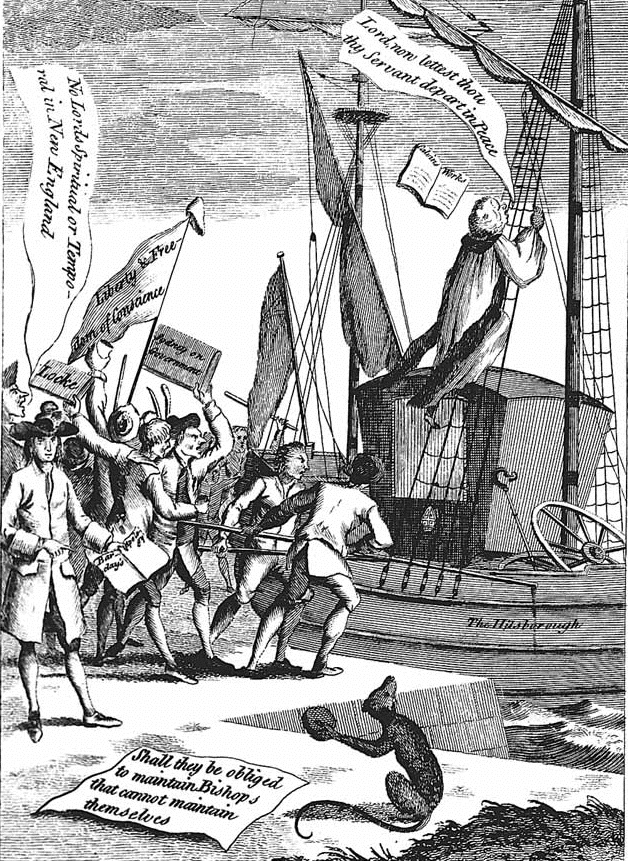 "An Attempt to Land a Bishop in America" depicts John Calvin and Algernon Sidney as being partners of John Locke, while John Adams said John Ponet's work contained "all the essential principles of liberty, which were afterward dilated on by [Algernon] Sidney and Locke". John Adams additionally recommended the anonymous Vindiciae Contra Tyrannos. I'm sure we all know who Calvin was, while John Ponet was a Protestant Christian during the persecutions of Protestants by Mary Tudor (Bloody Mary), the Vindiciae Contra Tyrannos was a Huguenot tract, and Sidney was a partner of Milton and Cromwell. In other words, the American Revolution was part of the general Reformed Christian movement of federalism and limited government that was behind the Dutch and English revolutions, and we must study it as part of that movement, not in isolation. And this Reformed Christian movement was closely related to the Whig and classical liberal tradition. After all, Locke's father fought under Cromwell, and Locke was familiar with Puritan and Congregationalist trends in England, and the two traditions remained very closely allied to each other. Analyzing Francis Schaeffer's claim that John Locke relied on Samuel Rutherford, Robert Arnold concluded that while there is no evidence that Locke utilized Rutherford, that nevertheless, Locke certainly relied on those who were part of Rutherford's same Reformed Christian school of thought, such as Milton. Indeed, let us also note that the Mayflower Compact displays a mature social contract theory decades before Locke was even born. Locke may be the most famous exponent of social contract theory, but he was not the first.
II. The Bill of Rights
And we should not mischaracterize the Bill of Rights, as I believe Moore does:
Is it really reasonable for us to imagine that the Federalists had no concern whatsoever for limited government and the securing of basic rights? Even if the Constitution said nothing, what about the Magna Carta, the Petition of Right (1628), and the English Bill of Rights (1689), not to mention the Declaration of Independence? After all, the Declaration of Rights of 1765 asserted
Similarly, the Declaration of Rights and Grievances of 1774 claimed,
So even if the Constitution says nothing, the Magna Carta (or rather, the Whig hagiography that grew up around it) ought to suffice. More importantly, when the Anti-Federalists asked for a Bill of Rights, the Federalists did not respond that men lack rights to freedom of speech, to bear arms, and such. Rather, they responded that a Bill of Rights would imply that any rights not listed were not to be protected. In other words, it was a legal/exegetical/hermeneutical dispute, not an ideological one. The Federalists had no disagreements with the substance of the Bill of Rights as demanded by the Anti-Federalists, but were afraid that explicitly listing those rights would disparage those rights not listed. The Federalists, as much as the Anti-Federalists, were part of the classical liberal tradition, and believed that all men are created by God, and as such, have the rights to speak freely and bear arms, and that the government is created by social contract and has only those powers delegated by the people.
III. Economic Policy
It may very well be, as Moore says, that the Constitution
But even Federalists would be aghast at how the Commerce and General Welfare Clauses have been interpreted. Given the fundamentally illiberal government we have today, the differences between the Federalists and the Anti-Federalists pale in comparison. Even a Federalist would say that the Commerce Clause was meant to prevent trade wars among states and that the General Welfare Clause was meant to protect the general welfare as opposed to parochial, sectarian welfare of select factions. If anything, the Federalists would be more upset than the Anti-Federalists! After all, the Anti-Federalists could always say, "I told you so. This is why I wanted us to stick to the Articles." But the Federalist had just spent so much time carefully crafting the Constitution, only for the New Deal court to come along and declare that the Commerce and General Welfare Clauses were carte blanches, and that the whole rest of the Constitution was literally useless and meaningless. So much toil and sweat and ink, for naught!
In the comments to Moore's original posting at The Way of Improvement Leads Home, I value Paul M.'s observations about Keynesianism and Shays's Rebellion. But he makes the same mistake as Moore when he says,
IV. Mindset, Worldview, and Intention of the Tea Party
Moore goes on to say
But I believe that the Tea Party's advocacy of loyalty to the Constitution is not so much a religious worship of the Constitution per se, as much as it is instead that:
So when Tea Partiers advocate adherence to the Constitution, they do this instead of advocating for the Articles of Confederation because (respectively):
...the Constitution merely happens to be on the books, but were the Articles on the books, they'd advocate for it instead.
...the Articles and the Constitution are both relatively similar. Both are enshrining basically the same principles, and so a classical liberal or libertarian can advocate adherence to the Constitution when really, what he means to advocate is adherence to the entire classical liberal-type canon, including not only the Constitution, but also the Articles, common law, the Magna Carta, John Locke, etc. etc. The Constitution is merely a shorthand. Indeed, see what is included in the Patriot's Edition of the 1599 Geneva Bible; the Constitution is joined by other documents as well, such as the Mayflower Compact, the Magna Carta, and the Articles of Confederation.
To summarize my argument, I believe Moore takes too narrow a view of history when he says the Tea Party is like the Anti-Federalists and thus should be opposed to the Constitution. I believe that he has overstated the differences between the Anti-Federalists and the Federalists, and the Articles and the Constitution, because his chosen time-span of history is too small.
[Michael Makovi is an Orthodox Jewish student studying in Jerusalem, and is originally from Silver Spring, MD. Mr. Makovi's focus is on political philosophy, with a special interest in Reformed Christian sources of libertarianism. His personal blog is here.]
by Michael Makovi
Guest Blogger
I. General Historical and Ideological Context
Joseph Moore's argument is that the Constitution was meant to limit populist movements like the Tea Party, and that the Tea Party has more in common with the Anti-Federalists than with the Federalists:
"The Constitution was written to constrain movements like the Tea Party. Ironic, then, that Tea Partiers espouse such a religious reverence for it. ... The paradox of this crusader's zeal for the Founding Fathers is that the Tea Party more closely resembles the groups that opposed the Constitution than those who wrote it in 1787. ... The Constitution was written to protect government from movements like the Tea Party. It was written to ensure the power of the federal government to direct economic policy. It was written to keep control away from angry men with guns. It was, in short, everything Tea Party advocates like Beck and Michael Savage think it was not."
Moore concludes that the Tea Party is voicing historically-legitimate views (those of the Anti-Federalists), but is confused, in that it's relating itself, wrongly, to the Constitution:
"Ironically, the Tea Partiers have embodied what their most sacred text opposed. This does not delegitimize them.They stand in a meaningful tradition even as they misunderstand it. They have channeled the old angst of Anti-Federalism, good and bad, into the present by combining Jeffersonian fear of government with anger for anger's sake. Their zeal is both tremendous and historic."
However, I think Moore needs to view this whole matter in greater historical perspective. Yes, the Tea Party might very well be more like the Anti-Federalists than like the Federalists, but if we compare them both together with other political philosophies, then we see they are both of the same classical liberal, constitutionalist, limited government school. The Anti-Federalists and the Federalists were both two different opposing factions of the same general school of thought. Had Moore studied these two factions against the backdrop of the entire history of the classical liberal and federal traditions, he would have seen how similar the Federalists and the Anti-Federalists really were.
In fact, most of the differences between the two come down to mere tactics; i.e., they differed not on the theory, but on how to enshrine that theory in practice. It is one thing to believe in limited government and social contract, but it is something else to determine how to put those into effect, and the Anti-Federalists and Federalists mostly disagreed merely on practice, not on theory.
And whatever theoretical differences they did have, were relatively minor when put into a greater perspective. The Federalists, like the Anti-Federalists, also feared that a strong government would take away their freedoms. After all, that is exactly why the American Revolution was fought. The Federalists may not have been as libertarian as the Anti-Federalists, but they weren't Tories!
We cannot have such a myopic and narrow view of history. The American Revolution cannot be viewed in isolation. It must be viewed alongside the Dutch, English, and French Revolutions, and viewed as the sequel to the first two that it truly was. The cartoon
"An Attempt to Land a Bishop in America" depicts John Calvin and Algernon Sidney as being partners of John Locke, while John Adams said John Ponet's work contained "all the essential principles of liberty, which were afterward dilated on by [Algernon] Sidney and Locke". John Adams additionally recommended the anonymous Vindiciae Contra Tyrannos. I'm sure we all know who Calvin was, while John Ponet was a Protestant Christian during the persecutions of Protestants by Mary Tudor (Bloody Mary), the Vindiciae Contra Tyrannos was a Huguenot tract, and Sidney was a partner of Milton and Cromwell. In other words, the American Revolution was part of the general Reformed Christian movement of federalism and limited government that was behind the Dutch and English revolutions, and we must study it as part of that movement, not in isolation. And this Reformed Christian movement was closely related to the Whig and classical liberal tradition. After all, Locke's father fought under Cromwell, and Locke was familiar with Puritan and Congregationalist trends in England, and the two traditions remained very closely allied to each other. Analyzing Francis Schaeffer's claim that John Locke relied on Samuel Rutherford, Robert Arnold concluded that while there is no evidence that Locke utilized Rutherford, that nevertheless, Locke certainly relied on those who were part of Rutherford's same Reformed Christian school of thought, such as Milton. Indeed, let us also note that the Mayflower Compact displays a mature social contract theory decades before Locke was even born. Locke may be the most famous exponent of social contract theory, but he was not the first.II. The Bill of Rights
And we should not mischaracterize the Bill of Rights, as I believe Moore does:
"The original Constitution did not include the rights to free speech, religious choice, bearing arms, due process, or trial by jury. ... Along the way the Anti-Federalists browbeat ten notable concessions called the Bill of Rights out of Washington and 'the establishment.'"
Is it really reasonable for us to imagine that the Federalists had no concern whatsoever for limited government and the securing of basic rights? Even if the Constitution said nothing, what about the Magna Carta, the Petition of Right (1628), and the English Bill of Rights (1689), not to mention the Declaration of Independence? After all, the Declaration of Rights of 1765 asserted
That his majesty’s liege subjects in these colonies, are entitled to all the inherent rights and liberties of his natural born subjects, within the kingdom of Great Britain.
Similarly, the Declaration of Rights and Grievances of 1774 claimed,
"That the inhabitants of the English Colonies in North America, by the immutable laws of nature, the principles of the English constitution, and the several charters or compacts, have the following Rights."
So even if the Constitution says nothing, the Magna Carta (or rather, the Whig hagiography that grew up around it) ought to suffice. More importantly, when the Anti-Federalists asked for a Bill of Rights, the Federalists did not respond that men lack rights to freedom of speech, to bear arms, and such. Rather, they responded that a Bill of Rights would imply that any rights not listed were not to be protected. In other words, it was a legal/exegetical/hermeneutical dispute, not an ideological one. The Federalists had no disagreements with the substance of the Bill of Rights as demanded by the Anti-Federalists, but were afraid that explicitly listing those rights would disparage those rights not listed. The Federalists, as much as the Anti-Federalists, were part of the classical liberal tradition, and believed that all men are created by God, and as such, have the rights to speak freely and bear arms, and that the government is created by social contract and has only those powers delegated by the people.
III. Economic Policy
It may very well be, as Moore says, that the Constitution
"was written to ensure the power of the federal government to direct economic policy."
But even Federalists would be aghast at how the Commerce and General Welfare Clauses have been interpreted. Given the fundamentally illiberal government we have today, the differences between the Federalists and the Anti-Federalists pale in comparison. Even a Federalist would say that the Commerce Clause was meant to prevent trade wars among states and that the General Welfare Clause was meant to protect the general welfare as opposed to parochial, sectarian welfare of select factions. If anything, the Federalists would be more upset than the Anti-Federalists! After all, the Anti-Federalists could always say, "I told you so. This is why I wanted us to stick to the Articles." But the Federalist had just spent so much time carefully crafting the Constitution, only for the New Deal court to come along and declare that the Commerce and General Welfare Clauses were carte blanches, and that the whole rest of the Constitution was literally useless and meaningless. So much toil and sweat and ink, for naught!
In the comments to Moore's original posting at The Way of Improvement Leads Home, I value Paul M.'s observations about Keynesianism and Shays's Rebellion. But he makes the same mistake as Moore when he says,
It is very ironic that the Tea Party movement has embraced a document designed as a check on individual liberties and local and state autonomy. ... Isn't it amazing that the scope of the federal government has become so extensive as to make the Constitution a check on federal authority rather than the expansion it was originally intended to be?
IV. Mindset, Worldview, and Intention of the Tea Party
Moore goes on to say
"They collapse evangelical views on the Bible (as written by divinely inspired men and therefore inerrant) into conservative views of the Constitution (same, same). When faced with problems, Glenn Beck proclaimed to a group of kids this summer, "The answer is always 'restore the Constitution.'" In August, a Greensboro crowd carrying weapons met for a "Restore the Constitution" rally. they have turned 'don't tread on me' into 'don't tread on the Constitution.'"
But I believe that the Tea Party's advocacy of loyalty to the Constitution is not so much a religious worship of the Constitution per se, as much as it is instead that:
- The Constitution is what we already have. Anyone concerned with the rule-of-law and federalism (meaning "covenantalism", i.e. social contract) is going to advocate loyalty to the Constitution not only because of its intrinsic value and goodness, but simply because it is what is already on the law-books; the libertarian will demand observance of the Constitution not only because it is intrinsically good, but simply because the rule-of-law demands it. Even if the Anti-Federalist would say the Constitution is evil, it is at least lawful evil.
2. The Constitution enshrines principles greater than itself. The Constitution is a specific instance of federalism (social contract), and so anyone who supports federalism in general - i.e. classical liberals and libertarians - is going to see the Constitution as a good approximation of what they seek. It does not mean the Constitution is perfect, but it is among the closest things to perfection in today's world. It provides a good starting point, and once we reinstate it as the lawful king that it ought to be, then we can talk about improving on it. Those who advocate adherence to the Constitution are likely planning on moving past the Constitution, towards a more completely libertarian government, but they rightly see the Constitution as a step in that direction.
So when Tea Partiers advocate adherence to the Constitution, they do this instead of advocating for the Articles of Confederation because (respectively):
To summarize my argument, I believe Moore takes too narrow a view of history when he says the Tea Party is like the Anti-Federalists and thus should be opposed to the Constitution. I believe that he has overstated the differences between the Anti-Federalists and the Federalists, and the Articles and the Constitution, because his chosen time-span of history is too small.
[Michael Makovi is an Orthodox Jewish student studying in Jerusalem, and is originally from Silver Spring, MD. Mr. Makovi's focus is on political philosophy, with a special interest in Reformed Christian sources of libertarianism. His personal blog is here.]
Michael Gerson on Christian Nationalism
Here.
Quote:
Quote:
.... America is not a Christian country and has never been, for historical, theological and philosophic reasons.
First, the Constitution was designed for religious diversity because the Founders were religiously diverse. The 18th century was a time not of quiet piety but of religious controversy. It was a high tide of American Unitarianism, a direct challenge to Christian orthodoxy. Thomas Jefferson's deism flirted with atheism -- a God so distant that He didn't even require his own existence. As journalist Jon Meacham points out, the Founders were less orthodox than the generation that preceded them, as well as the one that followed them. Their commitment to disestablishment, in some cases, accommodated their own heterodoxy.
Second, American religious communities were often strong supporters of disestablishment. Dissenting Protestants had a long history of resentment for the established English church. Others -- Catholics and Quakers -- were minorities suspicious of majority religious rule. Christians generally saw state intrusion as a threat to their theological integrity and worldly power as a diversion from their mission. They supported disestablishment for the sake of the church. And their political independence contributed to their religious vitality.
Saturday, October 23, 2010
A quote from the indispensable man himself on the necessity of religion and morality in civic life

- George Washington (1732-1799), Farewell Address, September 19, 1796, quoted in The Founders on Religion: A Book of Quotations, ed. by James H. Huston (Princeton: 2005), pg. 193.
Friday, October 22, 2010
Quote of the day: America should not be an enemy to "the religion of the Gospel"

- Elias Boudinot (1740-1821), American founding father, President of the Continental Congress, and U.S. congressman, from The Age of Revelation (Philadelphia: Asbury Dickins, 1801), pg. xxii., quoted in The Founders on Religion: A Book of Quotations, ed. by James H. Hutson (Princeton: 2005), pg. 191.
Philip Hamburger's Weakest Argument Against SOCAS
Note: I like Hamburger's book. I think it deserves much of the praise it got and that he is a top notch scholar. However that doesn't make it immune from criticism or serious error.
Jim Lindgren, no religious fanatic he (a self described atheist), and another top notch scholar (in my opinion; he wouldn't be blogging at Volokh if he weren't) has a post which peddles the weakest aspect of Philip Hamburger's work.
The following is an email I sent Prof. Lindgren. (I don’t expect a reply because I’ve sent him a few other emails over the years to which he didn’t reply):
Ed Brayton did a post on the matter a few years ago which raises a similar point.
I also noted on this First Things thread, this argument isn't just "poisoning the well"/the genetic fallacy, it's also a non-sequitur. That is, even IF Black was an anti-Roman Catholic bigot when Everson was decided, it doesn’t follow that he would deny Roman Catholics their religious rights.
John Adams was an anti-Catholic bigot, but, nonetheless believed in respecting the religious rights of Roman Catholics.
“I do not like the late Resurrection of the Jesuits. They have a General, now in Russia, in correspondence with the Jesuits in the U.S. who are more numerous than every body knows. Shall We not have Swarms of them here. In as many shapes and disguises as ever a King of Gypsies, Bamfield More Carew himself, assumed? In the shape of Printers, Editors, Writers School masters etc. I have lately read Pascalls Letters over again, and four Volumes of the History of the Jesuits. If ever any Congregation of Men could merit, eternal Perdition on Earth and in Hell, According to these Historians, though like Pascal true Catholicks, it is this Company of Loiola [Ignatius Loyola -- Ed.]. Our System however of Religious Liberty must afford them an Assylum. But if they do not put the Purity of our Elections to a severe Tryal, it will be a Wonder.”
- John Adams (1735-1826), Letter to Thomas Jefferson, May 6, 1816, quoted in The Founders on Religion: A Book of Quotations, James H. Hutson, editor (Princeton University Press: 2005), 44-45.
Jim Lindgren, no religious fanatic he (a self described atheist), and another top notch scholar (in my opinion; he wouldn't be blogging at Volokh if he weren't) has a post which peddles the weakest aspect of Philip Hamburger's work.
The following is an email I sent Prof. Lindgren. (I don’t expect a reply because I’ve sent him a few other emails over the years to which he didn’t reply):
Jim,
In a general sense, I like Hamburger’s book and endorse the idea that “SOCAS” doesn’t properly vet constitutional religious rights, especially those that incorporate against state and local govts. I also think the research Hamburger et al. did with regards to the KKK and their anti-Catholic bias and endorsement of the separation principle is interesting.
However, to try to bring that up in an argument over the proper way to interpret the Constitution is weak. It’s the genetic fallacy/poisoning the well. And no, the evidence does not show Justice Black’s (or Rutledge’s) “Klan” mentality led them to decide the way they did in Everson.
Regards,
Jon Rowe
Ed Brayton did a post on the matter a few years ago which raises a similar point.
I also noted on this First Things thread, this argument isn't just "poisoning the well"/the genetic fallacy, it's also a non-sequitur. That is, even IF Black was an anti-Roman Catholic bigot when Everson was decided, it doesn’t follow that he would deny Roman Catholics their religious rights.
John Adams was an anti-Catholic bigot, but, nonetheless believed in respecting the religious rights of Roman Catholics.
“I do not like the late Resurrection of the Jesuits. They have a General, now in Russia, in correspondence with the Jesuits in the U.S. who are more numerous than every body knows. Shall We not have Swarms of them here. In as many shapes and disguises as ever a King of Gypsies, Bamfield More Carew himself, assumed? In the shape of Printers, Editors, Writers School masters etc. I have lately read Pascalls Letters over again, and four Volumes of the History of the Jesuits. If ever any Congregation of Men could merit, eternal Perdition on Earth and in Hell, According to these Historians, though like Pascal true Catholicks, it is this Company of Loiola [Ignatius Loyola -- Ed.]. Our System however of Religious Liberty must afford them an Assylum. But if they do not put the Purity of our Elections to a severe Tryal, it will be a Wonder.”
- John Adams (1735-1826), Letter to Thomas Jefferson, May 6, 1816, quoted in The Founders on Religion: A Book of Quotations, James H. Hutson, editor (Princeton University Press: 2005), 44-45.
Thursday, October 21, 2010
The Declaration--Nonsense Upon Stilts?
The natural rights tradition of our Founding Fathers came under attack shortly after our country’s founding. In the English-speaking nations the foremost critic was Jeremy Bentham, who called natural rights “nonsense upon stilts.” Bentham founded the Utilitarian school of social thought, with its ethical criteria of maximizing aggregate happiness. Together with Pragmatism, these two consequentialist schools of ethics would dominate the next two centuries of American social thought. But Bentham has nothing to do with America’s Creation … or so I thought.
I was browsing the excellent collection of books on the American Revolution in the Jefferson Library--that’s Jefferson Township, New Jersey--when in an unusual collection of essays, I found Bentham’s critique of the Declaration of Independence, written on behalf of the British government. Long before the excesses of the French Revolution, Bentham had already engaged in a frontal assault on the very notion of natural rights. Here is what he has to say in John Lind's book, An Answer to the Declaration of the American Congress (London, 1776), p119-132:
I was browsing the excellent collection of books on the American Revolution in the Jefferson Library--that’s Jefferson Township, New Jersey--when in an unusual collection of essays, I found Bentham’s critique of the Declaration of Independence, written on behalf of the British government. Long before the excesses of the French Revolution, Bentham had already engaged in a frontal assault on the very notion of natural rights. Here is what he has to say in John Lind's book, An Answer to the Declaration of the American Congress (London, 1776), p119-132:
It is interesting how he rejects Locke’s concept of owning one’s own life in favor of a different idea: successfully enjoying life—a turn that suggests the emergence of utilitarianism. One might say there are two views of equality: equality of ends vs. equality of process. As a utilitarian, Bentham would come to view the ends, in the aggregate, as the criteria of good government. If his misrepresentation of the doctrine of natural rights isn’t clear, read the following:
“They are about ‘to assume,’ as they tell us, ‘among the powers of the earth, that equal and separate station to which”—they have lately discovered—'the laws of Nature, and of Nature’s God entitle them.' What difference these acute legislators suppose between the laws of Nature and of Nature’s God, is more than I can take upon me to determine, or even to guess. If to what they now demand they were entitled by any law of God, they had only to produce that law, all controversy was at an end. Instead of this, what do they produce? What they call self-evident truths. 'All men,' they tell us, 'are created equal.' This surely is a new discovery; now, for the first time, we learn, that a child, at the moment of his birth, has the same quantity of natural power as the parent, the same quantity of political power as the magistrate.
The rights of 'life, liberty, and the pursuit of happiness'—by which, if they mean any thing, they must mean the right to enjoy life, to enjoy liberty, and to pursue happiness—they 'hold to be unalienable.' This they 'hold to be among truths self-evident.' At the same time, to secure these rights, they are content that Government should be instituted. They perceive not, or will not seem to perceive, that nothing which can be called Government ever was, or ever could be, in any instance, exercised, but at the expense of one or other of those rights.—that, consequently, in as many instance as Government is ever exercised, some one or other of these rights, pretended to be unalienable, is actually alienated.”
“… that of enjoying liberty, and pursuing happiness;--that is,--if they mean anything,--pursuing it wherever a man thinks he can see it, and by whatever means he thinks he can attain it:--That is, that all penal laws—those made by their selves among others—which affect life or liberty, are contrary to the law of God, and the unalienable rights of mankind:--That is, that thieves are not to be restrained from theft, murderers from murder, rebels from rebellion.”Need I comment?
Christine O'Donnell, the First Amendment, and the "Separation of Church and State"
Much has been made across the blogosphere about Delaware Senate candidate Christine O'Donnell's (correct) assertion that the First Amendment does not actually contain the phrase "separation of church and state." While much of the anti-Tea Party wing of the media and interwebs crowd was quick to pounce on O'Donnell's assertion, the simple fact of the matter is that the phrase "separation of church and state" does not come from the First Amendment at all, which reads as follows:
So, where does the phrase come from? As readers of this blog know, the phrase is not found in the Constitution or in the writing of any of the Founders at the time of the enactment or ratification of the Constitution or the Bill of Rights. The phrase comes from a letter written in 1802 by then-President Thomas Jefferson to the Danbury Baptist Association. The full text of the letter is available at the Library of Congress website, but here is the relevant language:
But that doesn't explain how Jefferson's phrase and ideology ended up getting introduced into the jurisprudence interpreting and applying the First Amendment to church-state issues. That story is told over at the always interesting Volokh Conspiracy law blog. Spoiler: the KKK was involved!
Update: in response to the comment thread on this point, blogger extraordinaire and University of Wisconsin constitutional law professor Ann Althouse looks at the precise language used in the O'Donnell-Coons debate and comes to the conclusion that Coons was making a "blatant misstatement of the Establishment Clause of the First Amendment." She thinks O'Donnell's got the better of the debate on this point.
Althouse has more commentary on the debate and the terminology used by O'Donnell and Coons here. As Althouse points out, O'Donnell was making a point about the actual text of the Constitution, a point that she got right. Coons was making a point about the interpretation of that text. And how did we get to that interpretation of the text? That's what the Volokh Conspiracy post that I link to above helps us to understand.
Congress shall make no law respecting an establishment of religion, or prohibiting the free exercise thereof; or abridging the freedom of speech, or of the press; or the right of the people peaceably to assemble, and to petition the Government for a redress of grievances.So, as we see, O'Donnell was quite right. The phrase "separation of church and state" is nowhere to be found in the First Amendment. What is found in the text is a strong federalist approach to the question of religious establishment -- namely that Congress should not intervene to either set up a national religious establishment or tear down then-existing state establishments of religion. That congressional prohibition was later extended to the states via the 14th Amendment incorporation doctrine. But the actual texts of both the First or 14th Amendments do not employ the phrase "separation of church and state."
So, where does the phrase come from? As readers of this blog know, the phrase is not found in the Constitution or in the writing of any of the Founders at the time of the enactment or ratification of the Constitution or the Bill of Rights. The phrase comes from a letter written in 1802 by then-President Thomas Jefferson to the Danbury Baptist Association. The full text of the letter is available at the Library of Congress website, but here is the relevant language:
Believing with you that religion is a matter which lies solely between Man & his God, that he owes account to none other for his faith or his worship, that the legitimate powers of government reach actions only, & not opinions, I contemplate with sovereign reverence that act of the whole American people which declared that their legislature should "make no law respecting an establishment of religion, or prohibiting the free exercise thereof," thus building a wall of separation between Church & State. Adhering to this expression of the supreme will of the nation in behalf of the rights of conscience, I shall see with sincere satisfaction the progress of those sentiments which tend to restore to man all his natural rights, convinced he has no natural right in opposition to his social duties.Jefferson's use of the phrase "wall of separation between Church & State," written well after the adoption of the Constitution and the Bill of Rights, is a key moment in the development of the idea that the First Amendment's guarantees of religious liberty and non-establishment entail the notion of separation between religion and government. It is no fluke that Jefferson stated this idea to a letter to a congregation of Baptists, the Baptist movement being one of the prime originators within free church Protestantism of the idea of separating the religious and political spheres.
But that doesn't explain how Jefferson's phrase and ideology ended up getting introduced into the jurisprudence interpreting and applying the First Amendment to church-state issues. That story is told over at the always interesting Volokh Conspiracy law blog. Spoiler: the KKK was involved!
Update: in response to the comment thread on this point, blogger extraordinaire and University of Wisconsin constitutional law professor Ann Althouse looks at the precise language used in the O'Donnell-Coons debate and comes to the conclusion that Coons was making a "blatant misstatement of the Establishment Clause of the First Amendment." She thinks O'Donnell's got the better of the debate on this point.
Althouse has more commentary on the debate and the terminology used by O'Donnell and Coons here. As Althouse points out, O'Donnell was making a point about the actual text of the Constitution, a point that she got right. Coons was making a point about the interpretation of that text. And how did we get to that interpretation of the text? That's what the Volokh Conspiracy post that I link to above helps us to understand.
Tuesday, October 19, 2010
The Tea Party and the Constitution
 Dr. John Fea, historian, author and long-time friend of American Creation, has posted an interesting article on the Tea Party movement. The article is written by Joseph Moore, a graduate student in American history at UNC-Greensboro. Mr. Moore writes:
The Constitution was written to constrain movements like the Tea Party. Ironic, then, that Tea Partiers espouse such a religious reverence for it. They collapse evangelical views on the Bible (as written by divinely inspired men and therefore inerrant) into conservative views of the Constitution (same, same). When faced with problems, Glenn Beck proclaimed to a group of kids this summer, "The answer is always 'restore the Constitution.'" In August, a Greensboro crowd carrying weapons met for a "Restore the Constitution" rally. they have turned 'don't tread on me' into 'don't tread on the Constitution.'And though I am not a fan or an apologist of the Tea Party movement, I believe that Mr. Moore's summation is a bit too superficial.
The paradox of this crusader's zeal for the Founding Fathers is that the Tea Party more closely resembles the groups that opposed the Constitution than those who wrote it in 1787. The world was different then, but not so different.
Our Constitution was a reaction to a great recession. America couldn't even pay the interest on the national debt taken out to finance the Revolution. Cheap imported goods flooded the market, diving American workers out of a living. These patriotic people, many of them war veterans, had financed their homes with loans. With no one buying American anymore, regular people couldn't pay their mortgages, and banks foreclosed on homes across the nation.
In Massachusetts, a war veteran named Daniel Shays espoused something like the modern sentiment, 'we're mad as hell and we're not going to take it anymore.' Shays and other farmers took up arms, took to the streets, and became the faces of a movement sweeping the country. In the spirit of American patriotism, they demanded that state lawmakers pass legislation protecting hardworking people against bankers and taxes. Thomas Jefferson noted approvingly, "A little rebellion now and then is a good thing."
Thomas Jefferson was in Paris when he said that. George Washington, James Madison and Alexander Hamilton were not. Those Founding Fathers called for a new government to stave off groups like Shays'. The document they created, the Constitution, put distance between the people and their government. Politicians, not the people, chose Senators. Not one private citizen voted for George Washington to be president. The original Constitution did not include the rights to free speech, religious choice, bearing arms, due process, or trial by jury. "We the People of the United States" was added in the final day of editing- to save space.
Enter the Anti-Federalists. They were panicked that the new government would enable "the rich to oppress and ruin the poor." This annoyed Washington, who privately remarked that the protesters gave "the tone" of being "obnoxious," and that it was best that citizens should not have opportunity to "peak behind the curtain" of US government.
What frustrated our first President were the Anti-Federalists; emotional appeal and their conspiracy theories about strong central government colluding to take away people's freedoms. "This government, " one opponent prophesied, "will set out a moderate aristocracy."
The Anti-Federalists lost, mostly because in the midst of economic crisis a strong national government made the best sense. Along the way the Anti-Federalists browbeat ten notable concessions called the Bill of Rights out of Washington and 'the establishment.' We woe them our thanks. But that cannot change irrefutable historical facts:
The Constitution was written to protect government from movements like the Tea Party. It was written to ensure the power of the federal government to direct economic policy. It was written to Keep control away from angry men with guns. It was, in short, everything Tea Party advocates like Beck and Michale Savage think it was not.
Ironically, the Tea Partiers have embodied what their most sacred text opposed. This does not delegitimize them.They stand in a meaningful tradition even as they misunderstand it. They have channeled the old angst of Anti-Federalism, good and bad, into the present by combining Jeffersonian fear of government with anger for anger's sake. Their zeal is both tremendous and historic.
Perhaps the ultimate irony is that the political moderation the Tea Party hates and the Founding Fathers loved is now represented not by politicians, but by comedians. One week before the mid-term elections, Comedy Central's Jon Stewart will hold his "Rally To Restore Sanity" on the National Mall. The restoration of sanity was what the Constitution was originally about.
But what say you?
Monday, October 18, 2010
What Did the Founding Fathers Learn From Cicero?
The thesis of Carl J. Richard's provocative new book, Why We’re All Romans, wouldn’t have been a surprise to those educated in colonial colleges. The liberal arts curriculum of our founding fathers was dominated by Roman literature and letters. Fluent knowledge of Latin was an admission requirement and necessary to understand the lectures—which were all in Latin. A study of the founder’s education gives us a glimpse into a worldview that is almost foreign to the modern reader.
Caroline Winterer, in The Culture of Classicism, describes the importance of classical languages and culture in early American college education. The emphasis on Latin literature was part of colonial higher education from the founding of our first college, Harvard, in 1636. In addition to Latin, students were expected to translate “the New Testament (which they referred to as the ‘Greek Testament’”. “A century later the language curriculum had hardly changed, an example of the intellectual constancy that characterized American college education ...” By 1776 there were nine colleges “remarkably uniform in their classical curriculum.”
Colonial colleges were founded by different religious denominations and at first completely staffed by the ministry to prepare students for the ministry. By 1750 40% of the graduates still went into the ministry. What is remarkable is the degree that Latin-based classical humanism was found to be in concord with the religious purpose of the institution. The hostility today that we often see between secular Greco-Roman and Judeo-Christian traditions was virtually absent in our colonial period.
We tend to think of Greece first when we think of the glory of classical civilization but the colonials looked to Rome—Republican Rome. The change came in the beginning of the 19th century when European trends (and Hegel’s influence) downplayed Rome in favor of Greece. Carl J. Richard is right about Rome’s influence … when we talk about our founding fathers.
Of all the Roman writers, Cicero was the most respected and revered. “As all the ages of the world have not produced a greater statesman and philosopher united than Cicero, his authority should have great weight” wrote John Adams (1778). A young Thomas Jefferson studied Latin under Rev. James Maury. “In terms of classical authors, Maury saved his highest praise for Cicero, whom he called ‘Reason’s great Highpriest and Interpreter.’ Jefferson would share this opinion” [p38] Maury had Jefferson read De Officiis. [p34] Years later Jefferson would recommend Cicero’s ethical works to his nephew, Peter Carr.
We think of Cicero first and foremost as an orator and statesman but his treatises on ethical philosophy were virtually textbooks on the subjects in the Latin-based classical education. First and foremost of these was Cicero’s De Officiis, often translated as On Duty or On Moral Obligation. It was universally read through out Western Christendom. In Konigsberg, before one steps into Orthodox Russia, a young Immanuel Kant studied Cicero’s De Officiis in his sixth year of grammar school about the same time Samuel Adams was learning to read his copy.
This humanistic liberal arts education originated in the 14th century. Petrarch championed the study of Cicero as an alternative to Scholastic learning. He saw Cicero as applicable to civic affairs while scientific Scholastic studies appeared to be “merely academic.” As a devout Christian and loyal church member he could say “You would fancy sometimes … it is not a Pagan philosopher but a Christian apostle who is speaking.” Indeed, St. Ambrose’s De Officiis is modeled after Cicero’s. Of surviving hand-copied books, Cicero’s De Officiis is the second most numerous of Latin texts. It was also the second Latin text to be published with the advent of the printing press.
Cicero has disappeared from the college curriculum. His works are rarely studied in philosophy and only appear as a footnote on Roman history. His ideas are alien to the modern mind. We still read John Locke and the Bible, but I maintain the ethnical and political thoughts of a Latin-based liberal arts tradition that spanned five centuries is also crucial for understanding the mindset of colonial America. The importance of this book on the classical humanist education and its near complete omission from 20th century cannon shows a radical shift in ethical thought.
I hope I’ve conveyed the importance if Cicero’s ethical writings on 18th century thought. But I’m afraid the task isn’t that easy. There still the nagging question: what exactly did the Founding Fathers learn from reading Cicero? What can Cicero’s works tell us about the Founding generation?
Caroline Winterer, in The Culture of Classicism, describes the importance of classical languages and culture in early American college education. The emphasis on Latin literature was part of colonial higher education from the founding of our first college, Harvard, in 1636. In addition to Latin, students were expected to translate “the New Testament (which they referred to as the ‘Greek Testament’”. “A century later the language curriculum had hardly changed, an example of the intellectual constancy that characterized American college education ...” By 1776 there were nine colleges “remarkably uniform in their classical curriculum.”
Colonial colleges were founded by different religious denominations and at first completely staffed by the ministry to prepare students for the ministry. By 1750 40% of the graduates still went into the ministry. What is remarkable is the degree that Latin-based classical humanism was found to be in concord with the religious purpose of the institution. The hostility today that we often see between secular Greco-Roman and Judeo-Christian traditions was virtually absent in our colonial period.
We tend to think of Greece first when we think of the glory of classical civilization but the colonials looked to Rome—Republican Rome. The change came in the beginning of the 19th century when European trends (and Hegel’s influence) downplayed Rome in favor of Greece. Carl J. Richard is right about Rome’s influence … when we talk about our founding fathers.
Of all the Roman writers, Cicero was the most respected and revered. “As all the ages of the world have not produced a greater statesman and philosopher united than Cicero, his authority should have great weight” wrote John Adams (1778). A young Thomas Jefferson studied Latin under Rev. James Maury. “In terms of classical authors, Maury saved his highest praise for Cicero, whom he called ‘Reason’s great Highpriest and Interpreter.’ Jefferson would share this opinion” [p38] Maury had Jefferson read De Officiis. [p34] Years later Jefferson would recommend Cicero’s ethical works to his nephew, Peter Carr.
We think of Cicero first and foremost as an orator and statesman but his treatises on ethical philosophy were virtually textbooks on the subjects in the Latin-based classical education. First and foremost of these was Cicero’s De Officiis, often translated as On Duty or On Moral Obligation. It was universally read through out Western Christendom. In Konigsberg, before one steps into Orthodox Russia, a young Immanuel Kant studied Cicero’s De Officiis in his sixth year of grammar school about the same time Samuel Adams was learning to read his copy.
This humanistic liberal arts education originated in the 14th century. Petrarch championed the study of Cicero as an alternative to Scholastic learning. He saw Cicero as applicable to civic affairs while scientific Scholastic studies appeared to be “merely academic.” As a devout Christian and loyal church member he could say “You would fancy sometimes … it is not a Pagan philosopher but a Christian apostle who is speaking.” Indeed, St. Ambrose’s De Officiis is modeled after Cicero’s. Of surviving hand-copied books, Cicero’s De Officiis is the second most numerous of Latin texts. It was also the second Latin text to be published with the advent of the printing press.
Cicero has disappeared from the college curriculum. His works are rarely studied in philosophy and only appear as a footnote on Roman history. His ideas are alien to the modern mind. We still read John Locke and the Bible, but I maintain the ethnical and political thoughts of a Latin-based liberal arts tradition that spanned five centuries is also crucial for understanding the mindset of colonial America. The importance of this book on the classical humanist education and its near complete omission from 20th century cannon shows a radical shift in ethical thought.
I hope I’ve conveyed the importance if Cicero’s ethical writings on 18th century thought. But I’m afraid the task isn’t that easy. There still the nagging question: what exactly did the Founding Fathers learn from reading Cicero? What can Cicero’s works tell us about the Founding generation?
Sunday, October 17, 2010
Davis on America's Theocratic Planting
As opposed to its non-theocratic "Founding."
From historian Kenneth Davis. Quote:
Hat Tip: Andrew Sullivan.
This is a theme I've long explored. For instance, in my recent post entitled, Would the Puritans Have Executed John Adams For His Religious Heresy?
From historian Kenneth Davis. Quote:
From the earliest arrival of Europeans on America’s shores, religion has often been a cudgel, used to discriminate, suppress and even kill the foreign, the “heretic” and the “unbeliever”—including the “heathen” natives already here. Moreover, while it is true that the vast majority of early-generation Americans were Christian, the pitched battles between various Protestant sects and, more explosively, between Protestants and Catholics, present an unavoidable contradiction to the widely held notion that America is a “Christian nation."
Hat Tip: Andrew Sullivan.
This is a theme I've long explored. For instance, in my recent post entitled, Would the Puritans Have Executed John Adams For His Religious Heresy?
Thursday, October 14, 2010
Quote of the day: religious tolerance doesn't mean religous acceptance
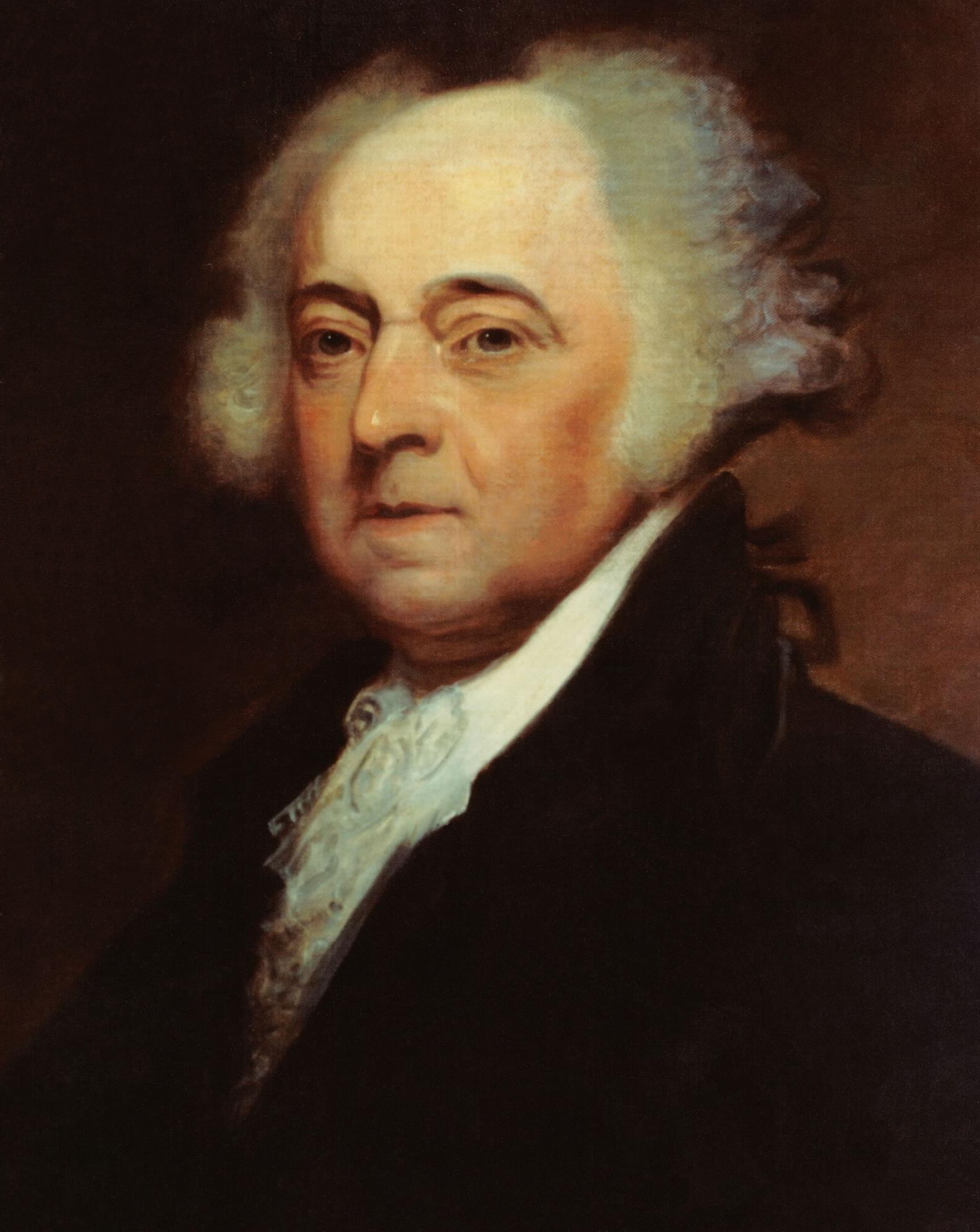
- John Adams (1735-1826), Letter to Thomas Jefferson, May 6, 1816, quoted in The Founders on Religion: A Book of Quotations, James H. Hutson, editor (Princeton University Press: 2005), 44-45.
Wednesday, October 13, 2010
Quote of the day: morals, religion and a republic

- Charles Carroll of Carrollton (1737-1832), Founding Father and only Catholic signer of the Declaration of Independence, letter to Charles Carroll, Jr., November 4, 1800, quoted in The Founders on Religion: A Book of Quotations, James H. Huston, editor (Princeton: 2005), pg. 191.
Subscribe to:
Posts (Atom)