Wednesday, June 26, 2019

Unitarianism Over the Span of the American Founding

From 1750 to 1820 (ish). 

John Adams, in 1815, writes to an orthodox critic remarks that relate back to 1750.
I thank you for your favour of the 10th and the pamphlet enclosed, "American Unitarianism." I have turned over its leaves and have found nothing that was not familiarly known to me. 
In the preface Unitarianism is represented as only thirty years old in New England. I can testify as a Witness to its old age. Sixty five years ago my own minister the Reverend Samuel Bryant, Dr. Johnathan Mayhew of the west Church in Boston, the Reverend Mr. Shute of Hingham, the Reverend John Brown of Cohasset & perhaps equal to all if not above all the Reverend Mr. Gay of Hingham were Unitarians. Among the Laity how many could I name, Lawyers, Physicians, Tradesman, farmers! 
-- John Adams to Jedidiah Morse, May 15, 1815. Adams Papers (microfilm), reel 122, Library of Congress.
The reason why there was "confusion" as to how old unitarianism was relates to unitarianism being in the closet. It was not safe, in some cases not legal in say 1750, to publicly proclaim one's unitarianism.

But over time, it became safer. And I think that was probably part of the motivation behind the fervent push for liberty of conscience in some quarters (i.e., Adams' and Thomas Jefferson's, among others).

In the 1800s, Jefferson and Adams seemed downright gleeful that unitarianism was making progress. It was turning into Unitarianism, not just a theology (small u) but the official name of denominations (capital U).

As I've noted before the two options from the which to choose were Arianism and Socinianism with the former being more popular. Fast forward to 1821 and we see Jefferson in a letter to Timothy Pickering (United States Secretary of State under Presidents George Washington and John Adams) mention William Channing, Richard Price and Joseph Priestley:
I thank you for mr Channing’s discourse, which you have been so kind as to forward me. ... and read it with high satisfaction. no one sees with greater pleasure than myself the progress of reason in it’s advances towards rational Christianity. when we shall have done away the incomprehensible jargon of the Trinitarian arithmetic, that three are one, and one is three; when we shall have knocked down the artificial scaffolding, reared to mask from view the simple structure of Jesus, when, in short, we shall have unlearned every thing which has been taught since his day, and got back to the pure and simple doctrines he inculcated, we shall then be truly and worthily his disciples: ...
So off the bat Jefferson tells Pickering he read William Channings' address on "rational Christianity" which is Arian, and gave it his approval. Pickering was a fellow unitarian. Perhaps Jefferson suspects Pickering was, like what Channing argued for, an Arian.

But Jefferson was not an Arian. I would argue he was some kind of modified Socinian. But let the man speak for himself:
in the present advance of truth, which we both approve, I do not know that you and I may think alike on all points. as the Creator has made no two faces alike, so no two minds, and probably no two creeds. we well know that among Unitarians themselves there are strong shades of difference, as between Doctors Price and Priestley for example. so there may be peculiarities in your creed and in mine. they are honestly formed without doubt. I do not wish to trouble the world with mine, nor to be troubled for them. these accounts are to be settled only with him who made us; and to him we leave it, with charity for all others, of whom also he is the only rightful and competent judge. I have little doubt that the whole of our country will soon be rallied to the Unity of the Creator, and, I hope, to the pure doctrines of Jesus also.
Price was the notable influential British Arian and Priestley was his Socinian counterpart. Jefferson's comments above illustrate that the unitarianism of his time was highly individualistic. That is, it didn't exist like Trinitarianism did. Trinitarianism was institutionalized in churches with creeds; unitarianism was more of a theological philosophy that free thinking individuals attached to Trinitarian churches either flirted with or believe in.

Then it became a Church (Unitarianism with a capital U) starting at the end of the 18th Century, but more so in the 19th Century.

Friday, June 21, 2019

Why Socinianism Matters to the American Founding

Because it's part of unitarianism. And unitarianism matters. During America's founding era many claimed to be "unitarians" and there were two chief varieties. One, Arianism (which taught Jesus some kind of divine being, but created by and subordinate to the Father), the other, Socinianism (which taught Jesus 100% human in His nature, but on a divine mission). Arianism was the more popular of the two varieties.

John Locke is oft-referred to, for good reason, as "America's philosopher." On how governments ought to treat their citizens, including and especially on religious matters, Locke matters.

And we can almost be certain that Locke was not an orthodox Trinitarian Christian. So that means he must have been something else. But Locke had a problem with putting his explicit religious cards on the table: In Great Britain in Locke's time, it was illegal to publicly deny the Trinity. Yet many did doubt or deny the Trinity back then. They just tended to, for safety, do it in private.

So Locke writes the book called "The Reasonableness of Christianity" where he sets out his ideal understanding of the common faith. Locke proposes a formula for defining who gets to be a "real Christian" as we might put that term today. And it's this: Jesus is a unique Messiah.

That's pretty much it (yeah, we can get into some other details, like you have to repent).

This simple formula got Locke accused by an orthodox theologian of being a Socinian. Because it's true that Socinians could pass Locke's test. But I don't think Locke was a Socinian. Rather he probably was some kind of Arian (this is what Locke scholar the late Paul Sigmund of Princeton told me, citing other Locke scholar John Marshall of Johns Hopkins).

So as it turns out Locke's orthodox critic probably was right that Locke was a unitarian, but wrong on which kind.

Still, Trinitarians, Arians, Socinians, Modalists, Mormons, Jehovah's Witnesses, and Swedenborgians among others all believe Jesus Messiah and therefore get to be "Christians" according to Locke's formula.

Or as John Adams described the American landscape, that implemented Locke's ideas, some time later:
... There were among them, Roman Catholicks English Episcopalians, Scotch and American Presbyterians, Methodists, Moravians, Anababtists, German Lutherans, German Calvinists Universalists, Arians, Priestleyans, Socinians, Independents, Congregationalists, Horse Protestants and House Protestants, Deists and Atheists; and “Protestans qui ne croyent rien.” Very few however of Several of these Species. Never the less all Educated in the general Principles of Christianity: and the general Principles of English and American Liberty.
"Socinians" actually made Adams' list twice. Most American Socinians probably wouldn't be imbibed in the "Racovian Confession," but rather influenced by Joseph Priestley's theology, which is a form of Socinianism. "Priestleyans" are Socinians.

I've heard people claim John Adams was an Arian, but I am not convinced. I know that Adams was a fervent unitarian, but of which kind I'm not sure Adams himself knew. He just "knew" the Trinity was false.

Wednesday, June 19, 2019

The Unitarians of America's Founding

Much has been written here about the "unitarians" of the Founding era. John Adams averred he was one, as did Abigail Adams. But were they Christians?

Well, they certainly considered themselves Christians, and protested quite vociferously when accused of not being Christians, usually by competing "orthodox" Protestant clergy.

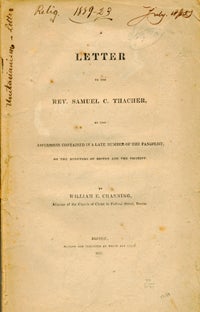
It all came to a head around 1815, when William Ellery Channing---generally regarded then as now as exemplary of that era's unitarianism---answered some prevailing charges against unitarianism in his famous pamphlet


A Letter to the Rev. Samuel C. Thacher on the Aspersions Contained in a Late Number of the Panoplist, on the Ministers of Boston and the Vicinity
.

Now, perhaps the defining feature of unitarianism was that it didn't believe in the Trinity---as John Adams wrote to Thomas Jefferson, 1 + 1 + 1 would equal Three, not One. Hence the term "unitarian."

There were other orthodox doctrines rejected, too, namely, as Channing wrote:

"I fear, that the Author of the Lord's prayer will, according to this rule, be driven as a heretick from the very church which he has purchased with his own blood. In that well known prayer I can discover no reference to the "inspiration of the holy scriptures, to the supreme divinity of the Son and Holy Ghost, to the atonement and intercession of Jesus Christ, to the native and total depravity of the unregenerate, and to the reality and necessity of special divine grace to renew and sanctify the souls of men;" and these, let it be remembered, are _five_ out of the _six_ articles which are given by the Reviewer as fundamental articles of a christian's faith."


So that's what they didn't believe. So what did they believe? Channing wrote:


"The word UNITARIANISM, as denoting this opposition to Trinitarianism, undoubtedly expresses the character of a considerable part of the ministers of this town and its vicinity, and the commonwealth...We both agreed in our late conference, that a majority of our brethren believe, that Jesus Christ is more than man, that he existed before the world, that he literally came from heaven to save our race, that he sustains other offices than those of a teacher and witness to the truth, and that he still acts for our benefit, and is our intercessor with the Father. This we agreed to be the prevalent sentiment of our brethren." 


Is that Christian enough? Certainly not to the orthodox clergy and various laymen of the time who stood in opposition to them.

Probably not Christian enough for most Christian theologians of any stripe today, certainly not evangelical or orthodox. But perhaps Christian enough for the sociologist or the historian. 

Jesus Christ is:


  • more than man
  • who existed before the world ["Truly, truly, I say to you, before Abraham was born, I am"---John 5:58]
  • literally came from heaven 
  • to save our race [the Redeemer, the Messiah]
  • more than just a "teacher"
  • still acts for our benefit and is our intercessor with the Father


"Unitarian Christian" is my own preference, both descriptively and definitively, at least for our best understanding in our day and age. [Channing and others used "'rational' Christians," but in our day, I'm not sure that's helpful or descriptive enough, although it's certainly a proper term. Channing himself published a popular tract in 1819 called Unitarian Christianity.]

Do read Channing's letter for yourself, as there's more than can be sketched or excerpted here. It offers an excellent window into what is called the Unitarian Controversy today, and clearly outlines the issues and the players, a clarity require to consider these "unitarians" properly in the scheme of things. The unitarians cannot be plunked under an umbrella term like "theistic rationalist" along with outliers such as Thomas Jefferson without a great loss of precision and clarity.

Saturday, June 15, 2019

Smithsonian: "Why No One Can Agree on What George Washington Thought About the Relationship Between Church and State"

By a professor at Stanford. A taste:
Historians were not deaf to Washington’s religious references. While the clergy and the scientists saw them as evidence of Washington’s devotion, the historians stressed the president’s precision in crafting a vocabulary that would unite the dizzying array of Protestant denominations in post-revolutionary America without alienating the small but important groups of Catholics, Jews, and freethinkers dotting the American landscape. It was precisely because he understood that Americans did not believe the same thing that Washington was scrupulous in choosing words that would be acceptable to a wide spectrum of religious groups.

In his own time, Washington’s reluctance to show his doctrinal cards dismayed his Christian co-religionists. Members of the first Presbytery of the Eastward (comprised of Presbyterian churches in Massachusetts and New Hampshire) complained to the president that the Constitution failed to mention the cardinal tenets of Christian faith: “We should not have been alone in rejoicing to have seen some explicit acknowledgement of the only true God and Jesus Christ,” they wrote. Washington dodged the criticism by assuring the Presbyterians that the “path of true piety is so plain as to require but little political direction.”  
Similarly, a week before his 1789 proclamation, Washington responded to a letter from Reverend Samuel Langdon, the president of Harvard College from 1774-1780. Langdon had implored Washington to “let all men know that you are not ashamed to be a disciple of the Lord Jesus Christ.” Once again, instead of affirming Christian tenets, Washington wrote back offering thanks to the generic “Author of the Universe.”

Friday, June 14, 2019

Christianity & Religious Liberty

This new book Robert Louis Wilken, Liberty in the Things of God, looks to be a must read. I disagree with the subtitle of the American Conservative review article that doesn't credit "The Enlightenment." Yes, there were sources of religious liberty that preceded the Enlightenment. But it was during the Enlightenment when such became normative. A taste from the article:
This tension reached a climax during the Reformation and post-Reformation era. Wilken includes chapters on Lutheran Germany, Calvinist and Zwinglian Switzerland, and on Catholic-Protestant battles in France, the Netherlands, and England. Readers may be surprised to learn how often it was not just Protestants but also Catholics who turned to liberty in defense of their religious beliefs. Nuns in Germany, clergyman in Switzerland, Benedictine abbots in France, and papist lawyers in England all appealed to their consciences in the face of Protestant persecution. Indeed, while Reformation history is full of Catholic oppression of Protestants, it is equally full of Protestants oppressing, persecuting, and even forbidding Catholic worship. 
It is ultimately the Englishmen—Roger Williams, John Owen, William Penn, and John Locke—to whom America and the West are indebted for their conception of religious freedom. Williams argued that liberty of conscience applied to all men equally, including dissenting Christians, Jews, Muslims, and even the hated Catholics. He also “severed the link between the two tables of the law,” meaning that he rejected any role for the state in the affairs of the church and vice versa. Owen, in turn, interpreted Tertullian’s earlier cited argument to mean that “liberty of conscience is a natural right” rather than one created and protected by the state. Penn, meanwhile, argued that this liberty of conscience necessarily extended to public worship. Locke, finally, incorporated some of these elements, but went even further by arguing that religious communities are fundamentally voluntary societies composed of individuals possessing “free and spontaneous” rights.
For instance the Calvinist covenanters like Samuel Rutherford and John Knox who were "good" on resistance to tyrants in the face of Romans 13 were still defending Calvin having Servetus put to death for denying the Trinity. By the time of the American Founding, John Witherspoon and his Presbyterians had accepted liberty of conscience as an unalienable right.

Friday, June 7, 2019

Excerpt From Seidel's "THE FOUNDING MYTH"

The following is reprinted with permission from The Founding Myth: Why Christian Nationalism is Un-American © 2019 Andrew Seidel, published by Sterling Publishing Co., Inc.


Christian nationalism has already had a massive impact on our government and its policies, including foreign policy. When Trump moved the US embassy to Jerusalem, Christian nationalist mouthpieces on Fox News declared that he had “fulfilled . . . biblical prophecy” and related the move back to “the foundation of our own Judeo-Christian nation.” Christian nationalism affects immigration policy, as we’ve just seen. Its effects on education policy could be felt for decades, and not just because Secretary of Education Betsy DeVos was a dream appointment for the Christian nationalist goal of dismantling public schools through vouchers and school choice. It has denigrated our con­cept of equality, including by meddling with the legal definition of dis­crimination and attempting to redefine religious freedom as a license to discriminate, and it has sought to restrict women’s rights and even the social safety net. And, of course, Christian nationalism features heavily in the culture wars.

Correcting the record is important. The political theology of Christian nationalism, the very identity of the Christian nationalist, depends on the myths exposed in this book. Christian nationalism’s hold on political power in America rests on the claim that America was founded as a Christian nation. Without historical support, many of their policy justifications crumble. Without their common well of myths, the Christian nationalist identity will wither and fade. Their entire political and ideological reality is incredibly weak and vulnera­ble because it is based on historical distortions and lies. In this right-wing religious culture, the lies are so commonplace, so uncritically accepted, that these vulnerabilities are not recognized. The purpose of this book is simple, if lofty: to utterly destroy the myths that underlie this un-American political ideology.
What I’m Arguing and Who I Am
This objective is particularly important because history is powerful. George Santayana’s warning that “those who cannot remember the past are condemned to repeat it” rings true because the past influences the present.  Unfortunately, history’s power does not depend on its accuracy. A widely believed historical lie can have as much impact as a historical truth. President John F. Kennedy explained to Yale’s graduat­ing class of 1962 that “the great enemy of the truth is very often not the lie—deliberate, contrived, and dishonest—but the myth—persistent, persuasive, and unrealistic. Too often we hold fast to the clichés of our forebears. . . . We enjoy the comfort of opinion without the discomfort of thought.” Powerful historical falsehoods are particularly harmful in constitutional republics such as the United States. Courts may uphold practices that would otherwise be illegal by relying on comfortable myths instead of legitimate history. Legislators might promulgate laws based on historical clichés instead of reality. Each law or court decision based on revisionist history provides a new foundation from which the myth can be expanded. The myth feeds off itself, lodging more firmly in our collective consciousness.

When James Madison protested Patrick Henry’s proposed three-penny tax to fund Christian ministers, he wrote a landmark in American history and law: the “Memorial and Remonstrance against Religious Assessments” (1785). Madison’s arguments overwhelmed Henry and convinced Virginians to strike down the proposed tax. Madison argued that even small, seemingly insignificant battles to uphold our rights must be fought on principle; otherwise the infringements become authority for future violations of our rights:

It is proper to take alarm at the first experiment on our liberties. We hold this prudent jealousy to be the first duty of Citizens, and one of the noblest characteristics of the late Revolution. The free men of America did not wait till usurped power had strengthened itself by exercise, and entangled the question in precedents. They saw all the consequences in the principle, and they avoided the consequences by denying the principle.

Because of history’s power, myths can endanger our liberty. It is our duty as citizens to guard the truth and prevent these myths from becoming tangled in legal and legislative precedents. When Christian nationalists are permitted to use the machinery of the state to impose their religion on us all, even if they do so during times when dissent is punished, these constitutional violations are remarkably tenacious. Christian nationalism operates like a ratchet or a noose, with each vio­lation tightening its hold and making it more difficult to undo. Worse, the violations are used to justify other violations, so the tightening proceeds apace.

Unfortunately, there are two Christian nationalist myths we failed to guard against. These two myths encompass all the lesser myths that Trump and Project Blitz feed into. The first is that America was founded as a Christian nation. The claim is demonstrably false as revealed by any number of documents from the time, including America’s godless Constitution, Madison’s Memorial, or the Treaty of Tripoli, which was negotiated under President George Washington and signed by Pres­ident John Adams with the unanimous consent of the US Senate in 1797, and which says that “the Government of the United States of America is not, in any sense, founded on the Christian religion.” Most people with even a modest grasp of US history, law, government, or politics can debunk this divisive fabrication.

This book does not depend on the specific language of a single treaty, however applicable it may be—“not in any sense founded on the Christian religion” is admirably clear. Nor will it focus on the first myth, that America is a Christian nation. According to Bertrand Russell, religious apologists “try to make the public forget their earlier obscurantism, in order that their present obscurantism may not be rec­ognized for what it is.” So do Christian nationalists. They abandon their earlier obscurantism, the first myth, in favor of a new one: the subtler argument that our nation is founded on Judeo-Christian prin­ciples. Christian nationalism hinges on this second myth and, unlike the first, it is broadly accepted.

This second myth is the focus of this book because it pervades all other Christian nationalist arguments. If America is not founded on Judeo-Christian principles, it is not a Christian nation. If America is not founded on Judeo-Christian principles, Christian nationalists are wrong. And although other authors have refuted the first fiction, the second remains untouched. This book seeks to change that by com­paring the principles of Judeo-Christianity and the principles upon which the United States of America was founded. By focusing on the central tenets, the core ideas, of America and Judeo-Christianity, the first myth—America as a “Christian nation”—will necessarily be tested, as will the relevance of the founding fathers’ personal religious choices. But those issues are subsumed in the second, greater question, the question the “nine commandments” judge never had to answer: did Judeo-Christian principles positively influence the founding of the United States?

No, they did not. America was not founded on Judeo-Christian principles. In fact, Judeo-Christian principles, especially those central to the Christian nationalist identity, are thoroughly opposed to the principles on which the United States was built. The two systems differ and conflict to such a degree that, to put it bluntly, Christianity is un-American.

Not only is it fair to say that Judeo-Christian principles are un- American, we must. The word “un-American” might make some squea­mish because of the value judgment inherent in it. But America is in a fight for its values—its soul, if you prefer—and Christian nation­alism is warping and torturing those values, dragging this country down a dark hole. To hesitate to describe this identity with apt phrases because they may be unpleasant is to cede the American identity to an imposter. To refuse to label that which is antithetical to America is to watch Christian nationalists hijack our nation.

Previous books offered gentle corrections to the Christian nation­alist: Here’s what history tells us, here’s what the founders actually meant, here’s what the founders actually said. And they’ve left it at that. But correction is not enough—otherwise we wouldn’t have a President Trump. 

No, pointing out errors is insufficient. This book does so, but then it takes the next step. It goes on the offensive. This book is an assault on the Christian nationalist identity. Not only are Christian nationalists wrong, but their beliefs and identity run counter to the ideals on which this nation was founded.

This book is an assault, but it’s also a defense, a defense of that quintessentially American invention, the “wall of separation between church and state.” I am a watcher on that wall. As a constitutional attorney with the Freedom From Religion Foundation, I defend the First Amendment to the US Constitution by ensuring that govern­ment officials do not use the power of a public office to promote their personal religion. It is my duty to take alarm at the first experiment on our liberties. We handle thousands of state/church complaints every year. Without fail, recalcitrant violators and their vocal supporters argue that they can impose prayer on kindergartners or pass out bibles in public schools or display the Ten Commandments on public prop­erty because this is a Christian nation founded on Christian principles. In short, I rebut this claim for a living, and I’ve dedicated my career to this fight because it is so important.

Sunday, June 2, 2019

Free Chapter on Gregg Frazer's First Book

Gregg Frazer's "thesis" on the political theology of the American founding, in my opinion, took the level of scholarly analysis to a "higher level." His book has its strengths and weaknesses. But it's certainly a must read for anyone who wants to seriously study the issue.

I just noticed that University of Kansas Press now features a free chapter of the book in PDF form. Check it out.

Saturday, June 1, 2019

Law & Liberty Site: "John Locke and Political Hebraism"

By one DAVID CONWAY. Check it out here. A taste:
The Paradox of Locke’s Sources  
Of course, Hebrew Scripture forms but a part of Christian Scripture, so that Locke would not but have taken the Old Testament to be every bit as divinely revealed as the New Testament. However, it is still puzzling just why he should have drawn so much more heavily on Old Testament sources than he did on New Testament ones, especially in respect of illustrating quite universally applicable theses about the law of nature. ...
But there seems an answer to the puzzle:
At the time of the so-called “Glorious Revolution” of 1688 in which James ll was deposed in favor of Mary, his Protestant daughter, and her Protestant Dutch husband William (who also happened to be the son of the deposed king’s deceased elder sister), the chief theoretical apostle of the divine right of kings had been the royalist Sir Robert Filmer (1588-1653). Filmer had defended the doctrine in his essay Patriarcha, which was published posthumously in 1679 at the time of the Exclusion Crisis, in which a vain parliamentary attempt was made to prevent James’s succeeding his elder brother, Charles. 
In 1688, Locke and his fellow Whigs who sought to sideline James, were particularly exercised to do so by the birth, earlier that year, of James’s son, which would have ensured a Catholic succession. Since Filmer had justified the doctrine of divine right by appealing to Old Testament stories about God’s granting Adam dominion over other creatures, Locke had no alternative but to take on Filmer at the hermeneutical task of Biblical exegesis. ...
Locke discussed the Old Testament so much by necessity to answer Filmer's claims which centered on the Old Testament. 

Andrew Seidel Publishes Book on "Christian Nation" Controversy

A hard hit from the secular left. Read about it here. A taste from an interview:
The second part of your book is "The United States versus the Bible." One chapter is titled "Biblical Obedience or American Freedom." Could you talk about this opposition in attitudes and philosophy?  
Sure. This also plays a lot into the Declaration of Independence itself, which was this document which was rebelling against this king, who was the defender of the faith. Even though the divine right of kings was gone by that time, he certainly believed himself to be instilled in that position by God.

The Bible demands obedience. The Bible is very, very clear on this point, many times over. The Judeo-Christian God demands obedience. And not just to himself, but also to the rulers that are on earth. Romans 13 is all about obedience to the earthly rulers. So here you have a country that was built on rebellion, versus a book that is all about obedience, and the two are in fundamental conflict. That's an important point that I try to make throughout the whole book. If you really pay attention to Judeo-Christian principles, and what those principles are — throughout the Bible, throughout the Ten Commandments — and look at the principles America holds dear and was founded on, the two are really diametrically opposed to each other. They’re in fundamental conflict. It does make it fair to say that these principles are un-American.

Tuesday, May 28, 2019

Tillman Cites Ezra Stiles on Deism

Over at The New Reform Club, Seth Barrett Tillman quotes from a decade or so old article where he scrutinized the claims of prominent law professor Geoff Stone. One thing that interests me about it is a quotation from Ezra Stiles, a notable "orthodox" Protestant figure from America's founding era, President of Yale, who took on the "deism" of his day.

Then, books on deism existed in the libraries of prominent colleges like Yale and Harvard. The ideas were spreading and the then "orthodox" leaders of those prominent educational institutions had to react to a such system that conflicted with "orthodoxy."

How did the "religiously correct" orthodox Protestants deal with the problem of their libraries having books on deism which influenced students in undesirable ways? That's the controversy. Below is what Stiles said:
It is true with this Liberty [of accepting deistical books into religiously-affiliated university libraries] Error may be introduced; but turn the Tables [and see that] the propagation of Truth may be extinguished [if you do otherwise]. Deism has got such Head in this Age of Licentious Liberty, that it would be in vain to try to stop it by hiding the Deistical Writings: and the only Way left to conquer & demolish it, is to come forth into the open Field & Dispute this matter on even Footing—the Evidences of Revelation in my opinion are nearly as demonstrative as Newton’s Principia, & these are the Weapons to be used . . . . Truth & this alone being our Aim in fact, open, frank & generous we shall avoid the very appearance of Evil.
Stiles was a good classically liberal Whig. He might have handled the circumstances with more liberality than say, Timothy Dwight, the President of Yale who succeeded Stiles. Stiles was, if I'm not mistaken, more sympathetic to Jefferson's and Madison's Democratic-Republican party than the Federalists. In fact, Stiles was a Francophile who supported some of the excesses of the French Revolutionaries.

Stiles was actually one of the "orthodox" figures that heterodox men like Ben Franklin felt somewhat comfortable sharing their religious heterodoxy with. The same can't be said of Timothy Dwight who was less liberal than Stiles.

Tuesday, May 21, 2019

Thoughtful Responses to a Piece I Wrote

So over at the Law and Liberty site, friend Mark David Hall has a piece that reviews Steven K. Green's new book, "The Third Disestablishment." Prof. Green is more of a "strict separationist" than Hall, and the two have previously debated on multiple occasions.

I entered the comments and ended up posting a link to a piece of mine published in 2012 entitled "Liberty For All" and received two thoughtful, lengthy responses. The first is from EK who writes:
That was a nice piece of writing. I don’t agree with much of it because I think your understandings of who the Puritans were and what the Bay Colony was all about are inaccurate but it was a nice piece of writing. I’m reminded of a pathologist examining a tissue sample looking for and so finding and describing signs of disease but silent on signs of health because. . . well . . . pathologists are paid to look for disease.   
A few years ago I began looking for the sources of the republicanism and self-government that is said to be fundamental to the American experience. I think I can safely say that reading American history should begin in 1534 with the dissolution of the monasteries and the Act of Supremacy and that our history should be read forward from that point and not backwards from the present.  
American history actually began in 1620 when Coke, after having been humiliated by James I, entered Parliament, aligned himself with the Puritan faction and began attacking Stuart notions of the divine right of kings and broad assertions of the royal prerogative. This culminated in the Petition of Right Parliament of 1628-9. The Massachusetts Bay Charter was also issued in 1628-9 and the Petition of Right is last constitutional document we share with the British.  
What the Winthrop migration did was to establish a republic where ultimate sovereignty was placed in God, not the king, and where the voters were sovereign. In 1630, the franchise to vote was limited to members of congregations but, in the case were almost all of the settlers soon became members of a congregation, this was not restrictive but rather the broadest possible extension of the franchise since it was not based on property or civil status. Six years later, Thomas Hooker and John Haynes took the more conventional approach and limited the franchise in the Connecticut Colony to 40 shilling free holders. Rhode Island, New Hampshire and Vermont followed Connecticut. Nevertheless, throughout American history this difference in the franchise does not seem to have made much difference at all in New England history.  
Special circumstances allowed the colonization to succeeded. The settlers were a stratified sample of English middle-class religious enthusiasts who shared a common culture and common vision for the future. They arrived in a land that had been depopulated in the 1610s and where the surviving Massasoits were in imminent danger of annihilation from unaffected tribes to the north, south and west. The surviving Algonquins from the Massachusetts Bay to the Connecticut River viewed cooperation with the Winthrop party as the best way to prevent further depredations and incursions from the Abenakis to the north, the Mokawks to the west and the Naragansitts, Pequods and Wampanoags to the south. The Puritans’ attitude towards the Massasoits and their affiliated clans in south-central New England was paternalistic and, to an extent, condescending but it was never intentionally cruel or exploitative. It appears that ultimately the Puritans’ Indian allies were not extirpated but rather assimilated.  
Read this way, the Puritans are not dour religious ideologues and bigots dressed in sad colors who spend all their time quoting scripture, hanging witches and Quakers and branding nice young girls with scarlet “A’s”. They become radical constitutional democratic-republicans who overthrew kings, established popular sovereignty, representative government and set men free. To an unhealthy extent the good the Puritans did was buried with them but that which was not so good has lived on and become a cartoon of evil.
And Standing Fast replied:
Jonathan Rowe: I read your article. I thought you started out really well. But, kind of got bogged down later on. I would like to address several points you made that I disagree with:

The concept of unalienable rights does not come from the Enlightenment, but derives from traditional teachings on the Ten Commandments and Cicero’s writings. Although they come from two different traditions, the principles are not incompatible. The teaching on the Ten Commandments says they were given by the Power that created the Universe whose authority supersedes any and all earthly powers. And from these commandments it is possible to infer precisely what these rights are and that they are given by God. As God is the Author of Life, Liberty and the Laws which govern the Universe, including mankind, we can say that they are unalienable. Cicero refers to a Divine power whose authority is also supreme and whose word is Law. He wrote that in order to be just, man’s laws must be consistent with God’s law.

These ideas came together in the Early Christian Church. To understand this tradition, it is necessary to study the ancient documents of the pagan world, the Torah, the Sermon on the Mount, Greek and Roman law, The Holy Bible, The Code of English Common Law, Magna Carta, the Protestant Reformation and Resistance Movement, the Mayflower Compact, the English Civil War, the Thirty-Nine Articles, the English Bill of Rights, the confessions of the various denominations & sects of Protestants, and America’s founding documents. After which you can begin reading the writings of the individuals who played a part in the establishment of this tradition, and be able to place them in the context of what they knew. That way, the development of these ideas is much easier to track. Who knew what and when did they know it?

Roger Williams’ religion places him outside of the Puritan fold, although for awhile he was a member of this sect. He started out as a communicating member of the Church Of England, was later ordained in the Anglican Church (Protestant in that the Pope was not the head of the church, but theology was Roman Catholic), then joined the Puritans (Low-Church Anglicans because they followed Protestant Reformed tradition and refused to use the Book of Common Prayer but believed the monarch should be the head of the church), then he joined the Separatists (exiled Puritans who did not believe the monarch should be the head of the church), then joined the Baptists (exiles and independents who came out of the Reformed and other Protestant traditions but did not believe civil government should have any power over matters of Conscience), left the Baptists because he disagreed with them on important points of theology, doctrine and church practice. More than any other individual on either side of the water, he championed Liberty of Conscience and Separation of Church & State. His influence has been under-rated by historians because they read what his enemies wrote without understanding what the arguments were about.

John Locke was influenced by Williams, Milton, Penn, Coke and others. And he, in turn, influenced Trenchard & Gordon. Benjamin Franklin, George Washington, John Adams, John Witherspoon, Thomas Paine, and the rest of the 18th Century American Political Philosophers. But, they were also influenced by people who neither knew Locke nor agreed with him.
My brief response, not meant to be comprehensive, but rather open the discussion that can proceed in the comments, follows: My main disagreement with EK is that while I try to contrast Roger Williams with the Puritans of Massachusetts who banished him as representing different visions -- Williams as an innovative hero on matters of religious liberty, with the Puritans as villains here -- EK seeks to collapse the distinction and make Williams sound not as good as he has been made out to be, and the Puritans, not as bad.

I agree more with Standing Fast on Roger Williams' innovative role as a religious liberty hero, but disagree on other things. First, while Cicero was a purported influence on the Declaration of Independence (by Thomas Jefferson himself) I'd like to see more evidence that Cicero's notion of "nature" included something like the unalienable rights of conscience (religious liberty) that Jefferson and others championed.

And the notion that the Ten Commandments are the source of "unalienable rights" is not just disputed, but arguably the opposite of what's accurate.  I spill much ink in my article explaining the tension between the First Commandment and the notion of unalienable rights of conscience that give men a right to worship no God or twenty gods, axiomatic to the unalienable rights of conscience.

This has to be answered with more than a mere assertion that the Ten Commandments are the source of "unalienable rights."

Saturday, May 11, 2019

Jefferson's Libertarian Maxim

In his only published book, "Notes on the State of Virginia" (1784), Thomas Jefferson noted:
"The legitimate powers of government extend to such acts only as are injurious to others. But it does me no injury for my neighbour to say there are twenty gods, or no god. It neither picks my pocket nor breaks my leg."
In my opinion, this is a great maxim to live by. Jefferson originally said this in the context of religious liberty; but libertarians like myself tend to generalize it to apply to everything.

What is interesting is that some of Jefferson's religiously orthodox enemies thought this a very dangerous sentiment. On a number of different grounds, spiritual and temporal.

On temporal grounds, one of the critics reasoned if people thought there was no God, they wouldn't just break your leg, but your neck.

I think that's quite melodramatic and mistaken. But even Jefferson thought that belief in a Providence who administers rewards and punishments was not just true but useful for civilizing man.

Saturday, April 20, 2019

"The Search For Christian America," Misuses of History


I was rereading this classic by Drs. Noll, Hatch and Marsden. And this passage from pages 150-51 struck me as especially relevant.

The book is remarkable in how it got three extremely important authorities together to write such. It wasn't just Mark Noll, who is a legend in his own right, but also Nathan O. Hatch and George Marsden.

Dr. Hatch is, if I'm not mistaken, the high paid college President in America, currently.

The book is strongly recommended.

Thursday, April 18, 2019

Ben Franklin & the Virginia View

On social media Prof. Francis J. Beckwith quotes Engel v. Vitale (1962), and the following by Justice Hugo Black's majority opinion:
But the purposes underlying the Establishment Clause go much further than that. Its first and most immediate purpose rested on the belief that a union of government and religion tends to destroy government and to degrade religion.
Some might balk at this as not representing the American Founding; but as I noted in the comments, I think it does, with a slightly exaggerated tone, represent the so called "Virginia view" on establishments articulated by Madison, Jefferson and some others.

The problem would be there were other competing views that were accepting of mild establishments compatible with religious liberty. This has been termed the "Massachusetts view" and has support from John Adams, Patrick Henry, and arguably George Washington.

I think Franklin's views are closer to the VA view, or what is quoted above by Justice Black.

Can anyone see anything in principle different in Franklin's and Black's positions? I don't.
I am fully of your Opinion respecting religious Tests; but, tho' the People of Massachusetts have not in their new Constitution kept quite clear of them, yet, if we consider what that People were 100 Years ago, we must allow they have gone great Lengths in Liberality of Sentiment on religious Subjects; and we may hope for greater Degrees of Perfection, when their Constitution, some years hence, shall be revised. If Christian Preachers had continued to teach as Christ and his Apostles did, without Salaries, and as the Quakers now do, I imagine Tests would never have existed; for I think they were invented, not so much to secure Religion itself, as the Emoluments of it. When a Religion is good, I conceive that it will support itself; and, when it cannot support itself, and God does not take care to support, so that its Professors are oblig'd to call for the help of the Civil Power, it is a sign, I apprehend, of its being a bad one. But I shall be out of my Depth, if I wade any deeper in Theology.
-- letter to Richard Price, 9 Oct. 1780

Friday, April 5, 2019

Mark David Hall at Cairn University

On Monday I saw friend of American Creation, Mark David Hall speak at Cairn University (geographically, in my backyard practically). He spoke on his forthcoming new book -- which I can't wait for -- that joins among others John Fea and Gregg Frazer on the "Christian America" question. 

Dr. Hall's book will stress the Christian component of the American founding as profoundly influential, while conceding the influence of the other components. Personally, I agree with the thrust of what I heard from Hall in that Christianity did strongly influence the American founding. He perhaps would stress it more than I would.

The question I asked was on the Treaty of Tripoli and here we might differ. Hall noted that indeed his book will discuss this Treaty, ratified during the founding era, that in Article 11 says, "As the government of the United States of America is not in any sense founded on the Christian Religion...." Hall tried to explain this away as something diplomatic. And I would agree the context of the treaty was diplomacy with hostile Muslims. However, I also think it's an accurate statement. The new federal GOVERNMENT was "not in any sense founded on the Christian Religion."

I don't think such contradicts the notion that Christian principles nonetheless were profoundly influential in a variety of ways in the American founding. It's a Christian principle after all to draw a distinction between the secular and the sacred, between Caesar and God.

Saturday, March 30, 2019

George Washington Too Offensive for 'Woke' GWU Students

"George the Colonial," the mascot for George Washington University, is no more. Thanks to a recently completed referendum, the students at GWU have abolished their traditional mascot, apparently deeming him to be too offensive.

"Goodbye George: GW Students Vote to 'Remove and Replace' Mascot"

That mascot, named "George the Colonial," is of course inspired by George Washington. It's only a matter of time before the students and administrators seek to rename George Washington University.

Personally, I find the increasing political correctness sweeping our nation, especially academia, to be deeply offensive and distressing. That university students in today's America would find the founder of their country unworthy of gratitude and honor is something no American should be satisfied with.

For more on this, see my Open Letter to GWU Students.

Thursday, March 28, 2019

Two More Interpretations of the P or I Clause @ Law & Liberty

We have seen, at the Law & Liberty site, Kurt Lash argue that the Privileges or Immunities Clause of the 14th Amendment incorporates the first eight amendments of the federal Constitutions to apply against state and local governments.

At that site, Devin Watkins just argued that the P or I Clause protects in addition to the enumerated rights Lash notes, unenumerated natural rights. This position is similar to Randy Barnett's and Timothy Sandefur's and also happens to be one with which I sympathize.

Finally, David Upham argues that the P or I Clause protects neither the enumerated federal bill of rights, nor unenumerated natural rights, but rather something else. Something more limited. Upham explains more his idea we have seen before that P or Is have to trace back to 1776, not 1787-1791. As he writes:
Hence, as Senator Howard indicated by quoting Justice Washington, the privileges of U.S. Citizenship are as old as the Republic; to find them, we should look back to Year 1 of the United States—or 1776. 
Why then, did Senator Howard look to rights listed in constitutional amendments adopted in 1791—the sixteenth year of the “Independence of the United States”? Probably for the same reason he looked to the “privileges and immunities of citizens” of Article IV, as expounded by Justice Washington in 1823. As Howard noted, such constitutional law merely “secured,” “guarantied” or “recognized” pre-existing rights. Such law did not create these rights, but provided very strong evidence thereof. And to identify the fundamental rights of citizenship, severally recognized by the American states from 1776, perhaps the best place to look would be the fundamental rights that the same American states jointly enumerated in the Constitution just a few years later.
Let me note that while I love the spirit behind the 14th Amendment -- of liberty and equality, classical liberalism's twin pillars -- the actual text and historical record surrounding it is, quite frankly, confusing and messy. Plenty of things to cherry pick and hang one's hat on. Give an inch, and take a mile. In for a penny, in for a pound.

Friday, March 22, 2019

Kurt Lash @ Law & Liberty on the P or I Clause

Kurt Lash has a new post on the Law & Liberty site about the Privileges or Immunities Clause and unenumerated rights. Note Lash disagrees with among others Randy Barnett that the P or I Clause validates unenumerated rights. I'm pretty sure I agree with Barnett here, but I'd have to refresh my recollection on the research.

Where Lash does fantastic work -- illustrated here -- is on the ENUMERATED rights that the P or I Clause was meant to incorporate to apply against state and local governments. Including but not limited to the first eight amendments of the federal bill of rights.

Lash reports:
The man who drafted the Privileges or Immunities Clause, John Bingham, could not have been clearer about his desire to enforce the Bill of Rights against the States. On February 28, 1866, when John Bingham submitted his first draft of the Privileges or Immunities Clause, he declared, “[t]he proposition pending before the House is simply a proposition to arm the Congress of the United States, by the consent of the people of the United States, with the power to enforce the bill of rights as it stands in the Constitution to-day. It “hath that extent—no more.”[2] On March 9th, Bingham again declared that “the enforcement of the bill of rights [against the states] is the want of the Republic.”[3] On May 10, following the submission of Bingham’s final draft, once again Bingham declared “There was a want hitherto, and there remains a want now, in the Constitution of our country, which the proposed amendment will supply.”[4] The Privileges or Immunities Clause would finally allow congress to enforce provisions like the eighth amendment’s protection against cruel and unusual punishments. Once again, Bingham assured his colleagues, “That is the extent that it hath, no more.”[5]  Finally, in 1871, Bingham explained: 
"Jefferson well said of the first eight articles of amendments to the Constitution of the United States, they constitute the American Bill of Rights.  . . . They secured  . . . all the rights dear to the American citizen. And yet it was decided, and rightfully, that these amendments, defining and protecting the rights of men and citizens, were only limitations on the power of Congress, not on the power of the States. . . . 
Mr. Speaker, this House may safely follow the example of the makers of the Constitution and the builders of the Republic, by passing laws for enforcing all the privileges and immunities of citizens of the United States, as guarantied by the amended Constitution and expressly enumerated in the Constitution.”[6]

Friday, March 15, 2019

Kurt Lash's Article on the Incorporation of the Establishment Clause: Its Important Answer

I don't think the Establishment Clause is going to be unincorporated anytime soon. However, I think it's important to answer good arguments. There is a good argument to be made that the Establishment Clause never should have been incorporated. There is also an argument to be made that NONE of the Bill of Rights should have been incorporated, which means that states would be free OR NOT to infringe on all of the Bill of Rights. There is also a good argument that the Privileges or Immunities Clause of the 14h Amendment in fact was intended to incorporate the Bill of Rights to apply against state and local governments. Then there is a refined argument that Justice Thomas is sympathetic to that yes, the P or I Clause was meant to incorporate the Bill of Rights, but not the Establishment Clause.

And that's because "Privileges or Immunities" relate to individuals rights. And whereas the Free Exercise and Free Speech Clauses of the First Amendment do relate to individual rights, the Establishment Clause does not. Rather it was understood, when constructed by America's founders to be a federalism provision. Incorporating the Establishment Clause would be akin to incorporating the 10th Amendment.

That's a good argument.

But here is a more specific answer to that claim that I didn't mention in my last post on this matter. You actually have to get to the end of Prof. Kurt Lash's 71 page article for him to make it. It is this: Whereas America's founders understood the exact words of the Establishment Clause to have a particular meaning, the framers and ratifiers of the 14th Amendment gave those same exact words a different meaning, one that reflected "anti-establishment values."

It should be noted that when John Bingham, a chief architect of the 14th Amendment, said on the floor of Congress "that the privileges and immunities secured by the Amendment were 'chiefly defined' in the first eight amendments, and then fully quoted all of these amendments," he included the Establishment Clause. He just read the first eight amendments verbatim.

We need to stress a point of interpretive contention: The argument is what is incorporated is NOT what America's original founders thought, rather it is what the framers and ratifiers of the 14th thought.

You are going to have to read Lash's entire article for his evidence, but I will provide one smoking gun in favor of this contention. It's on page 50/1133 of Lash's article. The 1857 Iowa Constitution and it reads"The general assembly shall make no law respecting an establishment of religion, or prohibiting the free exercise thereof...."

Try doing this with the 10th Amendment and see it totally doesn't work.

I know there is more to the argument. That provision of the Iowa Constitution doesn't demand the Establishment Clause in fact be incorporated against state and local governments. But I think it does demonstrate that it certainly is possible to view the clause as something other than a federalism clause.

Saturday, March 9, 2019

Poor John Dickinson: Who gets to be a "Founder"?

According to Bill Kristol and James Ceaser not John Dickinson. At least Dickinson doesn't get to be a first tier "key Founder." The reason why is because his major effort was the Articles of Confederation, which failed. If your most notable endeavors from the historical period didn't succeed, you don't get to be a "Founder" (at least not a notable one).