The site is still in beta, but the U.S. government archive has posted an extensive, annotated and searchable archive of the writings of the "top-tier" Founding Fathers: George Washington, Benjamin Franklin, Thomas Jefferson, the Adams family, James Madison and Alexander Hamilton. The site claims to have nearly 120,000 documents in its database. An amazing research source to be sure! Check it out here: Founders Online.
Now how am I going to get any work done!
Friday, June 14, 2013

Tuesday, June 11, 2013
Mark David Hall Responds to D.G.Hart
Dr. Hall sent me the following note:
Jon Rowe sent me the following post [here] by D.G. Hart and asked me if I wanted to respond on AC. I read it several times, but am not sure what to say. Based on earlier conversations with Hart, I suspect he objects to Gutzman’s suggestion that I think Locke and Calvin had a “consistent” approach to resisting tyrants. This is a contested question, which I try to finesse as follows:
“Calvin, one of the most politically conservative of the Reformers, contended that in some cases inferior magistrates might resist an ungodly ruler. However, Reformers such as John Knox (1505–72), George Buchanan (1506–82), and Samuel Rutherford (1600–1661) of Scotland, Theodore Beza (1519–1605) of France and Switzerland, David Pareus (1548–1622) of Germany, and Christopher Goodman (1520–1603) and John Ponet (1516–1556) of England argued that inferior magistrates must resist unjust rulers and even permitted or required citizens to do so” (15).I address Calvin’s views in a bit more detail in the notes, but I am more interested in political ideas that developed within the Calvinist tradition. My contention is that Sherman and other Reformed founders were significantly influenced by the Calvinist political tradition, not Calvin per se. Similarly, I contend that Reformed thinkers played a major role in developing the idea that an important (but not the only) role of government is to protect natural rights.To summarize a chief complaint of the book, I argue that “[a]lthough the days of Locke et praeterea nihil should be long gone, students of politics, law, and history are still too wont to attribute references to natural rights, religious liberty, consent, and the right to resist tyrannical governments to John Locke. In doing so, they neglect the reality that for many founders, these and other political principles were derived from Calvinist thought—and that in each case that they were present in Reformed communities long before Locke wrote the Second Treatise” (5).---------Best,Mark
Sunday, June 9, 2013
Was Locke the First Liberation Theologian?
That question brings to mind the legendary Princeton scholar Paul E. Sigmund, who is one of the foremost scholars on both liberation theology AND John Locke (I may be wrong; but I think he sees a connection.)
As I noted earlier, I don't see this part of the Declaration of Independence as coming from Calvinist resistance theology:
As I noted earlier, I don't see this part of the Declaration of Independence as coming from Calvinist resistance theology:
We hold these truths to be self-evident, that all men are created equal, that they are endowed by their Creator with certain unalienable Rights, that among these are Life, Liberty and the pursuit of Happiness.--That to secure these rights, Governments are instituted among Men, deriving their just powers from the consent of the governed, --That whenever any Form of Government becomes destructive of these ends, it is the Right of the People to alter or to abolish it, and to institute new Government, laying its foundation on such principles and organizing its powers in such form, as to them shall seem most likely to effect their Safety and Happiness.This is Lockean and it is revolutionary. Lino Graglia, who last I checked wasn't particularly religious (at least he wasn't when he wrote what follows), draws the necessary connection between God and revolutions:
"What [the Declaration of Independence] is, of course, is a document meant to justify revolution -- that is, illegal action. Having no human law to rely on -- being in defiance of authority -- revolutionaries necessarily come to rely on the law of God, who, happily, rarely issues a protest."
Kopel on Mayhew
That was the title of an old blogpost of mine from 2006. Here is Kopel's original article. Also see the comment at my blog where the commenter tries to make what America did "fit" with extant legal technicalities. That's Calvinist resistance speak.
Saturday, June 8, 2013
Calvinism and Rights
Apropos of the discussion, I have concluded after much investigation that Calvin himself was not good on "rights." No right to rebel against tyrants; no right to religious liberty (liberty of conscience).
Then some of his followers (Calvinists) through experience with tyrannical rulers began looking for ways to get around Calvin's prohibition against revolt. Or more carefully, to make the most of Calvin's "interposition" idea that said lower magistrates could overthrow higher magistrates as long as they did so pursuant to recognized legal mechanisms (the analogy here is the legal way in which Congress can impeach a President; they do it pursuant to the civil law, not by revolting against a tyrant).
Hence Mark Hall's book on the way in which the tradition of these Calvinist resisters influenced the American Revolution.
So while there is some language in the Declaration that does seem to foment rebellion, there is other language which speaks of their rights under extant legal technicalities, to do what they did. It's the latter language, not the former which is Calvinistic.
The former language --
Dr. Gregg Frazer’s thesis is the “Calvinist” churches and figures who supported the revolution actually turned to Locke, not Calvin and had their Calvinism so polluted.
The counter response is that the Calvinist resisters (Rutherford, et al.) predate Locke; so, a la Dr. Hall, this kind of resistance was well within the "Calvinist" tradition. They didn't need to turn to Locke. They had Rutherford et al.
Some go so far as to assert Rutherford taught Locke his principles. But, alas, there is no provable connection between Locke and Rutherford.
The American Clergy who supported Whig revolt mentioned some of the resisters (Daniel Dreisbach told me to look carefully at the Sandoz collection for these mentions). So did John Adams. But they cited Locke more.
I still haven’t gotten to the bottom of everything Rutherford, de Mornay, et al., wrote and stood for; but it seems to me that when you see preachers like Witherspoon, preaching for revolt using “state of nature” “contract and rights” buzzwords, this is Locke-speak not Calvinist resister-speak. The Calvinist resisters were also totally illiberal on religious liberty issues.
For religious liberty, the Quakers and Baptist Roger Williams broke new ground. The Calvinist resisters were busy defending what Calvin did to Servetus.
With Locke, a more complete liberalism -- religious liberty, the right to revolt against tyrants, and other issues -- was tied together.
Then some of his followers (Calvinists) through experience with tyrannical rulers began looking for ways to get around Calvin's prohibition against revolt. Or more carefully, to make the most of Calvin's "interposition" idea that said lower magistrates could overthrow higher magistrates as long as they did so pursuant to recognized legal mechanisms (the analogy here is the legal way in which Congress can impeach a President; they do it pursuant to the civil law, not by revolting against a tyrant).
Hence Mark Hall's book on the way in which the tradition of these Calvinist resisters influenced the American Revolution.
So while there is some language in the Declaration that does seem to foment rebellion, there is other language which speaks of their rights under extant legal technicalities, to do what they did. It's the latter language, not the former which is Calvinistic.
The former language --
We hold these truths to be self-evident, that all men are created equal, that they are endowed by their Creator with certain unalienable Rights, that among these are Life, Liberty and the pursuit of Happiness.--That to secure these rights, Governments are instituted among Men, deriving their just powers from the consent of the governed, --That whenever any Form of Government becomes destructive of these ends, it is the Right of the People to alter or to abolish it, and to institute new Government, laying its foundation on such principles and organizing its powers in such form, as to them shall seem most likely to effect their Safety and Happiness.-- is Lockean.
Dr. Gregg Frazer’s thesis is the “Calvinist” churches and figures who supported the revolution actually turned to Locke, not Calvin and had their Calvinism so polluted.
The counter response is that the Calvinist resisters (Rutherford, et al.) predate Locke; so, a la Dr. Hall, this kind of resistance was well within the "Calvinist" tradition. They didn't need to turn to Locke. They had Rutherford et al.
Some go so far as to assert Rutherford taught Locke his principles. But, alas, there is no provable connection between Locke and Rutherford.
The American Clergy who supported Whig revolt mentioned some of the resisters (Daniel Dreisbach told me to look carefully at the Sandoz collection for these mentions). So did John Adams. But they cited Locke more.
I still haven’t gotten to the bottom of everything Rutherford, de Mornay, et al., wrote and stood for; but it seems to me that when you see preachers like Witherspoon, preaching for revolt using “state of nature” “contract and rights” buzzwords, this is Locke-speak not Calvinist resister-speak. The Calvinist resisters were also totally illiberal on religious liberty issues.
For religious liberty, the Quakers and Baptist Roger Williams broke new ground. The Calvinist resisters were busy defending what Calvin did to Servetus.
With Locke, a more complete liberalism -- religious liberty, the right to revolt against tyrants, and other issues -- was tied together.
Friday, June 7, 2013
Mark David Hall on Religion and the Founding
 An excerpt from Kevin R.C. Guzman's review of Mark David Hall's "Roger Sherman and the Creation of the American Republic." Hall's research on the influence of religion on the American Founding, specifically that of "Reformed theology" more commonly called by outsiders "Calvinism":
"Hall sets out to correct a serious flaw in the historiography. While prominent accounts of the American Revolution's intellectual underpinnings devote considerable attention to the influence of Lockean, classical republican, Scottish Enlightenment traditions, the influence of Reformed Protestantism--that is, Calvinism--tends to be overlooked. Although the focus is on Sherman's political thinking, Hall tell us, his book shows that the Reformed tradition was central to the thought of Samuel Adams, John Hancock, Oliver Ellsworth, Jonathan Trumbull, William Paterson, John Witherspoon, and several other prominent Calvinist politicians as well.
As Hall puts it, "I am not arguing that Calvinism was the only influence on Sherman and his colleagues, simply that it was a very important influence that needs to be taken more seriously if we are to appreciate the political theory and actions of many of America's founders." Hall here continues the project on which he, Daniel L. Dreisbach, and Jeffry H. Morrison have long been jointly and severally embarked: that of fleshing out the story of religion's influence on the politics of the Revolution and Early Republic.
Hall decries the tendency to write as if George Washington, Thomas Jefferson, James Madison, Ben Franklin, Alexander Hamilton, and John Adams (a group disproportionately composed of deists and marginally committed Christians) were the entirety of the Revolutionary generation, and then to deduce the meaning of America's original commitment to religious freedom from the ideas of those men. One illustration of this tendency is that, by Hall's calculation, Supreme Court justices writing opinions about the First Amendment's religion clauses have referred to Thomas Jefferson 112 times and to Sherman only three, even though Sherman helped write the First Amendment and Jefferson was away on diplomatic business in France at the time..." Read the whole review here. Then check out the GoogleBooks preview here. Then buy the damn book.
Thursday, June 6, 2013
Constitutional Calvinist
"Roger Sherman and the Creation of the American Republic," Mark David Hall, Oxford, 224 pages.
By KEVIN R.C. GUTZMAN here.
Update: Try here.
Friday, May 31, 2013
Where does freedom come from? One answer from a Founding Father

- Samuel Adams (1722-1803), American revolutionary and Founding Father, in The Rights of the Colonists, November 20, 1772.
One of the points that almost all of the American Founders agreed upon is that the key rights of human beings come not from the hand of the State but from the hand of God. While political, legal and social forms are necessary to properly incarnate those rights within a stable and enduring political order, the rights themselves have their origins in a source beyond the power of government
Monday, May 27, 2013
On Memorial Day, a reminder of who made our Republic a reality
Here's a good reminder of who secured our freedom as an independent Republic: A Tradition of Sacrifice, From Yorktown to Ramadi. As the author of this op-ed, a former Navy Seal, writes:
Let's remember on Memorial Day—and every other day, for that matter—that America did not become a nation without a fight. Last week, I found myself in Washington, D.C., admiring a bronze statue of George Washington. The statue shows him as a general, astride a horse, sword drawn at the ready. This was Washington as a true American leader, inspiring those around him by showing that he too was willing to risk death for the cause of victory. The statue brought to mind the thousands of soldiers who marched with him into battle against the British, facing seemingly impossible odds.
It was not the Declaration of Independence that gave us freedom but the Continental Army. America was born from conflict, delivered by soldiers willing to pay with their blood the tremendous cost of freedom.
The dead did not wish to be martyred. They no doubt longed to return to their homes and families. But they believed in the "glorious cause," something far greater than themselves. Despite knowing the dangers before them, they followed Gen. Washington into the fray even when victory seemed hopeless and the cause all but lost.A special thanks to all the men and women who have served our country honorably in its defense, and especially those who have given the last full measure of their devotion to our country and its cause. You have helped to preserve freedom not just here at home, but have defended it abroad, from Valley Forge to the Shores of Tripoli, from Bull Run to San Juan Hill, from Omaha Beach to the Berlin Wall, from Inchon to Afghanistan. Thank you.
Jeremy Belknap on Watts' Sabellianism
Rev. Jeremy Belknap was a notable Patriotic Preacher. Isaac Watts influenced him away from orthodox Trinitarianism to Sabellianism (or modalism). Orthodox Trinitarianism, you see, teaches not just that the Father, Son and Holy Spirit are God, but that they are three eternally distinct PERSONS, who together are ONE GOD.
Sabellianism believes in the full divinity of the Father, Son, & Holy Spirit, but denies they are eternally distinct persons.
Anyway we blogged about the story of Belknap on Watts here. A taste from the mouth of Rev. Belknap:
Sabellianism believes in the full divinity of the Father, Son, & Holy Spirit, but denies they are eternally distinct persons.
Anyway we blogged about the story of Belknap on Watts here. A taste from the mouth of Rev. Belknap:
"With respect to the idea of Personality, as applicable to the Father, Son and Spirit. Dr. Watts differed from many Trinitarians, as he denied (and I think with sufficient reason) that there are in Deity three distinct Infinite Spirits, or really distinct persons, in the common sense of that term, each having a distinct intelligence, volition, power, &c., thinking such a supposition inconsistent with the proper Unity of the Godhead; which is doubtless one of the most obvious and fundamental doctrines of revelation.
Sunday, May 26, 2013
More on Watts on the Trinity
Whatever his exact position, I think it's safe to say he had problems with the orthodox notion of the Trinity.
From this link:
From this link:
The Arian controversy of his time left its mark on Watts. His hymns contain an entire book of doxologies modelled on the Gloria Patri. But at the conference about the ministers at Exeter held at Salters' Hall (1719) he voted with the minority, who refused to impose acceptance of the doctrine of the Trinity on the independent ministers. He did not believe it necessary to salvation; the creed of Constantinople had become to him only a human explication of the mystery of the divine Godhead; and he had himself adopted another explication, which he hoped might heal the breach between Arianism and the faith of the church. He broached this theory in 'The Christian Doctrine of the Trinity' (1722), and supported it in 'Dissertations relating to the Christian Doctrine of the Trinity' (1724-5). He returned to the subject in 'The Glory of Christ as God-Man Unveiled' (1746), and 'Useful and Important Questions concerning Jesus, the Son of God' (1746). His theory, held also by Henry More, Robert Fleming, and Burnet (DORNER,The Person of Christ, div. ii. ii. 329, transl. Clark), was that the human soul of Christ had been created anterior to the creation of the world, and united to the divine principle in the Godhead known as the Sophia or Logos (only a short step from Arianism, and with some affinity to Sabellianism); and that the personality of the Holy Ghost was figurative rather than proper or literal. None of the extant writings of Watts advances further than this; but a very pathetic piece, entitled 'A Solemn Address to the Great and Ever Blessed God' (published in a pamphlet called 'A Faithful Inquiry after the Ancient and Original Doctrine of the Trinity' in 1745, but suppressed by Watts at that time, and published in 1802), shows how deeply his mind was perplexed and troubled. He lays out all the perplexity before God, stating his belief in too very words of Scripture generally, with the plea 'Forbid it, oh! My God, that I should ever be so unhappy as to unglorify my Father, my Saviour, or my Sanctifier. . . . Help me . . . for I am quite tired and weary of these human explainings, so various and uncertain.' Lardner affirmed that in his last years (not more than two years at most, in failing health) Watts passed to the unitarian position, and wrote in defence of it; the papers were, as Lardner owned, unfit for publication, and as such were destroyed by Doddridge and Jennings, the literary trustees. Lardner declared also that the last belief of Watts was 'completely unitarian' (BELSHAM, Memoirs of Theophilus Lindsey, pp. 161-4). The testimony, however, of those who were most intimate with Watts to his last hours is entirely silent as to any such change; and his dependence at death on the atonement (which is incompatible with 'complete unitarianism') is emphatically attested (MILNER, Life, p. 315).
Saturday, May 25, 2013
Isaac Watts' Unitarianism
A very interesting link here. A taste:
“In The Glory of Christ as God-Man, Dr. Watts hazarded the opinion that ‘Michael is Jesus Christ, because he is called…the first of the princes, that is, the prime archangel.’4 Watts ‘confirms this sentiment’ that Christ and Michael are the same beings from Revelation 12:7. He continues, ‘Perhaps this Michael, that is Christ the King of the Jews, is the only archangel, or prince and head of all angels.’5 A little later he ventures the opinion that ‘Jesus Christ was that angel who generally appeared in ancient times to the patriarchs and to the Jews.’6
“According to Watts, God constantly resided in this angel (Christ-Michael) and influenced this angel.7 God has now given this archangel, or prince and head of all angels, dominion and power over all things. ‘This government of Christ is frequently represented as a gift and a reward, and therefore must belong eminently to the inferior nature [of Christ], which alone is capable of rewards and gifts from God.’8 It is because God has exalted Christ to be intercessor that Christ can particularly assist man, and not because Christ can himself ‘bestow effectual succour and relief.’9 In keeping with the spirit of his century Watts proposes to give ‘A rational account how the man Jesus Christ may be vested with such extensive powers.’10 Christ, he declares, does not now know ‘every single thought, word, or action of every particular creature,’ but does know ‘all the greater, more general, and more considerable affairs and transactions of nations, churches, and particular persons.’11 Christ’s human soul is ‘the brightest image or copy of the divine nature that is found among mere creatures.’12 ...This sounds similar to how the Jehovah's Witnesses view Christ.
Friday, May 24, 2013
Bill of Rights to go on display
The New York Public Library announced this week it has entered into a partnership with the National Constitution Center in Philadelphia to exhibit in both venues for 100 years the duplicate original (I avoid calling it a "copy") of the Bill of Rights which has been in the Library's archives, rarely seen by the public, since 1896.
Beginning in the fall of 2014, timed to commemorate the 225th anniversary of the document's drafting, this parchment will be on display in Philadelphia; it will return to New York City in 2017. The two institutions will share the honor of exhibiting the founding document consecutively for the ensuing 94 years.
Oh, heck. Why am I typing all of this when you simply can click here to read all about it? But before I go, allow me to share the bland remarks of the insipid Mikey Bloomberg, CEO of NYC, who intones: "I hope that New Yorkers – and our visitors from across the country and around the world – will take the opportunity to visit the Library and see the document that made America the freest nation on earth." It was only two months ago when the Mayor of Malarkey infamously stated "I do think there are certain times we should infringe on your freedom," in commenting on large cups of soda.
Tuesday, May 21, 2013
Do Christians and Muslims Worship the Same God?
A great article by Thomas Kidd here. Kidd discusses Miroslav Volf’s Allah: A Christian Response. Volf, a Yale Professor, is one of the most prominent Christian academicians.
Volf, like George W. Bush, answers the question affirmatively. Kidd seems not so sure. America's "key Founders" (the first 4 Presidents, Ben Franklin) like Volf and Bush, answered the question affirmatively.
(As noted many times before, these Founders thought uncoverted Great Spirit worshipping Native Americans worshipped the same God they did. And the Great Spirit, unlike Allah, doesn't even claim to be the God of Abraham.)
I saw Volf speak live last year at the CPS Conference at Gordon College. (Video of said presentation below.)
Monday, May 20, 2013
From the man who brought us Daylight Savings Time...

Franklin developed his phonetic alphabet in 1768 but it wasn’t published until 1789, when Noah Webster, intrigued by Franklin’s proposal, included its description in his book Dissertations on the English Language. However, because, Webster lacked the type blocks to illustrate Franklin’s changes, the alphabet wouldn’t be seen until Franklin had new blocks cast to print the alphabet for his 1779 collection of writings, Political, Miscellaneous, and Philosophical Pieces. It was the ultimate test of Franklin’s scholarship and polymathy, a phonetic alphabet designed to have a “more natural Order,” than the existing system. His proposal, “A Reformed Mode of Spelling,” opens with an analysis of spoken English in the form of a table prioritizing the alphabet by sound and vocal effort. Franklin gave preference to “Sounds formed by the Breath, with none or very little help of Tongue, Teeth, and Lips; and produced chiefly in the Windpipe.”Some of the letters look, well, more than a wee-bit strange. More important than Franklin's own work may have been his inspiration to Noah Webster in his efforts to improve and revise American English during the early Republic.
Saturday, May 18, 2013
Christianity and prudence in the political theory of Gouverneur Morris
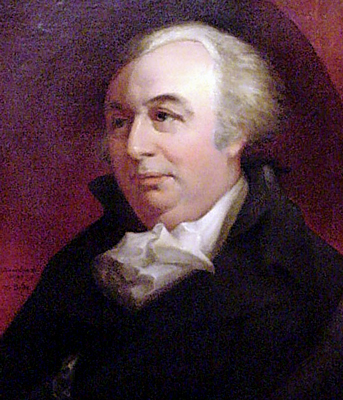
The most pervasive influence on Morris’s thinking was the Christian religion. That statement would have met with shocked disbelief among his many enemies, if for no other reason than that his womanizing was well known. John and Samuel Adams and other New England arch-republicans despised him, and the rigidly puritanical Roger Sherman went so far as to say that “with regard to moral character I consider him an irreligious and profane man.” But no irreligious and profane man could have written, as Morris did to his Loyalist mother from whom he was separated during the war, “Let me earnestly recommend to you so much of religion, as to bear inevitable evils with resignation.” As for himself, he told her, “I look forward serenely to the course of events, confident that the Fountain of supreme wisdom and virtue will provide for the happiness of his creatures.”
In the same vein, he wrote to a woman whose daughter had died, “Religion offers higher and better Motives for Resignation to the Will of our Almighty Father. Infinite Wisdom can alone determine What is best to give What to leave and What to take away. . .. Grief . . . turns our Affections from the World to fix them more steadily and strongly on the proper Objects and bends our Will to the Will of God.” Elsewhere he made numerous specific references to Jesus Christ as “Our Saviour.”
Morris cared little for rituals and forms of religion, however, and he was extremely tolerant. Early in his career, in the convention that drafted the New York Constitution of 1777, he frustrated John Jay’s attempt to exclude Roman Catholics from a religious freedom clause. From France he wrote to Robert Morris that “I like real Piety as much as I detest the Grimace of that which is false. I think I have more Religion than formerly since I have been in Paris: perhaps because the People here have or appear to have so little.” He added that he did not consider himself “of sufficient Consequence to share in the immediate Attention of divine Providence,” but was confident of his own “good Fortune,” which, he said, was “but another Name for the same Thing.” In conversation with a Frenchman who insisted that every country had an established religion. Morris assured him that it was not so in America, and went on to “tell him that God is sufficiently powerful to do his own Business without human Aid, and that Man should confine his Care to the Actions only of his fellow Creatures,” leaving it to God “to influence the Thoughts as he may think proper.”As McDonald details, Morris believed that religion played a vital role in stabilizing the political order by instilling values and virtues in the people, as well as necessitating education of the populace. Critically, religion reinforces the principle that rights and duties -- the constituent components of human liberty -- come not from the State but from a source transcendent to it. Liberty is not a gift from the government but from the hand of God. As McDonald explains, for Morris there was a clear distinction between political liberty and civil liberty, public public government and private concerns. The ties that held the two in balance rest, in Morris' view, on "Obedience to the moral Law," a moral law that was geared towards human flourishing:
Morris believed that God gives every man the right to liberty (hence his regarding slavery as an abomination), and he believed that legitimate government derives its authority from the consent of the governed; but to these largely Lockean notions he added some fine distinctions to minimize their threat to political stability. He conceived of liberty as being of two orders. One was political liberty, meaning participation by the people in the enactment of legislation and in holding government accountable. The other was civil liberty, the right of individuals to be left alone, and especially to do with their property what they choose without interference from government. He saw political liberty as being necessary for the protection of civil liberty, but also as posing a danger to it: “Political Liberty considered seperately from civil Liberty can have no other Effect than to gratify Pride”; ”Where political Liberty is in Excess Property must be insecure and where Property is not secure Society cannot advance”; and ”A Nation of Politicians, neglecting their own Business for that of the State, would be the most weak miserable and contemptible Nation on Earth.” The remedy was to limit political liberty by checking the power of the legislative through the establishment of independent executive and judicial branches. This sounds quite Montesquieuan until one recalls that Montesquieu thought that free commerce would totally undermine a republic, whereas Morris believed that commerce, as the most dynamic part of civil liberty, was an indispensable agent promoting the advancement of civilization. Commerce, he said, “requires not only the perfect Security of Property but perfect good Faith,” and thus its effects were “to encrease civil and to diminish political Liberty.- For those reasons, and because the standards of behavior in commercial transactions were so high when conducted honorably, commerce could make possible an increase in the general stock of virtue and “Obedience to the moral Law,” which were “the best Means of Promoting human Happiness.”Because human beings and human societies are different, there can be no one universal type of government for Morris. Diversity in organization and political forms are a hallmark of human life, and thus no one form of government can be prescribed to guarantee human flourishing. Thus, Morris did not display reflexive hostility to monarchy, although like most of the Founders he did display misgivings about democracy's tendency for the population to be bought off by the powers that be. The corruption of government power to loot and redistribute wealth, whether from the few to the many or from the many to the few drew Morris's disdain. Honorable government and honorable individuals, acting in accord with virtue, were as McDonald explains, a key concept of political practice for Morris, and this concept linked Morris's ideas with those of Federalist Founders like Washington and Hamilton:
Morris, like Washington, Hamilton, and many another High Federalist. had as a polestar a principle that has generally been given rather short shrift by historians, namely honor, in the sense in which Joseph Addison used the term in his popular play Cato. True honor, Addison explained, operates out of desire for “the esteem of wise and good men.” He elaborated, “Religion embraces virtue, as it is enjoined by the laws of God; honour, as it is graceful and ornamental to human nature.” As a religious man as well as a man of honor. Morris was impelled by both. Hence he could write, in a letter to Senator Oliver Ellsworth thanking him for supporting the appointment as minister to France. “the favorable Sentiment of virtuous and judicious Men has ever appeared to me (next to an approving Conscience) the highest earthly Reward for our Exertions.” He could refuse to join a speculative enterprise that was certain to be profitable because it was based on inside information, say to one who talked of legal obligation that ‘There is a moral Obligation anterior and paramount to Law,” and tell another who was torn between the dictates of duty and conscience that he knew of “no Duty but that which Conscience dictates.” The sanctity of contracts, of giving one’s word, was integral to the concept of honor; early on. Morris wrote that among the French “there is one fatal Principle which pervades all Ranks. It is a perfect Indifference to the Violation of Engagements.”McDonald's essay serves as a delightful short introduction to the thought of this important and yet overlooked American Founder. Read it all.
The cautionary tale of Alexander Hamilton's faith
An interesting reflection on that topic is posted over at the blog Holy Aspirations: A Look at the Faith of Alexander Hamilton. For what it's worth, my own theory is that Hamilton's religious faith became stronger as his worldly ambitions were increasingly frustrated. Hamilton always had a theological cast of mind, but his embrace of orthodox Protestant Christianity (evidenced by his death-bed desire to receive the eucharist) was long-a-coming. The collapse of the Federalist Party, the death of his son Philip in a dual, and his national humiliation in the Reynolds affair all contributed to Hamilton embracing faith more seriously. As is so often the case, when the things of the world turn to dust, the things of the spirit take new life.
Friday, May 17, 2013
Wednesday, May 8, 2013
JAMES WILSON AND THE SCOTTISH ENLIGHTENMENT
That's the title to a working paper by William Ewald, Professor of Law and Philosophy, University of Pennsylvania and that you may access here. I haven't read it yet. But for those interested, dig in.
Subscribe to:
Posts (Atom)